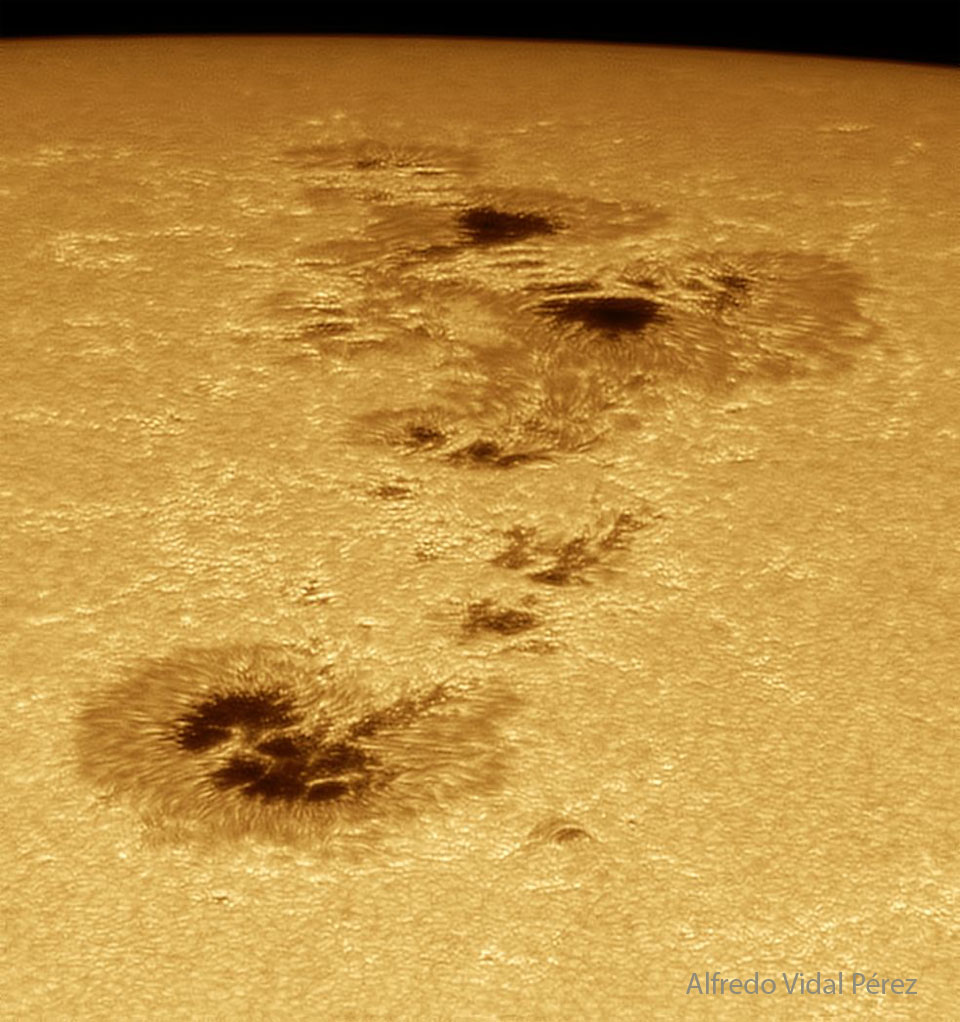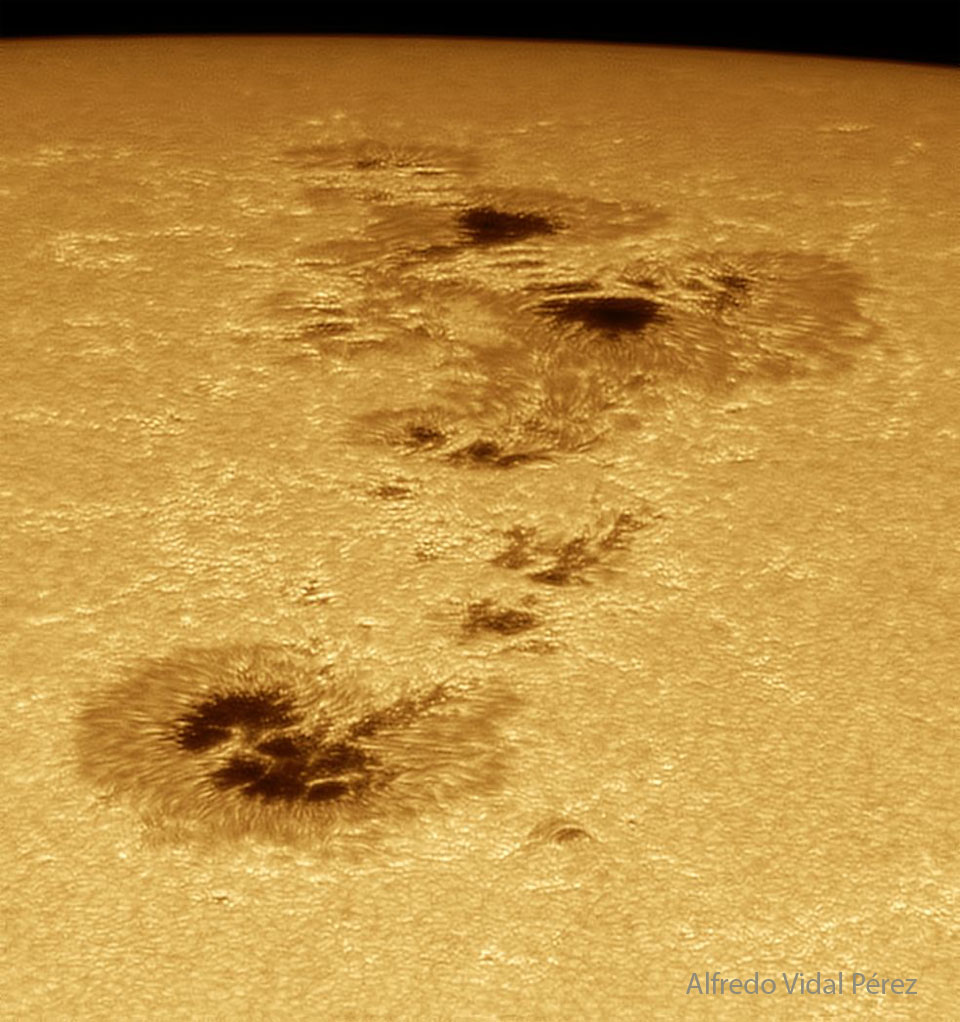
Right now, one of the largest sunspot groups in recent history is crossing the Sun. Active Region 4478 is not only big -- it's violent, showing tangled magnetic fields capable of throwing off huge clouds of particles into the Solar System. Some of these CMEs might impact the Earth. At the extreme, these solar storms could cause some Earth-orbiting satellites to malfunction, the Earth's atmosphere to slightly distort, and electrical power grids to surge. When impacting Earth's upper atmosphere, these particles can produce beautiful auroras. Pictured here, AR 4478 and its dark sunspots were captured in visible light a few days ago from Barcelona, Spain. Almost as large as AR 3664 was in 2024, the AR 4478 sunspot group is so big that it is visible just with glasses specially designed to view solar eclipses. This week, skygazing enthusiasts all over the globe will not only be tracking AR 4478 during the day -- but keenly watching night skies for its corresponding bright auroras. Sky Surprise: What picture did APOD feature on your birthday? (after 1995)
En este momento, uno de los grupos de manchas solares más grandes de la historia reciente está cruzando el Sol. La Región Activa 4478 no solo es enorme, sino también violenta: presenta campos magnéticos entrelazados capaces de lanzar enormes nubes de partículas hacia el Sistema Solar. Algunas de estas eyecciones de masa coronal (CME) podrían impactar la Tierra. En casos extremos, estas tormentas solares podrían causar el mal funcionamiento de algunos satélites en órbita terrestre, una leve distorsión de la atmósfera terrestre y sobrecargas en las redes eléctricas. Al impactar la atmósfera superior de la Tierra, estas partículas pueden producir hermosas auroras. En la imagen, AR 4478 y sus oscuras manchas solares fueron captadas en luz visible hace unos días desde Barcelona, España. Casi tan grande como lo fue AR 3664 en 2024, el grupo de manchas solares AR 4478 es tan extenso que puede verse a simple vista utilizando gafas especialmente diseñadas para observar eclipses solares. Esta semana, los entusiastas de la astronomía en todo el mundo no solo estarán siguiendo AR 4478 durante el día, sino también observando con atención los cielos nocturnos en busca de las brillantes auroras asociadas a esta región activa.