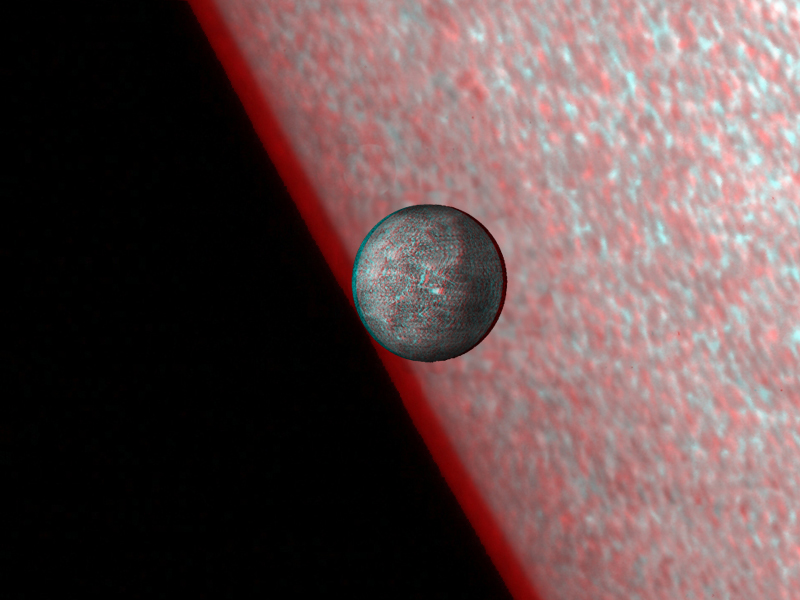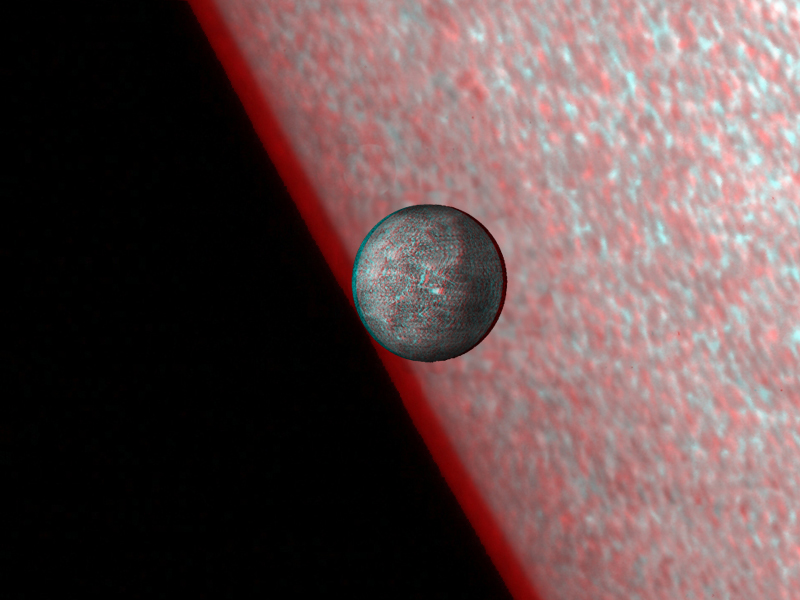
Mercury is now visible shortly before dawn, the brightest "star" just above the eastern horizon. But almost two weeks ago Mercury actually crossed the face of the Sun for the second time in the 21st century. Viewed with red/blue glasses, this stereo anaglyph combines space-based images of the Sun and innermost planet in a just-for-fun 3D presentation of the Mercury transit. The solar disk image is from Hinode. (sounds like "hee-no-day", means sunrise). A sun-staring observatory, Hinode was launched from Uchinoura Space Center and viewed the transit from Earth orbit. Superimposed on Mercury's dark silhouette is a detailed image of the planet's rugged surface based on data from the Mariner 10 probe that flew by Mercury in 1974 and 1975.
Mercurio es ahora visible poco antes del amanecer, el astro más brillante justo por encima del horizonte oriental. Pero hace casi dos semanas, Mercurio cruzó realmente la cara del Sol, el segundo tránsito del siglo XXI. Visto con gafas rojo/azul, esta anaglifo estereoscópica combina imágenes basadas en el espacio del Sol y del planeta más interno en una presentación en 3D llena de diversión del tránsito de Mercurio. La imagen del disco solar proviene de Hinode. (se pronuncia como "hee-no-day", significa amanecer). Hinode es una observación que mira fijamente al Sol, lanzada desde el Centro Espacial de Uchinoura y que observó el tránsito desde la órbita terrestre. Superpuesta sobre la silueta oscura de Mercurio se encuentra una imagen detallada de la rugosa superficie del planeta basada en datos de la sonda Mariner 10 que sobrevoló Mercurio en 1974 y 1975.