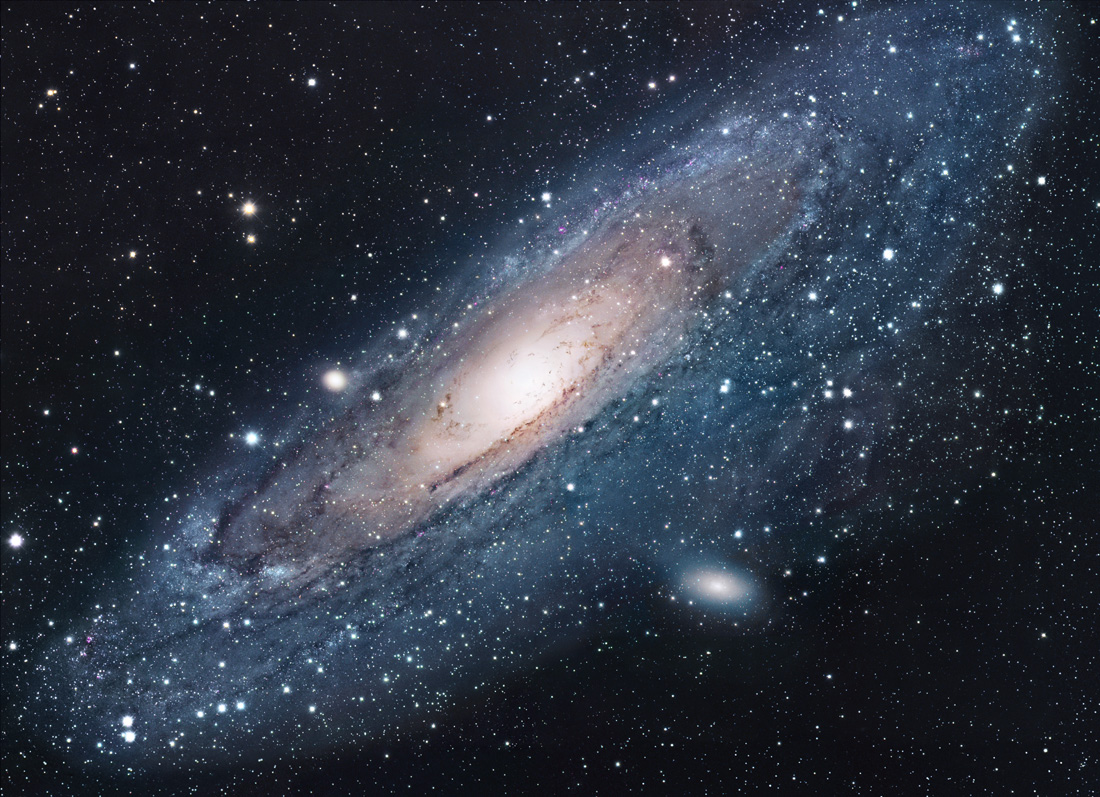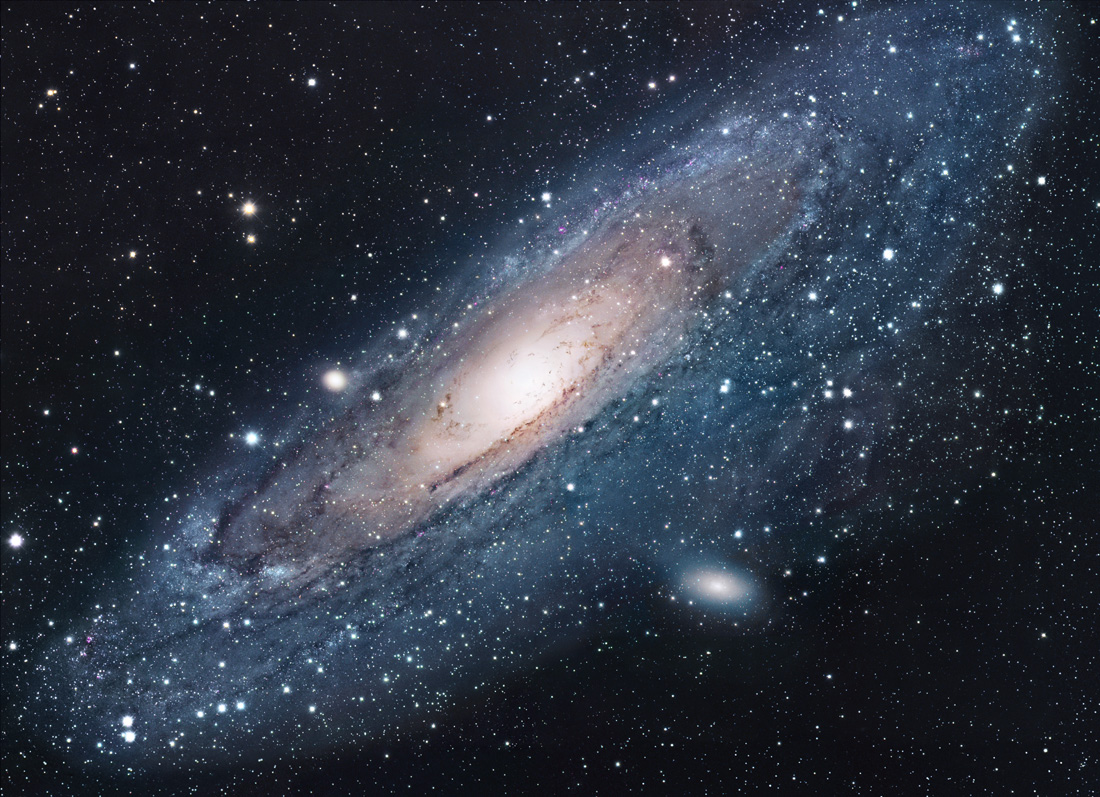
Andromeda is the nearest major galaxy to our own Milky Way Galaxy. Our Galaxy is thought to look much like Andromeda. Together these two galaxies dominate the Local Group of galaxies. The diffuse light from Andromeda is caused by the hundreds of billions of stars that compose it. The several distinct stars that surround Andromeda's image are actually stars in our Galaxy that are well in front of the background object. Andromeda is frequently referred to as M31 since it is the 31st object on Messier's list of diffuse sky objects. M31 is so distant it takes about two million years for light to reach us from there. Although visible without aid, the above image of M31 is a digital mosaic of 20 frames taken with a small telescope. Much about M31 remains unknown, including how the center acquired two nuclei.
Andrómeda es la galaxia más cercana de gran tamaño a nuestra propia Galaxia, la Vía Láctea. Se cree que nuestra Galaxia se parece mucho a Andrómeda. Juntas, estas dos galaxias dominan el Grupo Local de galaxias. La luz difusa de Andrómeda es causada por los cientos de miles de millones de estrellas que la componen. Las varias estrellas distintas que rodean la imagen de Andrómeda son en realidad estrellas de nuestra Galaxia que se encuentran claramente delante del objeto de fondo. Andrómeda es frecuentemente referida como M31, ya que es el objeto número 31 en la lista de Messier de objetos difusos del cielo. M31 está tan lejos que la luz tarda aproximadamente dos millones de años en llegar hasta nosotros. Aunque es visible a simple vista, la imagen de M31 mostrada arriba es un mosaico digital de 20 fotogramas tomados con un telescopio pequeño. Mucho sobre M31 sigue siendo desconocido, incluyendo cómo el centro adquirió dos núcleos.