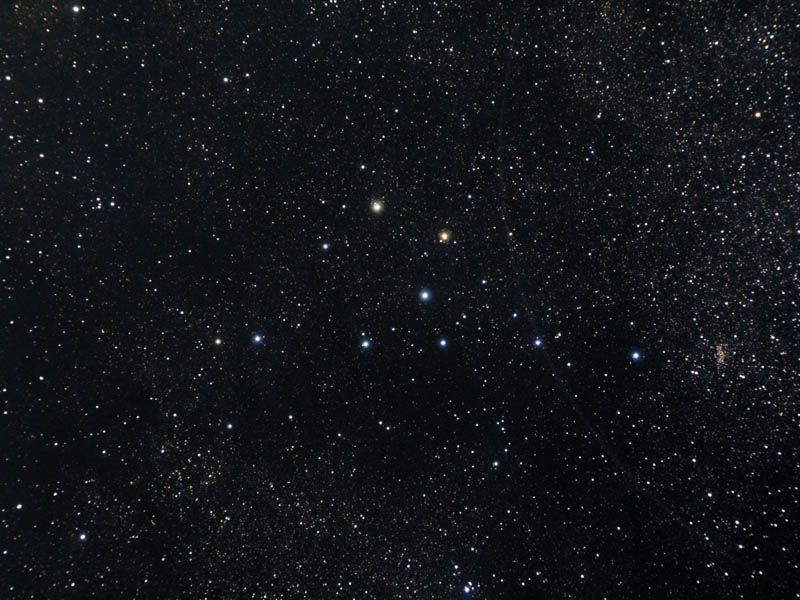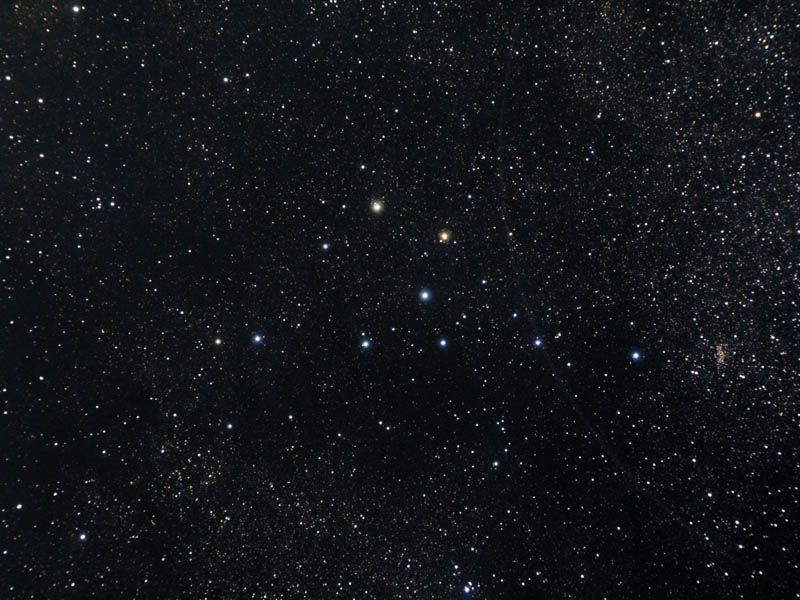
Is this coat hanger a star cluster or an asterism? This cosmic hang-up has been debated over much of last century, as astronomers wondered whether this binocular-visible object is really a physically associated open cluster or a chance projection. Chance star projections are known as asterisms, an example of which is the popular Big Dipper. Recent precise measurements from different vantage points in the Earth's orbit around the Sun have recently uncovered discrepant angular shifts indicating that the Coat Hanger is better described as an asterism. Known more formally as Collinder 399, this bright stellar grouping can be seen spanning more than a full moon toward the direction of the constellation of the Fox (Vulpecula). On the far right of the above image is the open cluster of stars NGC 6802.
¿Es este perchero un cúmulo estelar o un asterismo? Este interrogante cósmico ha sido debatido durante gran parte del siglo pasado, mientras los astrónomos se preguntaban si este objeto visible con binoculares es realmente un cúmulo abierto físicamente asociado o una proyección casual. Las proyecciones estelares casuales se conocen como asterismos, siendo un ejemplo de ellos la popular Osa Mayor. Las mediciones precisas recientes desde diferentes puntos de vista en la órbita terrestre alrededor del Sol han revelado desplazamientos angulares discrepantes que indican que el Perchero se describe mejor como un asterismo. Conocido más formalmente como Collinder 399, este brillante agrupamiento estelar puede verse extendiéndose más de una luna llena en la dirección de la constelación del Zorro (Vulpecula). En el extremo derecho de la imagen anterior se encuentra el cúmulo abierto de estrellas NGC 6802.