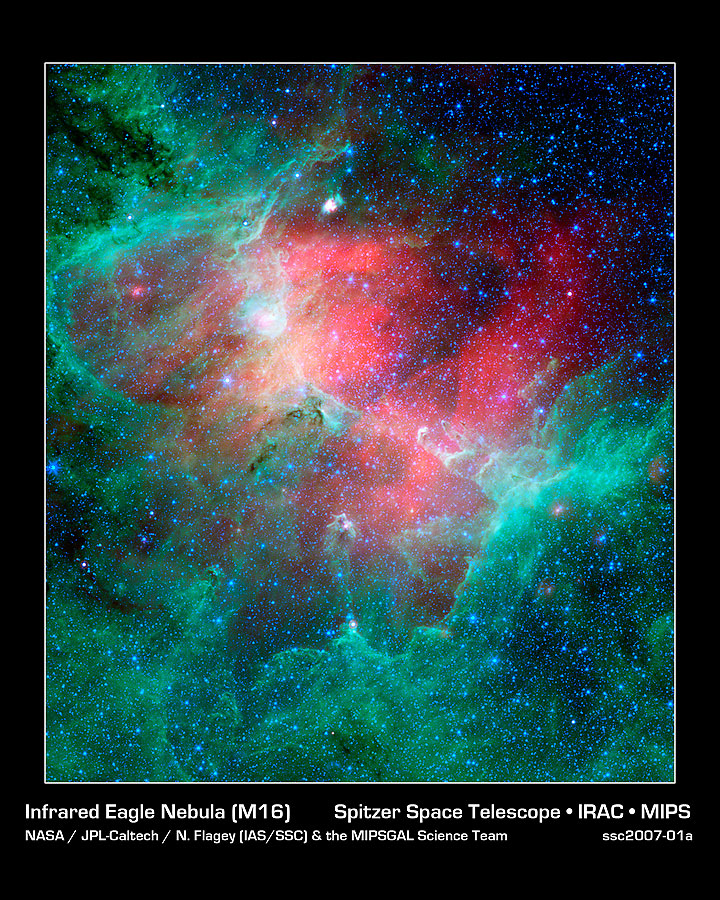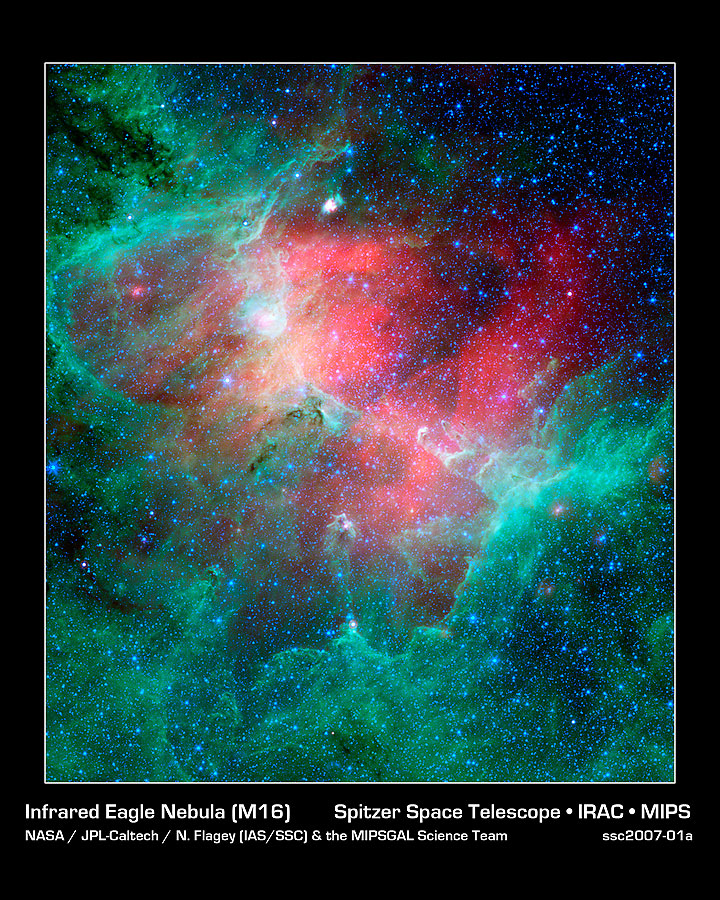
In visible light, the whole thing looks like an eagle. The region was captured recently in unprecedented detail in infrared light by the robotic orbiting Spitzer Space Telescope (SSC). Shown above, the infrared image allows observers to peer through normally opaque dust and so better capture the full complexity of the Eagle Nebula star forming region. In particular, the three famous pillars near the image center are seen bathed in dust likely warmed by a supernova explosion. The warm dust is digitally assigned the false color of red. Also visible, near the bottom of the image, is ten light-year long pillar sometimes dubbed the Fairy of Eagle Nebula. The greater Eagle emission nebula, tagged M16, lies about 6500 light years away, spans about 20 light-years, and is visible with binoculars toward the constellation of Serpens.
A la luz visible, todo el conjunto tiene el aspecto de un águila. La región fue capturada recientemente en detalle sin precedentes en luz infrarroja por el Telescopio Espacial Spitzer (SSC), un observatorio robótico en órbita. En la imagen mostrada arriba, la imagen infrarroja permite a los observadores atravesar el polvo normalmente opaco y captar así mejor la complejidad total de la región de formación estelar de la Nebulosa del Águila. En particular, los tres pilares famosos cerca del centro de la imagen se ven bañados en polvo que probablemente fue calentado por una explosión de supernova. El polvo caliente recibe digitalmente el falso color rojo. También visible, cerca del borde inferior de la imagen, hay un pilar de diez años luz de largo que a veces se conoce como el Hada de la Nebulosa del Águila. La mayor nebulosa de emisión del Águila, designada M16, se encuentra aproximadamente a 6500 años luz de distancia, abarca unos 20 años luz, y es visible con binoculares hacia la constelación de Serpens.