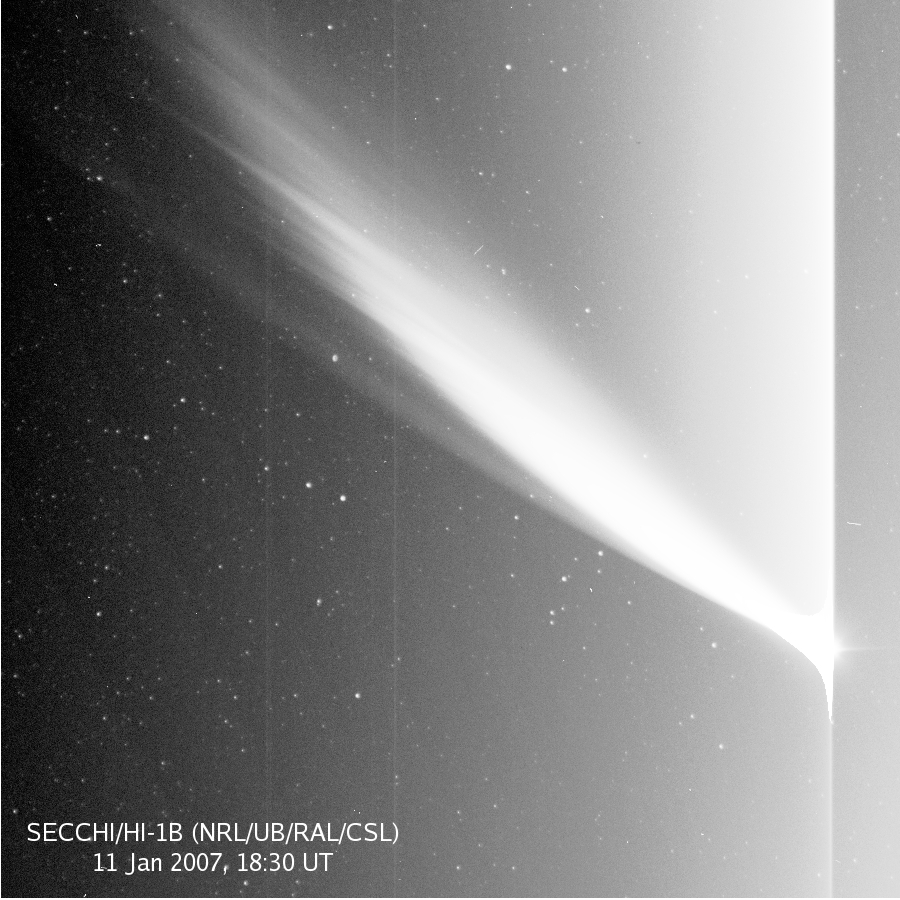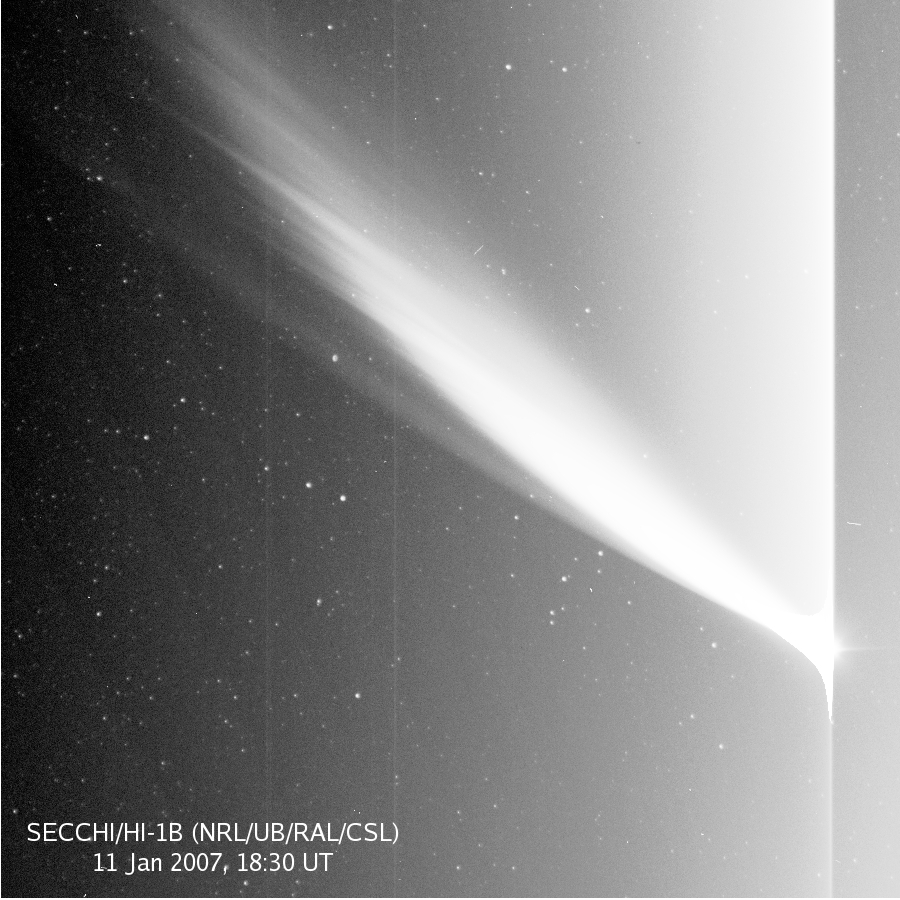
The brightest comet of recent decades was a surprising first sight for a new camera in space. The Sun Earth Connection Coronal and Heliospheric Investigation (SECCHI) instrument onboard the Solar TErrestrial RElations Observatory (STEREO) satellite had just opened up on January 11 when it snapped the above image of Comet McNaught. Visible was a spectacular view of the ion tail of Comet McNaught being swept away from the Sun by the solar wind in filamentary rays. The comet tail is seen to extend at least seven degrees across the above image, while the central coma is so bright it saturates. Comet McNaught is now reportedly so bright that it is visible even in broad daylight by blocking out the Sun with your hand. Comet McNaught has rounded the Sun and will slowly fade away for observers in Earth's Southern Hemisphere as it recedes from the Sun.
El cometa más brillante de las décadas recientes fue una sorpresa inesperada para una nueva cámara en el espacio. El instrumento de Investigación Heliosférica y Coronal de la Conexión Solar-Terrestre (SECCHI) a bordo del Observatorio de Relaciones Solares-Terrestres (STEREO) había abierto sus puertas el 11 de enero cuando capturó la imagen anterior del Cometa McNaught. Visible era una vista espectacular de la cola iónica del Cometa McNaught siendo barrida lejos del Sol por el viento solar en rayos filamentarios. Se ve que la cola del cometa se extiende al menos siete grados en la imagen anterior, mientras que la coma central es tan brillante que se satura. Se reporta que el Cometa McNaught es ahora tan brillante que es visible incluso a la luz del día bloqueando el Sol con la mano. El Cometa McNaught ha redondeado el Sol y se desvanecerá lentamente para los observadores en el Hemisferio Sur de la Tierra conforme se aleja del Sol.