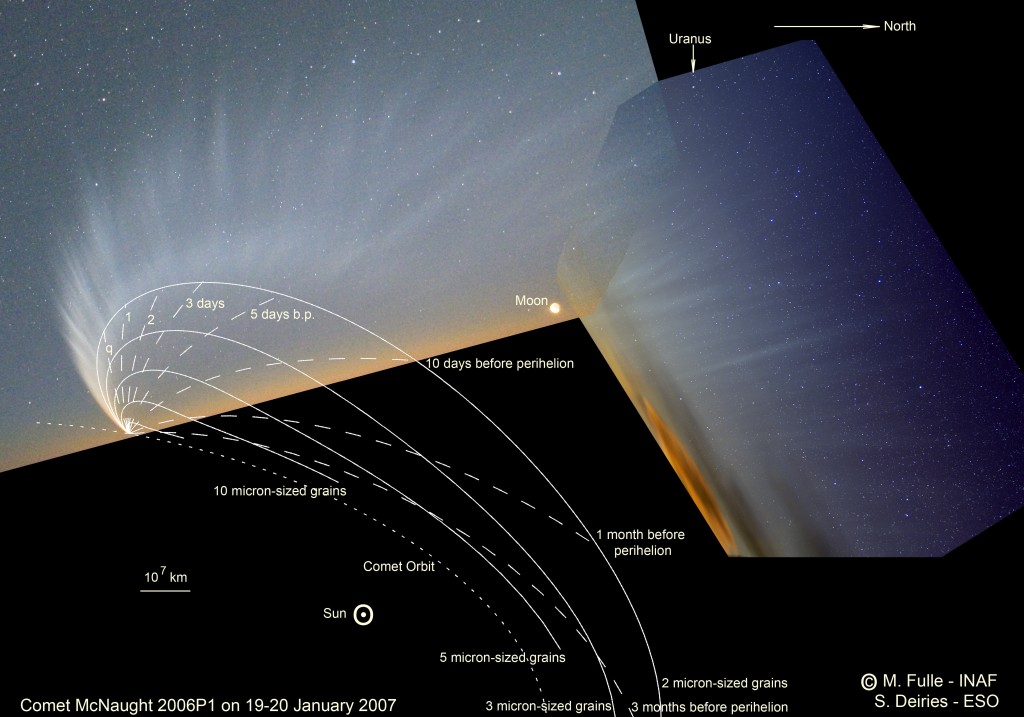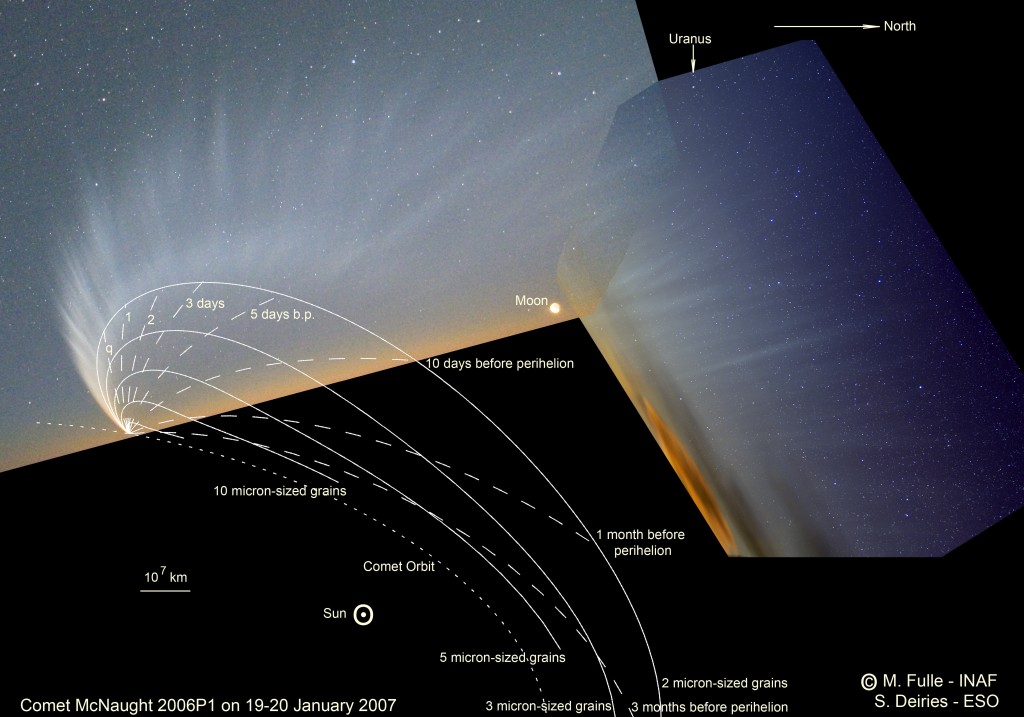
By January 19/20 Comet McNaught's magnificent dust tail stretched for about 150 million kilometers (~1 AU), requiring images from both southern and northern hemispheres of planet Earth to take it all in. Two such views - from Cerro Paranal in Chile (left) and the Carnic Alps in Italy - are combined in this unique graphic that also outlines a perspective view of the comet's orbit (dotted line) and relative position of the Sun. Driven by solar radiation pressure the dust tail initially points away from the Sun, but also trails outside the comet's orbit. Astronomers try to account for the complex structure along the tail, including the pronounced striations, by considering forces acting on the dust (e.g. gravity, solar wind and radiation) as well as the release time and size of the dust grains. In the diagram, the modeled location of dust grains released at approximately the same time relative to perihelion passage, synchrones, are shown as dashed lines. The location of grains of similar size, syndynes, are shown as solid lines.
Para el 19/20 de enero, la magnífica cola de polvo del Cometa McNaught se extendía aproximadamente 150 millones de kilómetros (~1 UA), requiriendo imágenes de ambos hemisferios de la Tierra para captarla en su totalidad. Dos vistas de este tipo —desde Cerro Paranal en Chile (izquierda) y los Alpes Cárnicos en Italia— se combinan en este gráfico único que también esboza una vista en perspectiva de la órbita del cometa (línea punteada) y la posición relativa del Sol. Impulsada por la presión de radiación solar, la cola de polvo apunta inicialmente alejándose del Sol, pero también se extiende fuera de la órbita del cometa. Los astrónomos intentan explicar la estructura compleja a lo largo de la cola, incluyendo las estrías pronunciadas, considerando las fuerzas que actúan sobre el polvo (por ejemplo, gravedad, viento solar y radiación) así como el momento de liberación y el tamaño de los granos de polvo. En el diagrama, la ubicación modelada de los granos de polvo liberados aproximadamente al mismo tiempo relativo al paso del perihelio, sincrónicas, se muestran como líneas punteadas. La ubicación de granos de tamaño similar, sindines, se muestran como líneas sólidas.