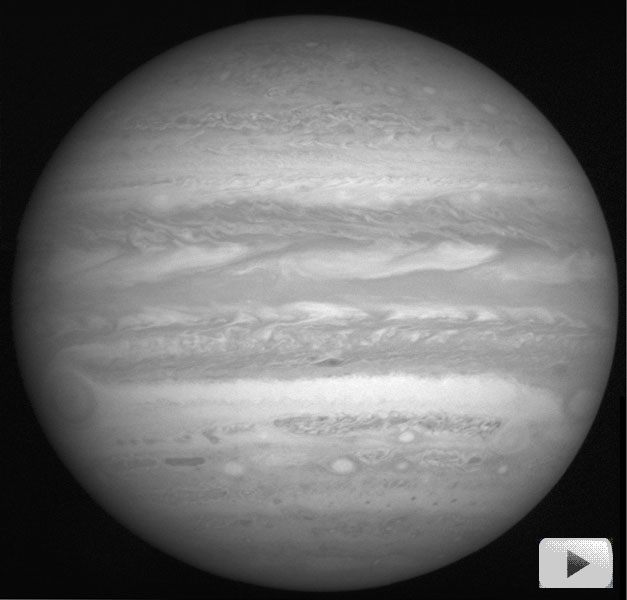
What would it be like to coast by Jupiter and watch it rotate? This was just the experience of the New Horizons spacecraft as it approached and flew by Jupiter earlier this year. Clicking on the image will bring up a movie of what the robotic spacecraft saw. Visible above in the extensive atmosphere of the Solar System's largest planet are bands and belts of light and dark clouds, as well as giant rotating storm systems seen as ovals. Other movies compiled by New Horizons and other passing spacecraft have captured the clouds swirling and moving relative to themselves. Jupiter has a diameter of about eleven times that of our Earth, and rotates once in about 10 hours. The robotic New Horizons spacecraft continues to speed toward the outer Solar System where it is expected to approach Pluto in 2015.
¿Cómo sería pasar junto a Júpiter y observar su rotación? Esta fue precisamente la experiencia que vivió la sonda espacial New Horizons al acercarse y sobrevolar Júpiter a principios de este año. Al hacer clic en la imagen se abre una película de lo que observó la sonda robótica. Visibles en la extensa atmósfera del planeta más grande del Sistema Solar hay bandas y cinturones de nubes claras y oscuras, así como sistemas de tormentas gigantes que rotan y aparecen como óvalos. Otras películas compiladas por New Horizons y otras sondas que han pasado cerca han capturado cómo las nubes se arremolinarán y se desplazan unas respecto a otras. Júpiter tiene un diámetro aproximadamente once veces mayor que el de nuestra Tierra, y completa una rotación en aproximadamente 10 horas. La sonda robótica New Horizons continúa acelerando hacia el Sistema Solar exterior, donde se espera que se acerque a Plutón en 2015.