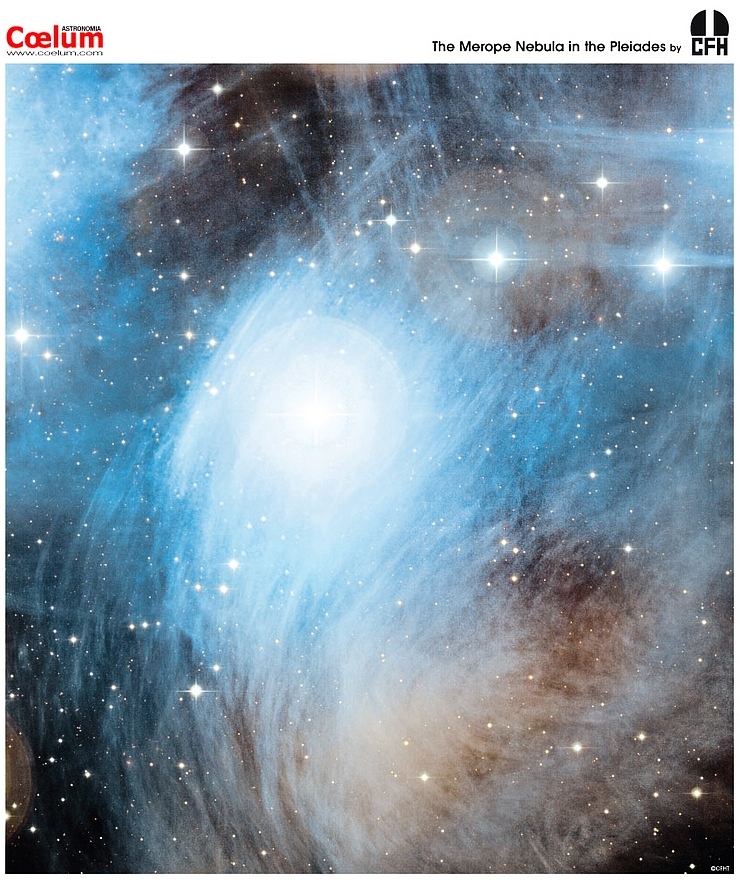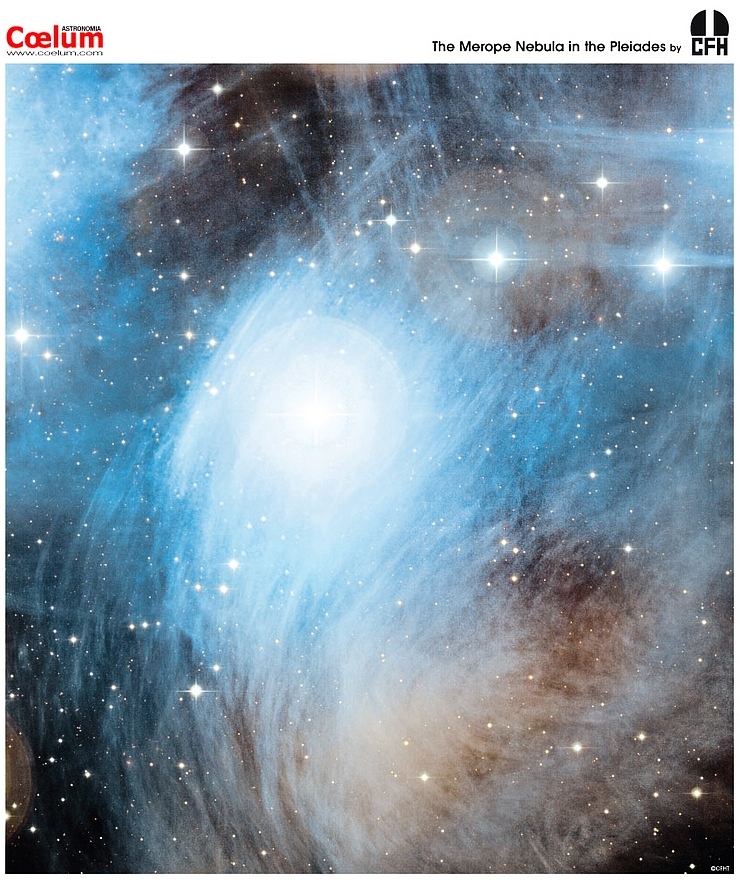
Reflection nebulas reflect light from a nearby star. Many small carbon grains in the nebula reflect the light. The blue color typical of reflection nebula is caused by blue light being more efficiently scattered by the carbon dust than red light. The brightness of the nebula is determined by the size and density of the reflecting grains, and by the color and brightness of the neighboring star(s). NGC 1435, pictured above, surrounds Merope (23 Tau), one of the brightest stars in the Pleiades (M45). The Pleiades nebulosity is caused by a chance encounter between an open cluster of stars and a molecular cloud.
Las nebulosas de reflexión reflejan la luz de una estrella cercana. Numerosos granos de carbono pequeños en la nebulosa reflejan la luz. El color azul típico de una nebulosa de reflexión es causado por la dispersión más eficiente de la luz azul en comparación con la luz roja por parte del polvo de carbono. El brillo de la nebulosa está determinado por el tamaño y la densidad de los granos reflectantes, y por el color y el brillo de la(s) estrella(s) vecina(s). NGC 1435, mostrada arriba, rodea a Merope (23 Tau), una de las estrellas más brillantes de las Pléyades (M45). La nebulosa de las Pléyades es causada por un encuentro fortuito entre un cúmulo abierto de estrellas y una nube molecular.