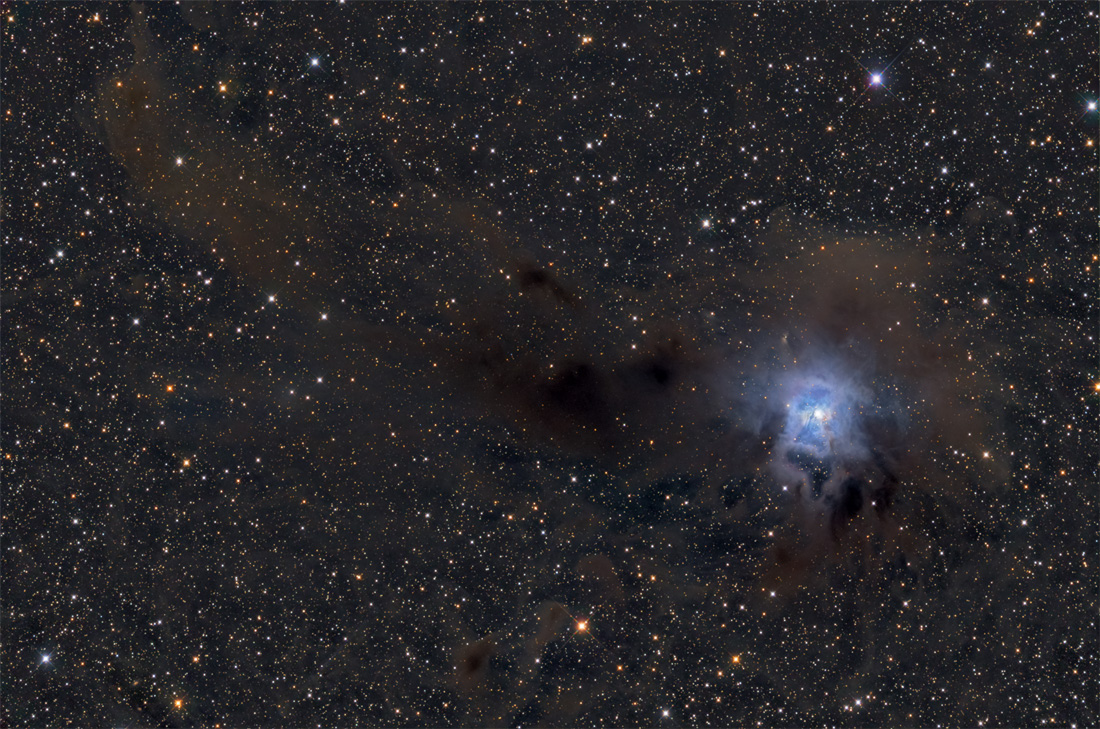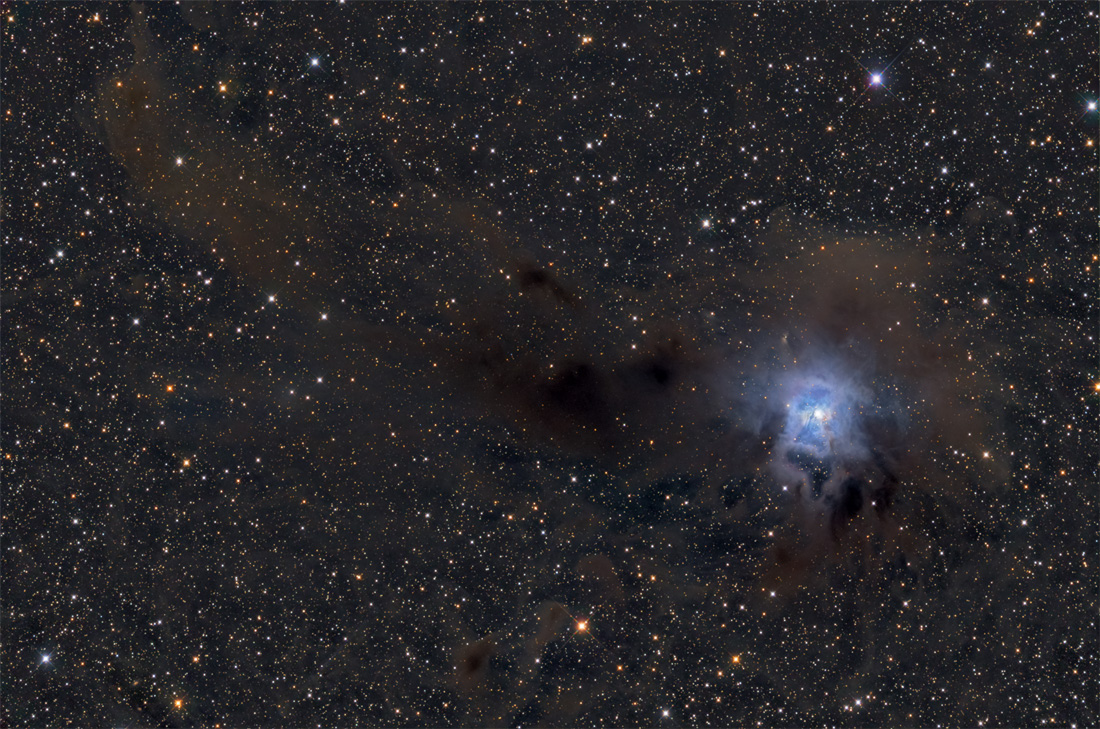
Like delicate cosmic petals, these clouds of interstellar dust and gas have blossomed 1,300 light-years away in the fertile star fields of the constellation Cepheus. Sometimes called the Iris Nebula and dutifully cataloged as NGC 7023, this is not the only nebula in the sky to evoke the imagery of flowers. Still, this beautiful digital image shows off the Iris Nebula's range of colors and symmetries in impressive detail. Within the Iris, dusty nebular material surrounds a massive, hot, young star in its formative years. Central filaments of cosmic dust glow with a reddish photoluminescence as some dust grains effectively convert the star's invisible ultraviolet radiation to visible red light. Yet the dominant color of the central nebula is blue, characteristic of dust grains reflecting starlight. Dark, obscuring clouds of dust and cold molecular gas are present on the left of the image, and lead the eye to see other convoluted and fantastic shapes. Infrared observations indicate that this nebula may contain complex carbon molecules known as PAHs. As shown here, the bright blue portion of the Iris Nebula is about six light-years across.
Como delicados pétalos cósmicos, estas nubes de polvo y gas interestelar han florecido a 1.300 años luz de distancia en los fértiles campos estelares de la constelación de Cefeo. A veces llamada Nebulosa Iris y debidamente catalogada como NGC 7023, esta no es la única nebulosa en el cielo que evoca la imaginería de flores. Sin embargo, esta hermosa imagen digital muestra la variedad de colores y simetrías de la Nebulosa Iris con impresionante detalle. Dentro de la Iris, material nebular polvoriento rodea una estrella masiva, caliente y joven en sus años formativos. Los filamentos centrales de polvo cósmico brillan con una fotoluminiscencia rojiza, ya que algunos granos de polvo convierten efectivamente la radiación ultravioleta invisible de la estrella en luz roja visible. Sin embargo, el color dominante de la nebulosa central es azul, característico de granos de polvo que reflejan la luz estelar. Nubes oscuras y opacas de polvo y gas molecular frío están presentes en el lado izquierdo de la imagen y guían la vista para ver otras formas retorcidas y fantásticas. Las observaciones infrarrojas indican que esta nebulosa puede contener moléculas de carbono complejas conocidas como HAPs. Como se muestra aquí, la porción azul brillante de la Nebulosa Iris tiene aproximadamente seis años luz de diámetro.