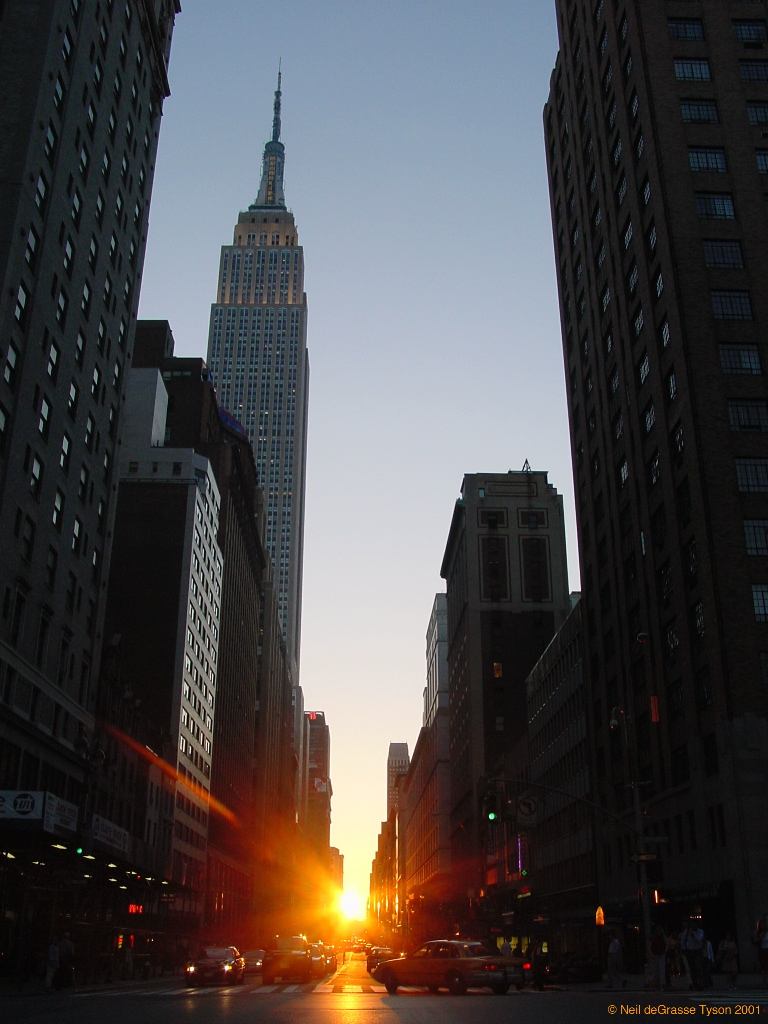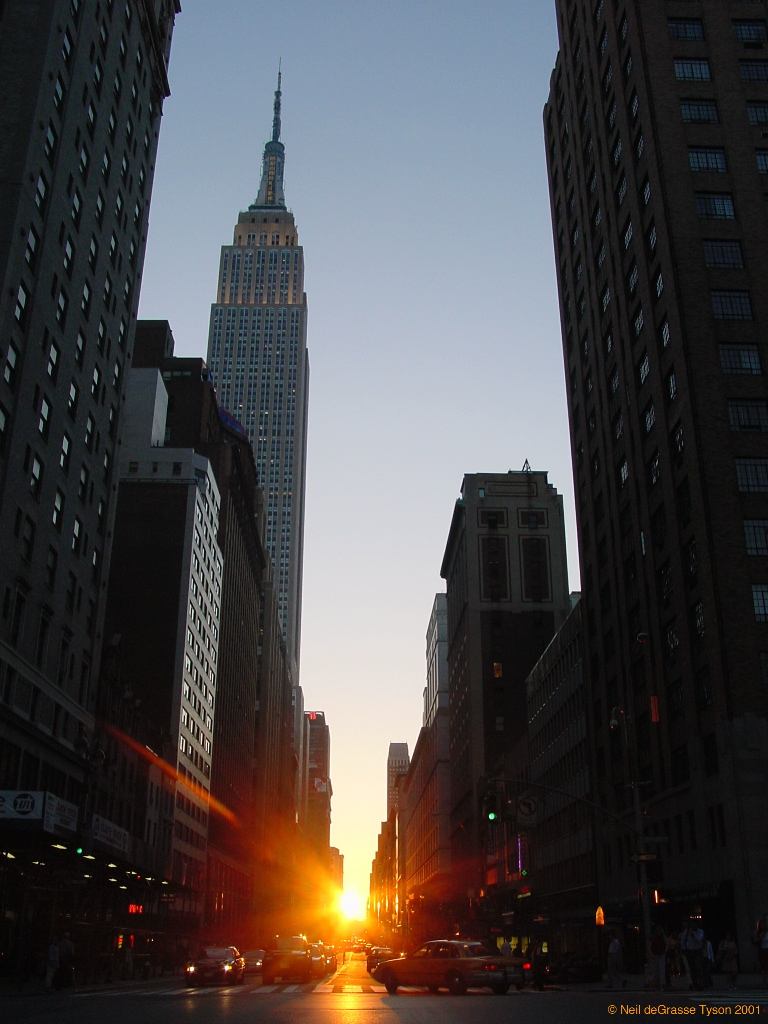
Today, if it is clear, well placed New Yorkers can go outside at sunset and watch their city act like a modern version of Stonehenge. Manhattan will flood dramatically with sunlight just as the Sun sets precisely on the centreline of every street. Usually, the tall buildings that line the gridded streets of New York City's tallest borough will hide the setting Sun. This effect makes Manhattan a type of modern Stonehenge, although only aligned to about 30 degrees east of north. Were Manhattan's road grid perfectly aligned to east and west, today's effect would occur on the Vernal and Autumnal Equinox, March 21 and September 21, the only two days that the Sun rises and sets due east and west. Pictured above in this horizontally stretched image, the Sun sets down 34th Street as viewed from Park Avenue. If today's sunset is hidden by clouds do not despair -- the same thing happens twice each year, in late May and mid July. On none of these occasions, however, should you ever look directly at the Sun.
Hoy, si el cielo está despejado, los neoyorquinos bien ubicados pueden salir al exterior al atardecer y ver su ciudad actuar como una versión moderna de Stonehenge. Manhattan se inundará dramáticamente de luz solar justo cuando el Sol se ponga precisamente sobre la línea central de cada calle. Normalmente, los altos edificios que bordean las calles en cuadrícula del borough más alto de la Ciudad de Nueva York ocultarán el Sol poniente. Este efecto convierte a Manhattan en un tipo de Stonehenge moderno, aunque solo alineado aproximadamente a 30 grados al este del norte. Si la cuadrícula de calles de Manhattan estuviera perfectamente alineada hacia el este y el oeste, este efecto ocurriría en los equinoccios de primavera y otoño, el 21 de marzo y el 21 de septiembre, los únicos dos días en que el Sol sale y se pone hacia el este y el oeste. En la imagen anterior, estirada horizontalmente, el Sol se pone sobre la calle 34 tal como se ve desde Park Avenue. Si el atardecer de hoy está oculto por las nubes, no se desespere: lo mismo sucede dos veces al año, a finales de mayo y mediados de julio. Sin embargo, en ninguna de estas ocasiones debe mirar directamente al Sol.