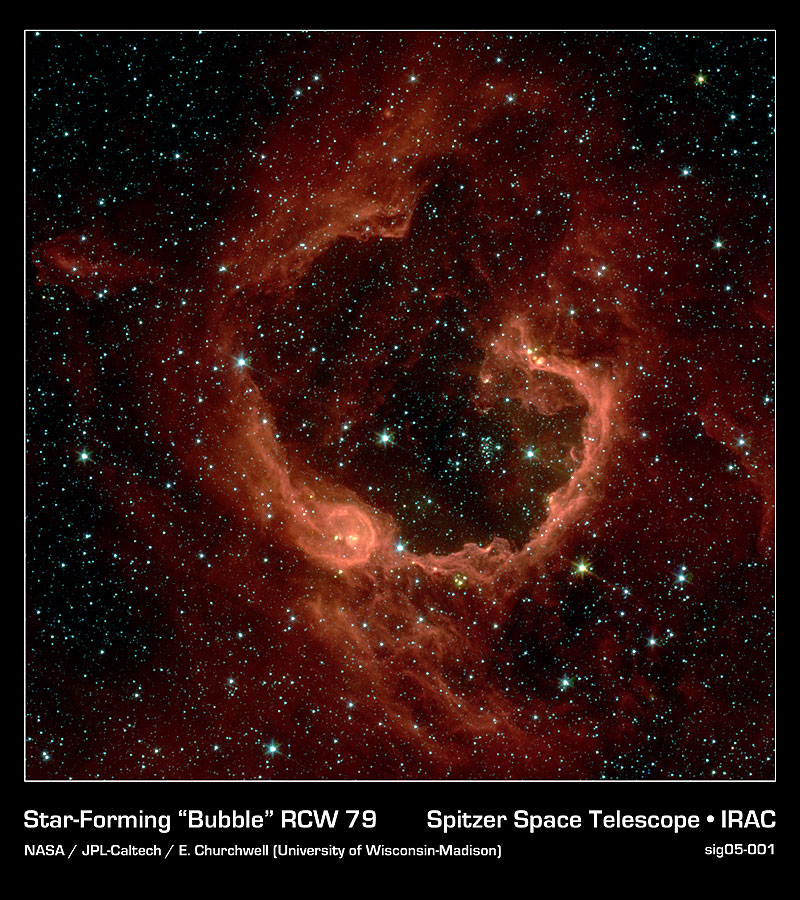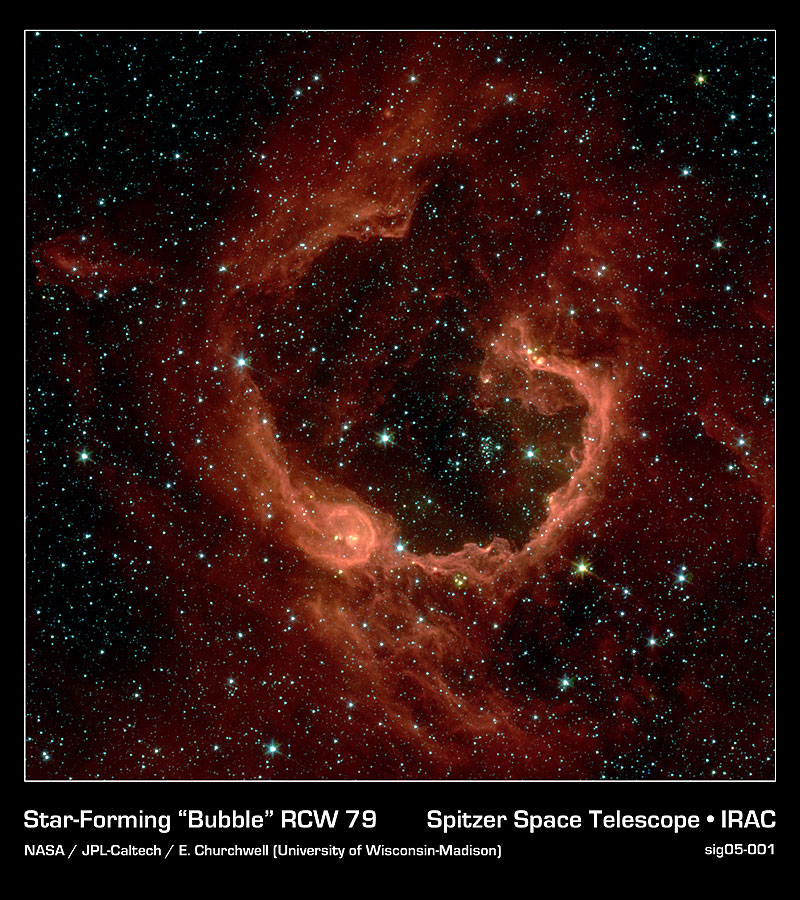
A cosmic bubble of gas and dust, RCW 79 has grown to about 70 light-years in diameter, blown by the winds and radiation from hot young stars. Infrared light from the dust embedded in the nebula is tinted red in this gorgeous false-color view from the Spitzer Space Telescope. A good 17 thousand light-years away in the grand southern constellation Centaurus, the expanding nebula itself has triggered star formation as it plows into the gas and dust surrounding it. In fact, this penetrating infrared picture reveals groups of new stars as yellowish points scattered along the bubble's edge. One remarkable group still lies within its own natal bubble at about 7 o'clock (lower left), while another can be seen near the upper gap at about 3 o'clock (right) from the bubble's center.
RCW 79 es una burbuja cósmica de gas y polvo que ha crecido hasta aproximadamente 70 años luz de diámetro, impulsada por los vientos y la radiación de estrellas jóvenes calientes. La luz infrarroja proveniente del polvo incrustado en la nebulosa aparece teñida de rojo en esta hermosa vista en falso color del Telescopio Espacial Spitzer. Ubicada a unos 17 mil años luz de distancia en la gran constelación austral de Centauro, la nebulosa en expansión ha desencadenado la formación de estrellas al abrirse paso a través del gas y el polvo que la rodean. De hecho, esta penetrante imagen infrarroja revela grupos de nuevas estrellas como puntos amarillentos dispersos a lo largo del borde de la burbuja. Un grupo notable aún se encuentra dentro de su propia burbuja natal aproximadamente a las 7 en punto (esquina inferior izquierda), mientras que otro puede verse cerca de la brecha superior aproximadamente a las 3 en punto (derecha) desde el centro de la burbuja.