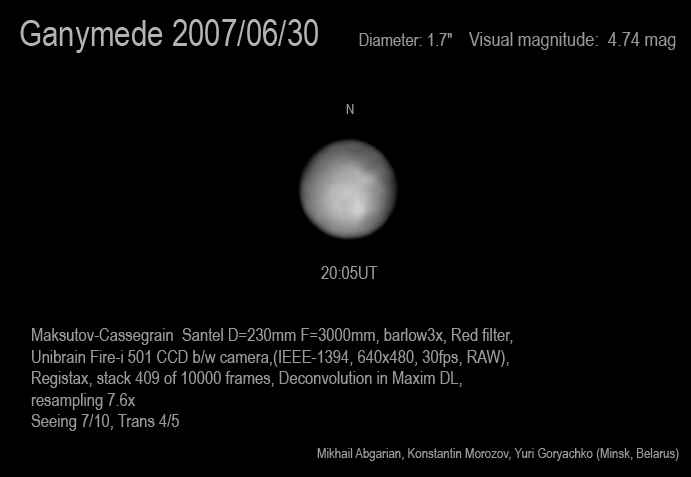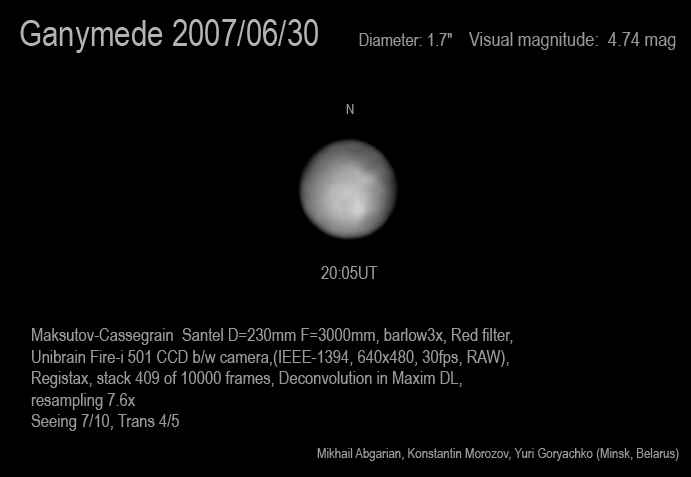
Jupiter is an astronomer's planet -- its large size and contrasting global cloud belts and zones allow detailed studies with a range of earthbound telescopes. On the other hand, most telescopic views of Jupiter's moons usually show only featureless, tantalizing points of light hovering near the ruling gas giant. But this impressive picture from a small, ground-based telescope reveals a stunning amount of detail on Ganymede, a jovian moon about the same size as Earth's moon but at least 1,500 times farther away. The image was carefully constructed by combining and processing only the 409 sharpest frames from a total of 10,000 recorded at 30 frames per second by a digital camera. Ganymede's radius is about 2,600 kilometers indicating that the surface markings visible are as small as around 900 kilometers across.
Júpiter es un planeta para astrónomos: su gran tamaño y sus cinturones y zonas nubosas globales contrastantes permiten estudios detallados con una variedad de telescopios terrestres. Por otro lado, la mayoría de las observaciones telescópicas de las lunas de Júpiter generalmente muestran solo puntos de luz sin características distintivas y tentadores cerca del gigante gaseoso dominante. Sin embargo, esta impresionante imagen de un pequeño telescopio terrestre revela una asombrosa cantidad de detalles en Ganimedes, una luna joviana aproximadamente del mismo tamaño que la Luna terrestre pero al menos 1.500 veces más lejana. La imagen fue cuidadosamente construida combinando y procesando solo los 409 fotogramas más nítidos de un total de 10.000 registrados a 30 fotogramas por segundo mediante una cámara digital. El radio de Ganimedes es de aproximadamente 2.600 kilómetros, lo que indica que los marcajes de superficie visibles tienen un tamaño de aproximadamente 900 kilómetros de extensión.