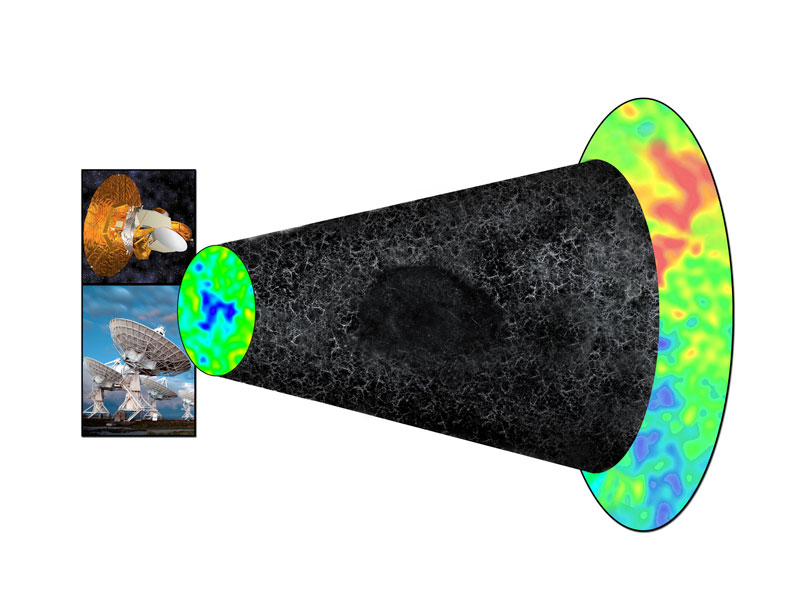
What has created this huge empty volume in the universe? No one is yet sure, and even the extent of the estimated billion-light year void is being researched. The void is not a hole in space like a black hole, but rather a vast region of the universe that appears to be mostly devoid of normal matter and even dark matter. The void is still thought to contain dark energy, though, and is clearly traversable by light. The void's existence is being postulated following scientific curiosity about how unusually cold spots came to appear on WMAP's map of cosmic microwave background (CMB) radiation. One possibility was that this CMB region was not actually very cold but light from the spot somehow became more cosmologically redshifted than normal along the way. Other voids in the universe are known to exist, but this void appears to have an unusually large gravitational effect, and so might possibly be the largest in our entire visible universe. Investigating this, a recent study found an unusually low number of cosmic radio sources between Earth and the CMB cold spot, which led to the inference of this giant void. An artist's depiction of the huge cosmic void is shown above.
¿Qué ha creado este volumen vacío tan grande en el universo? Nadie aún está seguro, y ni siquiera se conoce con certeza el tamaño estimado del hueco, que abarcaría mil millones de años luz. El hueco no es un agujero en el espacio como un agujero negro, sino más bien una vasta región del universo que parece estar casi completamente desprovista de materia normal e incluso de materia oscura. Sin embargo, se cree que el hueco aún contiene energía oscura, y es claramente transitable por la luz. La existencia de este hueco se postula como resultado de la curiosidad científica sobre cómo surgieron manchas inusualmente frías en el mapa del fondo cósmico de microondas (CMB, por sus siglas en inglés) obtenido por el satélite WMAP. Una posibilidad era que esta región del CMB no fuera realmente muy fría, sino que la luz de ese punto se hubiera desplazado hacia el rojo de manera inusualmente cosmológica durante su trayecto. Se conocen la existencia de otros huecos en el universo, pero este hueco parece tener un efecto gravitacional inusualmente grande, por lo que podría ser el más grande de todo nuestro universo visible. Al investigar este fenómeno, un estudio reciente encontró un número inusualmente bajo de fuentes de radio cósmico entre la Tierra y la mancha fría del CMB, lo que llevó a la inferencia de este hueco gigantesco. Se muestra arriba una representación artística de este inmenso hueco cósmico.