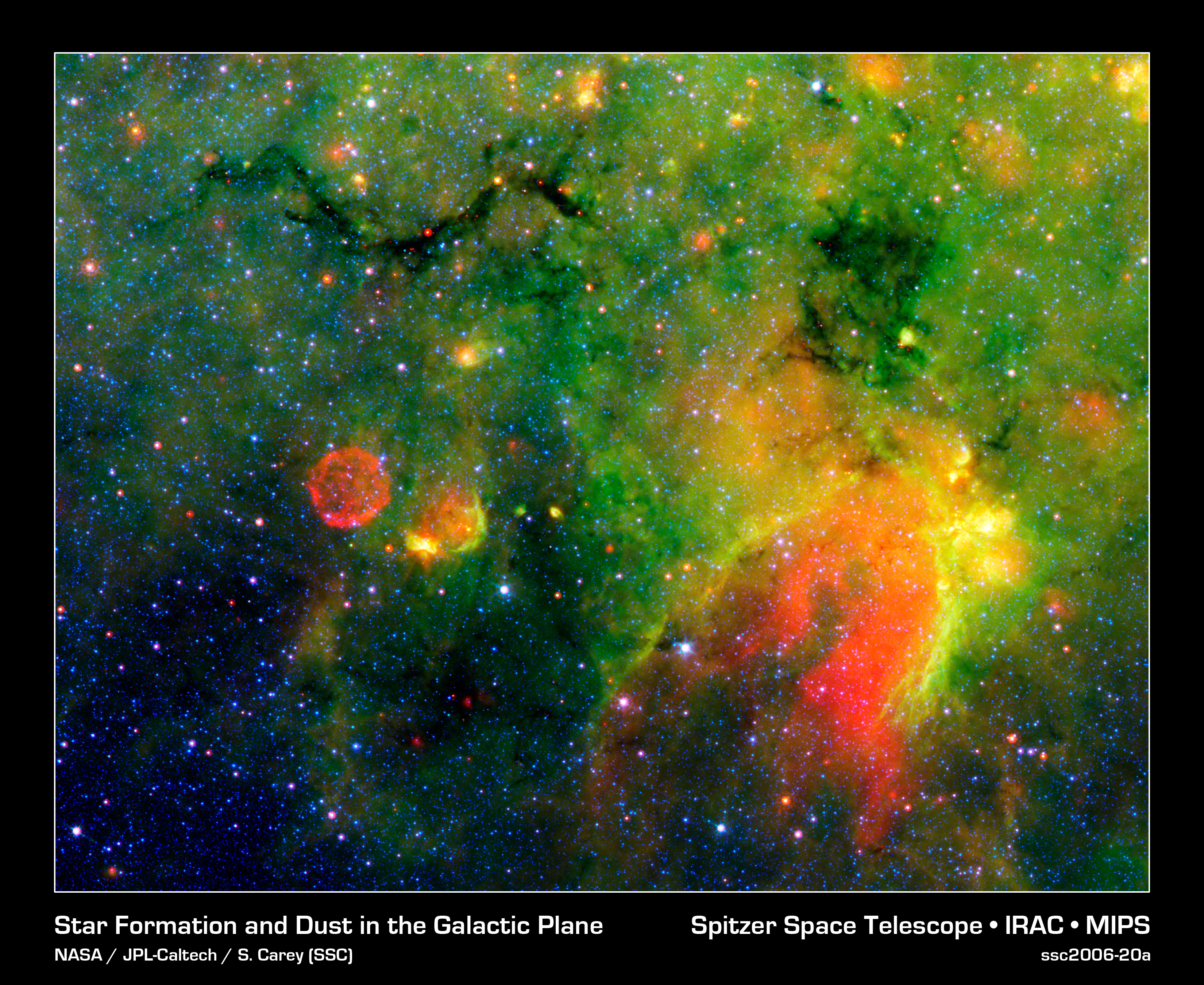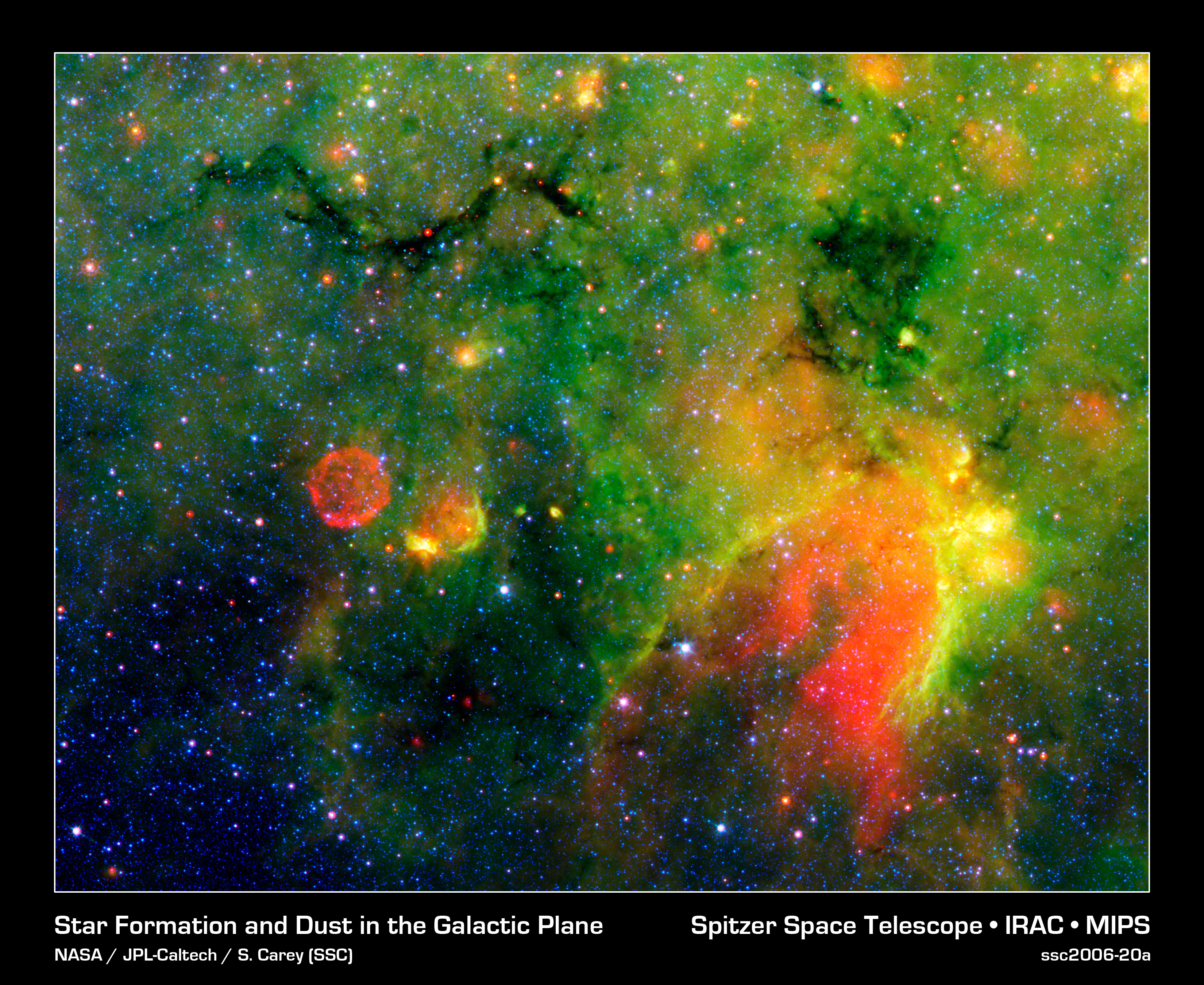
How do stars form? To help study this complex issue, astronomers took a deep image in infrared light of an active part of our Milky Way Galaxy where star formation is rampant. In IRDC G11.11-0.11, thick clouds of dust and gas are congealing into stars that are so dark that humans living there would see an empty night sky. The image, though, taken last year by the Spitzer Space Telescope in infrared light, shows vast glowing fields of gas and dust, indicating that much of this dust is heated by forming stars. The centers of some clouds, such as the snake-like structure on the upper left, are so thick and cold that they are dark even in infrared light. Many of the red dots are glowing dust shrouds centered on very young newly formed stars. The unusual red sphere below the snake is actually a supernova remnant, the glowing shell of a young star so massive it evolved rapidly and exploded. The region spans about 150 light years and lies about 10,000 light years away toward the constellation of Sagittarius. APOD editor to review best space pictures in Philadelphia Wednesday night
¿Cómo se forman las estrellas? Para ayudar a estudiar esta cuestión compleja, los astrónomos obtuvieron una imagen profunda en luz infrarroja de una parte activa de nuestra Galaxia Vía Láctea donde la formación estelar es abundante. En IRDC G11.11-0.11, densas nubes de polvo y gas se están condensando en estrellas tan oscuras que los seres humanos que vivieran allí verían un cielo nocturno vacío. Sin embargo, la imagen, tomada el año pasado por el Telescopio Espacial Spitzer en luz infrarroja, muestra vastos campos luminosos de gas y polvo, indicando que gran parte de este polvo se calienta por las estrellas en formación. Los centros de algunas nubes, como la estructura similar a una serpiente en la parte superior izquierda, son tan densos y fríos que aparecen oscuros incluso en luz infrarroja. Muchos de los puntos rojos son envolturas de polvo incandescentes centradas en estrellas recién formadas muy jóvenes. La inusual esfera roja debajo de la serpiente es en realidad un remanente de supernova, la cáscara luminosa de una estrella joven tan masiva que evolucionó rápidamente y explotó. La región abarca aproximadamente 150 años luz y se encuentra a unos 10.000 años luz de distancia hacia la constelación de Sagitario.