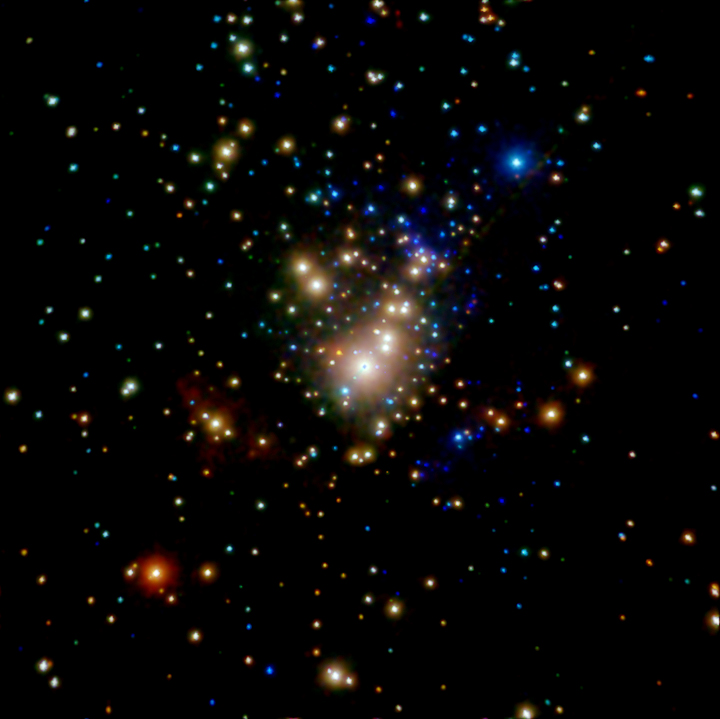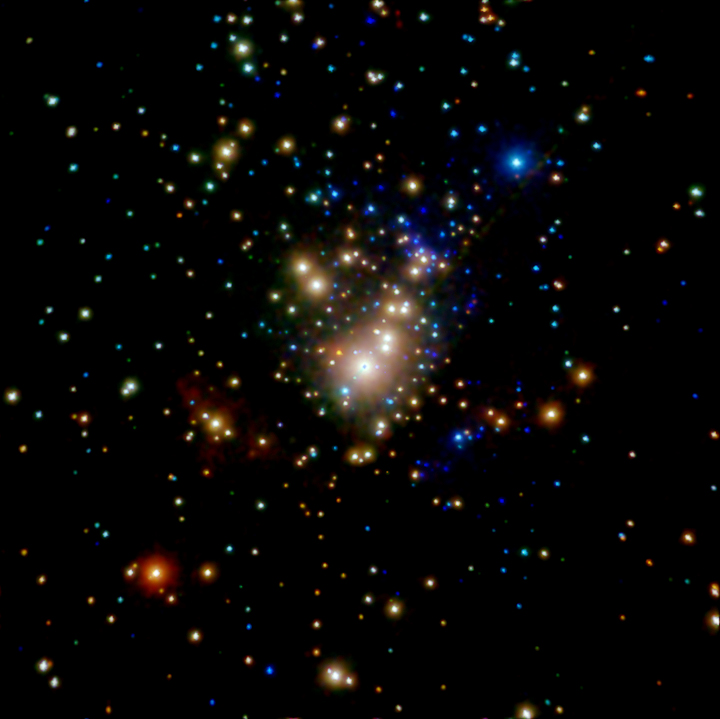
The stars of Orion shine brightly in visible light in planet Earth's night sky. The constellation harbors the closest large stellar nursery, the Great Nebula of Orion, a mere 1,500 light-years away. In fact, the apparently bright clump of stars near the center of this false color Chandra x-ray telescope picture are the massive stars of the Trapezium - the young star cluster which powers much of the nebula's visible-light glow. The stars shown in blue and orange are young sun-like stars; prodigious sources of x-rays thought to be produced in hot stellar coronae and surface flares in a young star's strong magnetic field. Our middle-aged Sun itself was probably thousands of times brighter in x-rays when, like the Trapezium stars, it was only a few million years old. The x-ray image spans about 2.5 light-years across the central region of the Orion Nebula.
Las estrellas de Orión brillan intensamente en luz visible en el cielo nocturno del planeta Tierra. La constelación alberga el vivero estelar grande más cercano, la Gran Nebulosa de Orión, a tan solo 1.500 años luz de distancia. De hecho, el aparentemente brillante cúmulo de estrellas cerca del centro de esta imagen en falso color del telescopio de rayos X Chandra son las estrellas masivas del Trapecio, el joven cúmulo de estrellas que proporciona la mayor parte del brillo visible de la nebulosa. Las estrellas mostradas en azul y naranja son jóvenes estrellas similares al Sol; fuentes prodigiosas de rayos X que se cree son producidas por coronas estelares calientes y destellos de superficie en el fuerte campo magnético de una estrella joven. Nuestro Sol de edad intermedia probablemente fue miles de veces más brillante en rayos X cuando, como las estrellas del Trapecio, tenía solo algunos millones de años de antigüedad. La imagen de rayos X abarca aproximadamente 2,5 años luz en la región central de la Nebulosa de Orión.