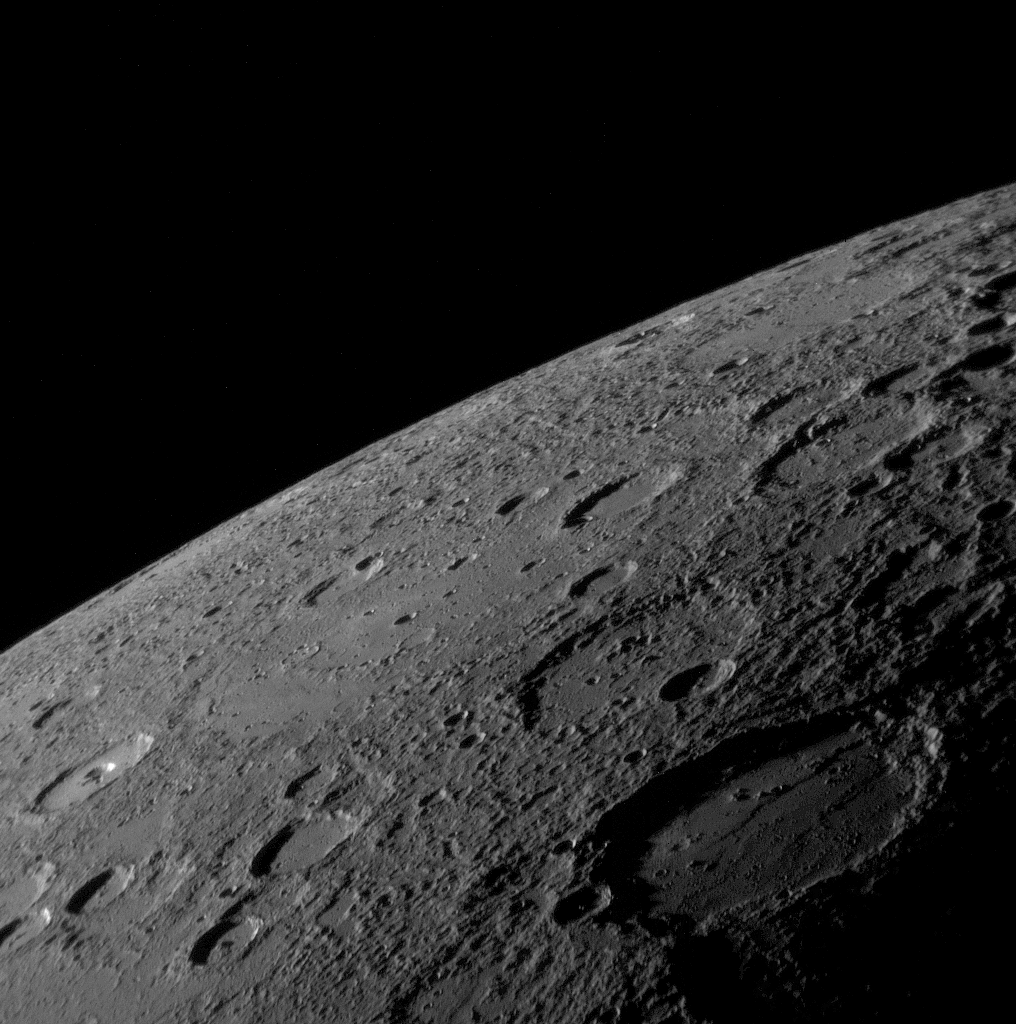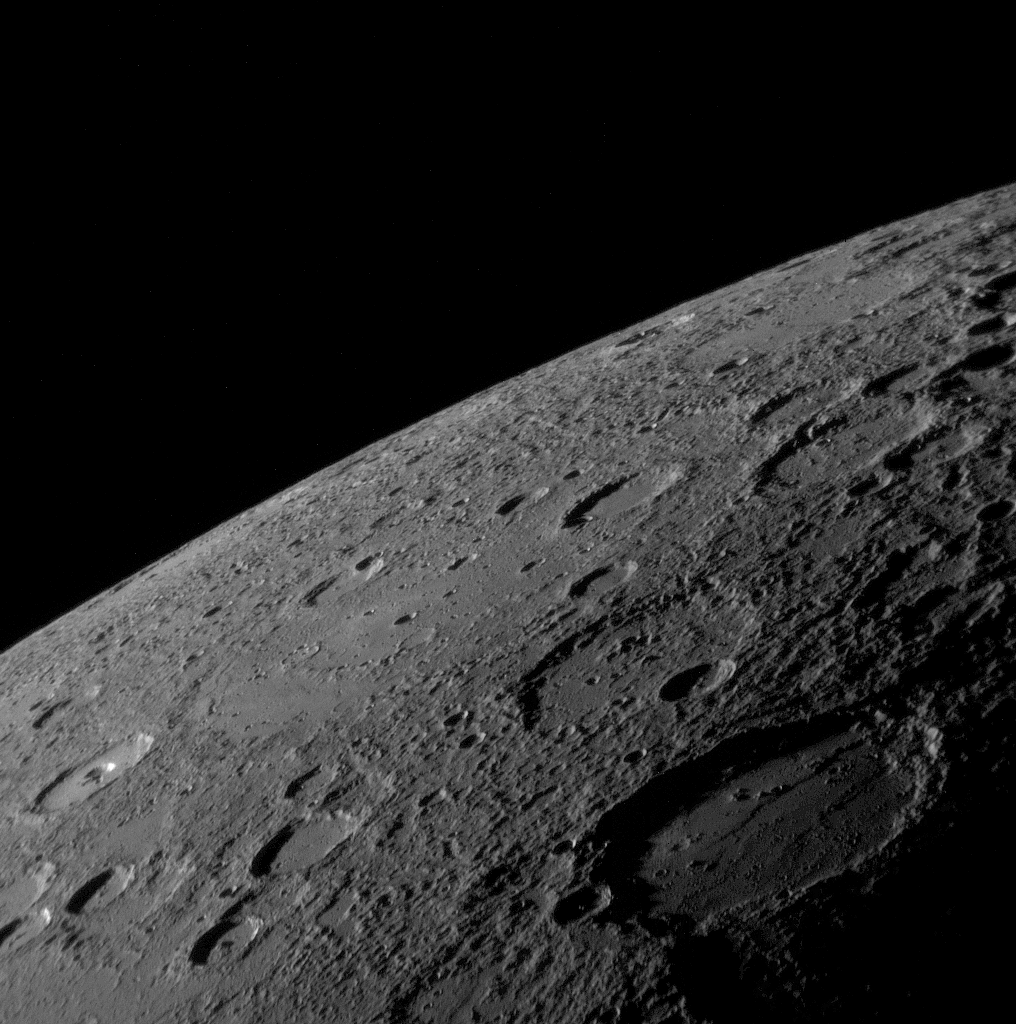
What would it look like to fly past Mercury? Just such an adventure was experienced last week by the MESSENGER spacecraft during its first flyby of the strange moon-like world nearest the Sun. Pictured above is the limb of Mercury seen by MESSENGER upon approach, from about 1 1/2 Earth diameters away. Visible on the hot and barren planet are many craters, many appeared to be more shallow than similarly sized craters on the Moon. The comparatively high gravity of Mercury helps flatten tall structures like high crater walls. MESSENGER was able to take over 1,000 images of Mercury which will be beamed back to Earth for planetary geologists to study. The robotic MESSENGER spacecraft is scheduled to fly past Mercury twice more before firing its thrusters to enter orbit in 2011.
¿Cómo sería sobrevolar Mercurio? Una aventura exactamente así fue experimentada la semana pasada por la nave espacial MESSENGER durante su primer acercamiento al extraño mundo similar a la Luna más cercano al Sol. En la imagen superior se ve el limbo de Mercurio observado por MESSENGER durante su aproximación, desde una distancia de aproximadamente 1½ diámetros terrestres. Visibles en el planeta caliente y árido hay numerosos cráteres, muchos de los cuales parecían ser más someros que cráteres de tamaño similar en la Luna. La gravedad comparativamente alta de Mercurio ayuda a aplanar estructuras altas como las paredes de cráteres elevadas. MESSENGER fue capaz de captar más de 1000 imágenes de Mercurio que serán transmitidas a la Tierra para que los geólogos planetarios las estudien. La nave espacial robótica MESSENGER está previsto que sobrevuele Mercurio dos veces más antes de encender sus propulsores para entrar en órbita en 2011.