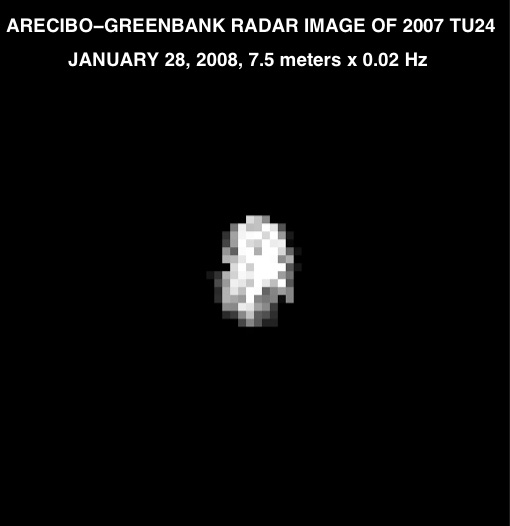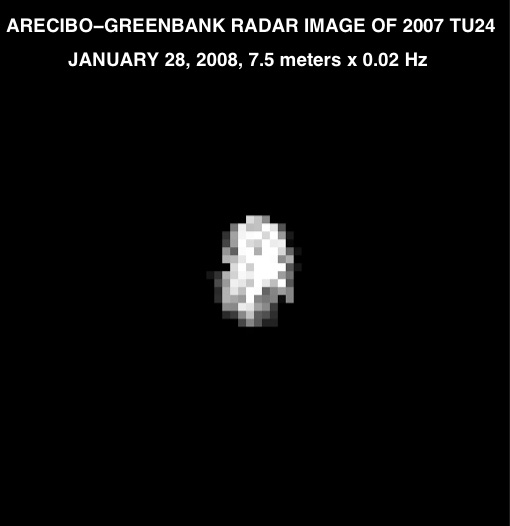
Asteroid 2007 TU24 passed by the Earth yesterday, posing no danger. The space rock, estimated to be about 250 meters across, coasted by just outside the orbit of Earth's Moon. The passing was not very unusual -- small rocks strike Earth daily, and in 2003 a rock the size of a bus passed inside the orbit of the Moon, being detected only after passing. TU24 was notable partly because it was so large. Were TU24 to have struck land, it might have caused a magnitude seven earthquake and left a city-sized crater. A perhaps larger danger would have occurred were TU24 to have struck the ocean and raised a large tsunami. This radar image was taken two days ago. The Arecibo Radio Telescope in Puerto Rico broadcast radar that was reflected by the asteroid and then recorded by the Byrd Radio Telescope in Green Bank, West Virginia. The resulting image shows TU24 to have an oblong and irregular shape. TU24 was discovered only three months ago, indicating that other potentially hazardous asteroids might lurk in our Solar System currently undetected. Objects like TU24 are hard to detect because they are so faint and move so fast. Humanity's ability to scan the sky to detect, catalog, and analyze such objects has increased notably in recent years.
El asteroide 2007 TU24 pasó cerca de la Tierra ayer, sin presentar peligro alguno. La roca espacial, estimada en aproximadamente 250 metros de diámetro, se desplazó justo fuera de la órbita de la Luna. El paso no fue muy inusual: pequeñas rocas impactan la Tierra diariamente, y en 2003 una roca del tamaño de un autobús pasó dentro de la órbita de la Luna, siendo detectada solo después de su paso. TU24 fue notable en parte por su gran tamaño. De haber impactado en tierra, podría haber causado un terremoto de magnitud siete y dejado un cráter del tamaño de una ciudad. Quizás un peligro aún mayor habría ocurrido si TU24 hubiera impactado el océano y generado un tsunami de gran magnitud. Esta imagen de radar fue tomada hace dos días. El Radiotelescopio de Arecibo en Puerto Rico transmitió radar que fue reflejado por el asteroide y luego registrado por el Radiotelescopio Byrd en Green Bank, Virginia Occidental. La imagen resultante muestra que TU24 tiene una forma oblonga e irregular. TU24 fue descubierto hace apenas tres meses, lo que indica que otros asteroides potencialmente peligrosos podrían estar ocultos en nuestro Sistema Solar sin ser detectados actualmente. Objetos como TU24 son difíciles de detectar porque son muy débiles y se mueven muy rápido. La capacidad de la humanidad para explorar el cielo, detectar, catalogar y analizar tales objetos ha aumentado notablemente en años recientes.