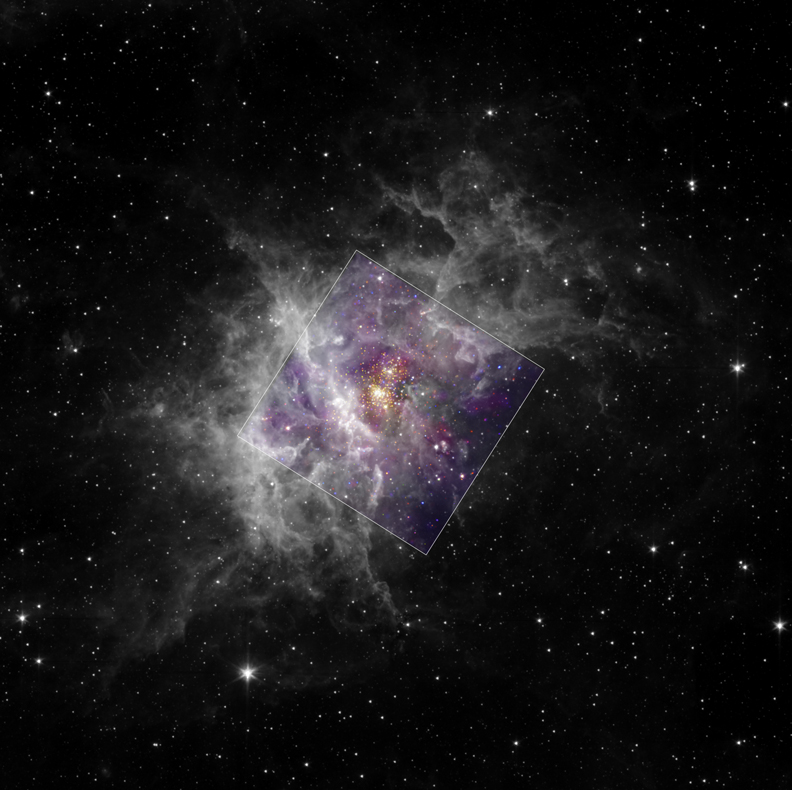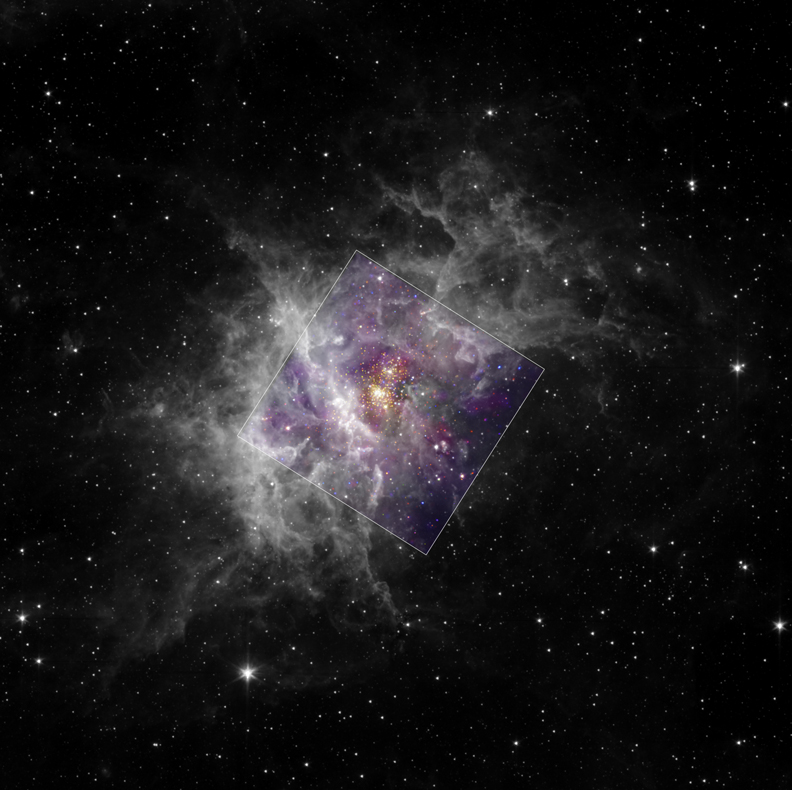
Dusty stellar nursery RCW 49 surrounds young star cluster Westerlund 2 in this remarkable composite skyscape from beyond the visible spectrum of light. Infrared data from the Spitzer Space Telescope is shown in black and white, complimenting the Chandra X-ray image data (in false color) of the hot energetic stars within the cluster's central region. Looking toward the grand southern constellation Centaurus, both views reveal stars and structures hidden from optical telescopes by obscuring dust. Westerlund 2 itself is a mere 2 million years old or less, and contains some of our galaxy's most luminous, massive and therefore short-lived stars. The infrared signatures of proto-planetary disks have also been identified in the intense star forming region. At the cluster's estimated distance of 20,000 light-years, the square marking the Chandra field of view would be about 50 light-years on a side.
La guardería estelar polvorientaRCW 49 rodea al joven cúmulo estelar Westerlund 2 en este extraordinario paisaje celestial compuesto más allá del espectro de luz visible. Los datos infrarrojos del Telescopio Espacial Spitzer se muestran en blanco y negro, complementando los datos de imagen de rayos X de Chandra (en falso color) de las estrellas calientes y energéticas en la región central del cúmulo. Mirando hacia la gran constelación austral de Centaurus, ambas vistas revelan estrellas y estructuras ocultas a los telescopios ópticos por el polvo que las oscurece. El propio Westerlund 2 tiene apenas 2 millones de años o menos, y contiene algunas de las estrellas más luminosas, masivas y, por lo tanto, de corta vida de nuestra galaxia. También se han identificado las firmas infrarrojas de discos protoplanetarios en la intensa región de formación estelar. A la distancia estimada de 20.000 años luz del cúmulo, el cuadrado que marca el campo de visión de Chandra tendría aproximadamente 50 años luz de lado.