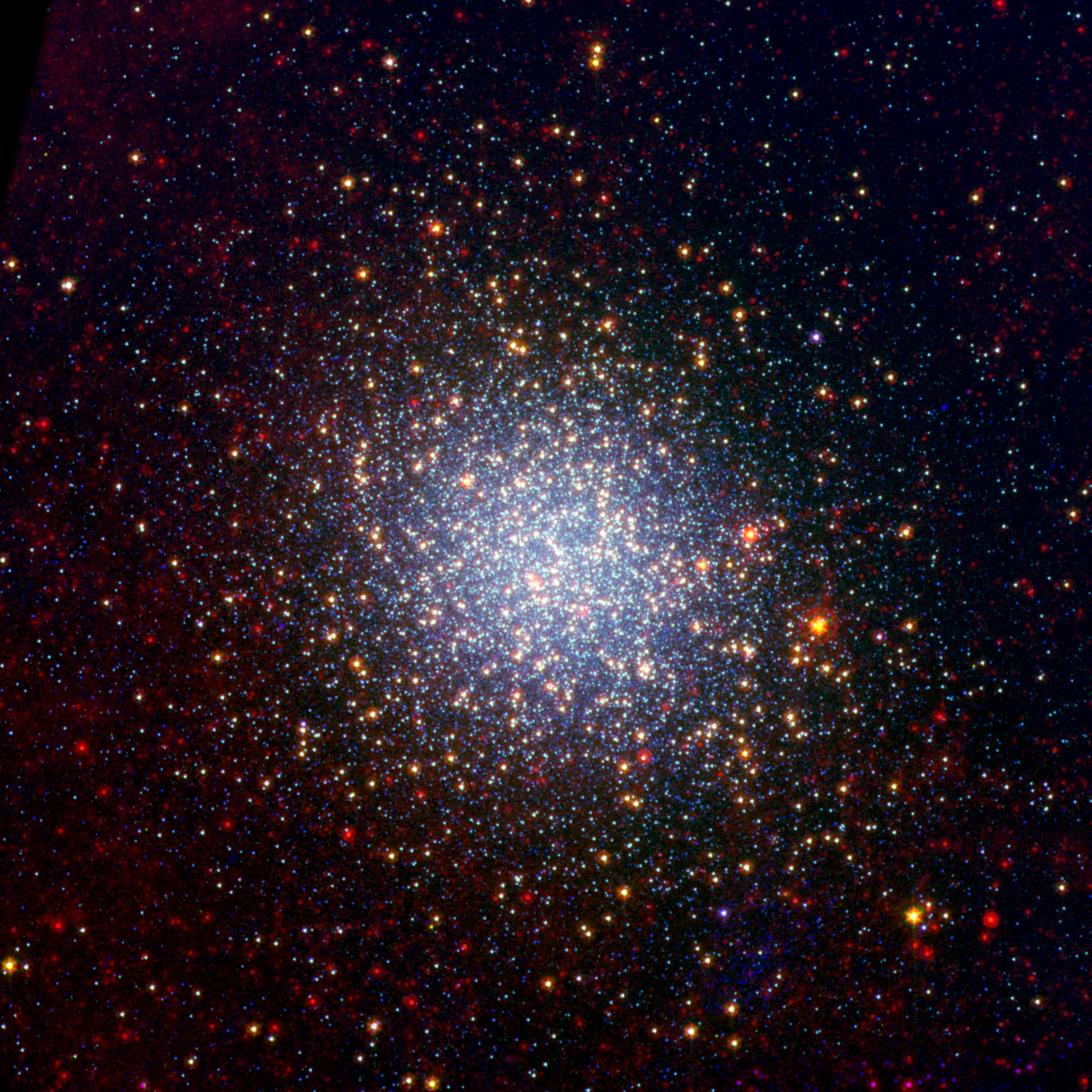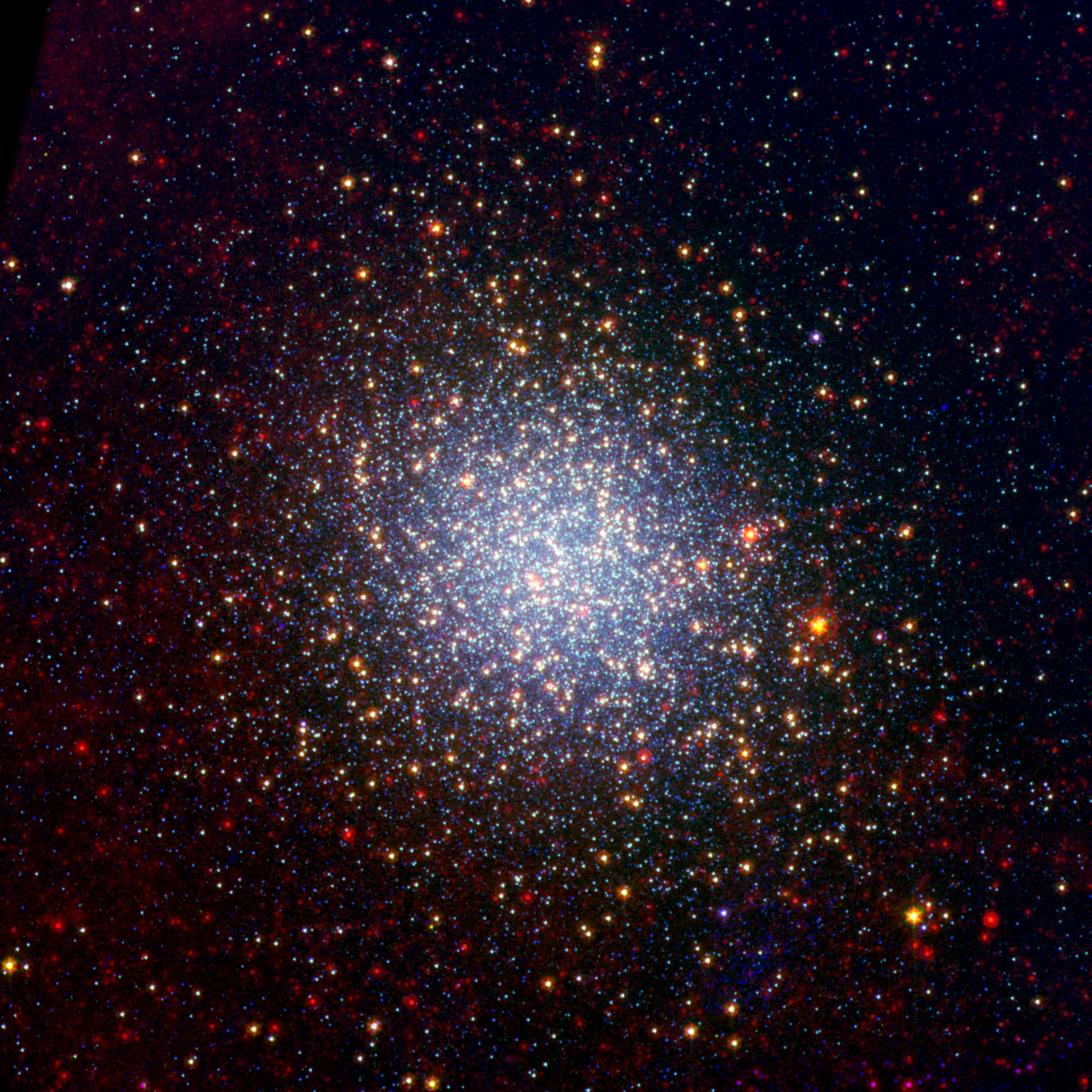
Globular star cluster Omega Centauri is some 15,000 light-years away and 150 light-years in diameter. Packed with about 10 million stars, Omega Cen is the largest of 200 or so known globular clusters that roam the halo of our Milky Way galaxy. This intriguing color picture combines a visible light image of the cluster in blue hues with infrared image data from the Spitzer Space Telescope. The Spitzer data includes images in two infrared bands, one shown in green and one in red. Both infrared bands are sensitive to light from the cool, giant stars in the cluster. Adding the red and green colors together creates yellow, showing off the cluster's giant stars as yellow spots. Of course, red spots also indicate cool, giant stars in the image, but some of the red spots are even more distant background galaxies. Also known simply as Red Giant Stars, they represent a stage in the life-cycle of stars more evolved than our own Sun, a stage the Sun will reach in about 5 billion years. Dust grains formed in the atmospheres of cool, giant stars are ultimately involved in the formation of other stars and planets.
El cúmulo globular Omega Centauri se encuentra a unos 15.000 años luz de distancia y tiene un diámetro de 150 años luz. Con aproximadamente 10 millones de estrellas, Omega Cen es el mayor de los 200 o más cúmulos globulares conocidos que orbitan en el halo de nuestra galaxia Vía Láctea. Esta intrigante imagen a color combina una imagen del cúmulo en luz visible en tonos azules con datos de imagen infrarroja del Telescopio Espacial Spitzer. Los datos de Spitzer incluyen imágenes en dos bandas infrarrojas, una mostrada en verde y otra en rojo. Ambas bandas infrarrojas son sensibles a la luz de las estrellas gigantes frías del cúmulo. Al sumar los colores rojo y verde se crea amarillo, revelando las estrellas gigantes del cúmulo como puntos amarillos. Por supuesto, los puntos rojos también indican estrellas gigantes frías en la imagen, pero algunos de los puntos rojos son galaxias de fondo aún más distantes. También conocidas simplemente como Gigantes Rojas, representan una etapa en el ciclo de vida de estrellas más evolucionadas que nuestro propio Sol, una etapa que el Sol alcanzará en aproximadamente 5 mil millones de años. Los granos de polvo formados en las atmósferas de las estrellas gigantes frías están involucrados en última instancia en la formación de otras estrellas y planetas.