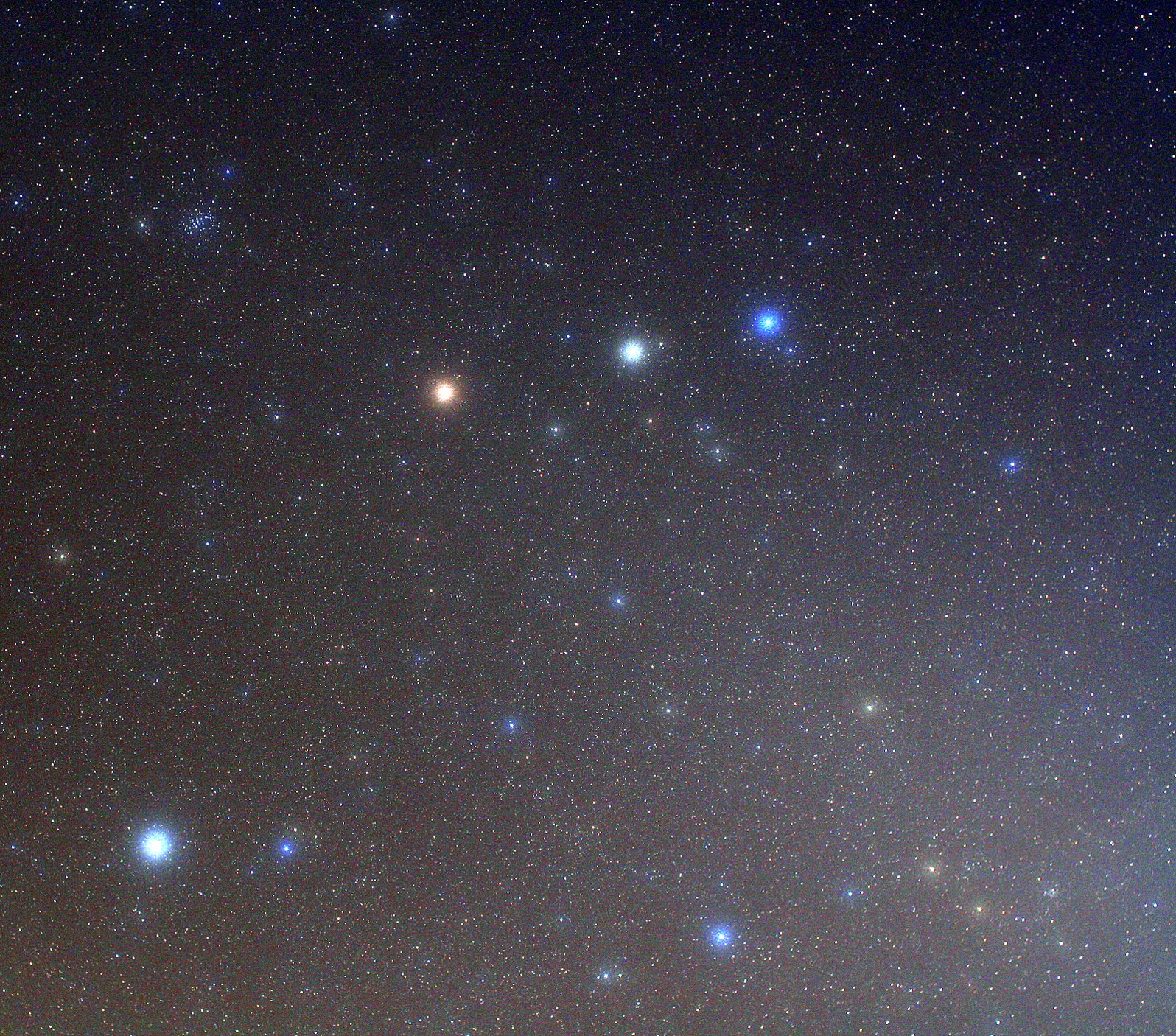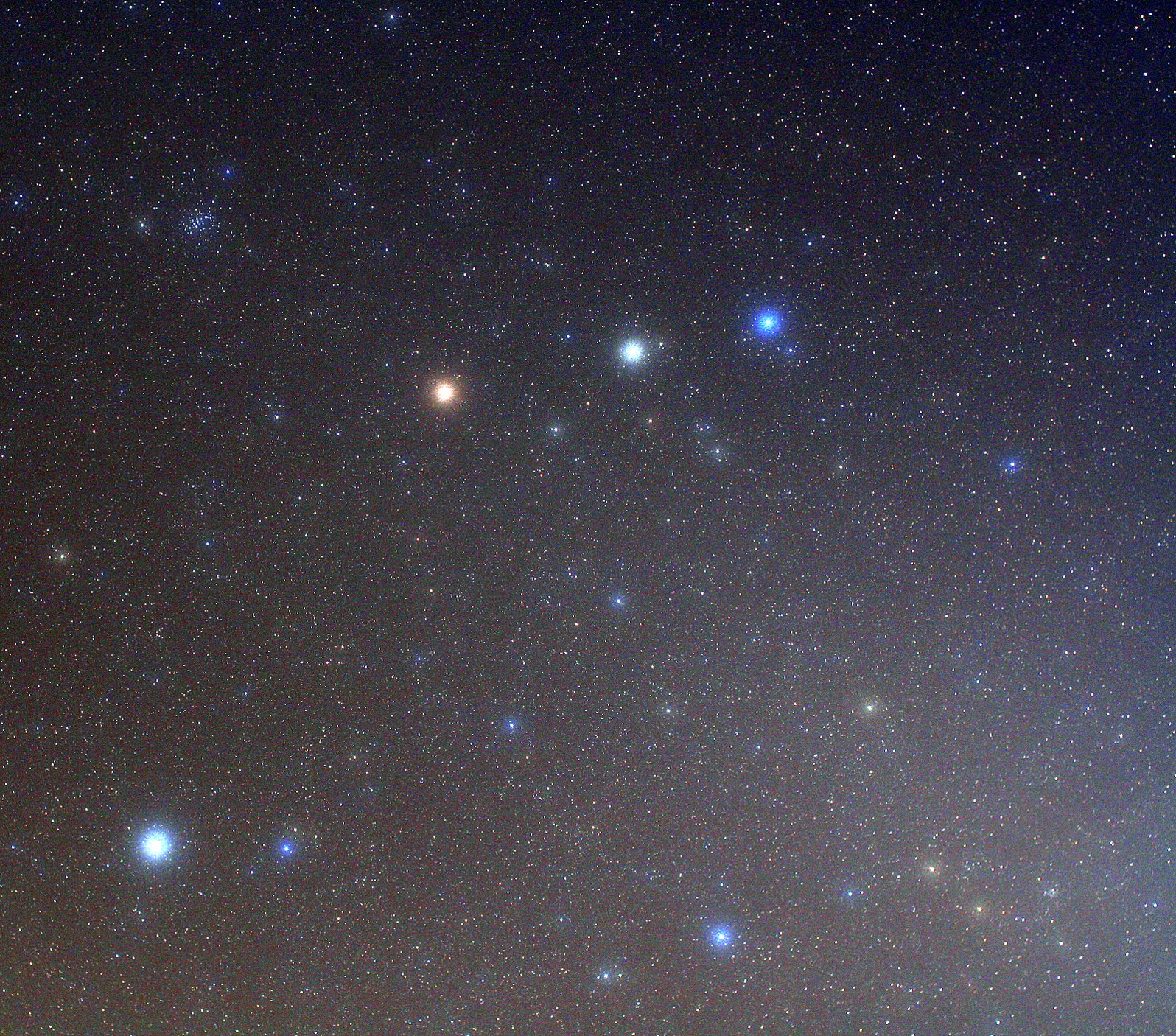
Wandering through the evening sky, on May 4th planet Mars stood in line with Castor and Pollux, the two bright stars of the constellation Gemini. In this time exposure of the celestial alignment, Mars actually takes on a distinct yellowish hue, contrasting in color with Pollux; a giant star known to have a Jupiter-class planet, and Castor; itself a multiple star system. Though in mythology Pollux and Castor are twin brothers, the two stars are physically unrelated and are about 34 and 50 light-years distant respectively. Included in the skyview are Procyon, alpha star of Canis Minor, and famous star cluster M44 also known as the Beehive Cluster. Dust in our own solar system reflecting sunlight creates the faint band of Zodiacal light emerging from the lower right corner of the frame. Just put your cursor over the picture for help with identifications. Of course, bright Mars can still be found in the western evening skies and tonight wanders near the crescent Moon.
Vagando a través del cielo vespertino, el 4 de mayo el planeta Marte se alineó con Castor y Polux, las dos estrellas brillantes de la constelación de Géminis. En esta exposición de larga duración de esta alineación celeste, Marte adquiere un matiz amarillento distintivo, contrastando en color con Polux; una estrella gigante conocida por poseer un planeta de tipo Júpiter, y Castor; un sistema estelar múltiple en sí mismo. Aunque en la mitología Polux y Castor son hermanos gemelos, las dos estrellas están físicamente sin relación y se encuentran a aproximadamente 34 y 50 años luz de distancia respectivamente. La vista incluye a Proción, la estrella alfa de Canis Minor, y el famoso cúmulo estelar M44, también conocido como el Cúmulo de la Colmena. El polvo en nuestro propio sistema solar que refleja la luz solar crea la tenue banda de luz zodiacal que emerge de la esquina inferior derecha del marco. El brillante Marte se puede encontrar en los cielos vespertinos occidentales y esta noche se sitúa cerca de la Luna creciente.