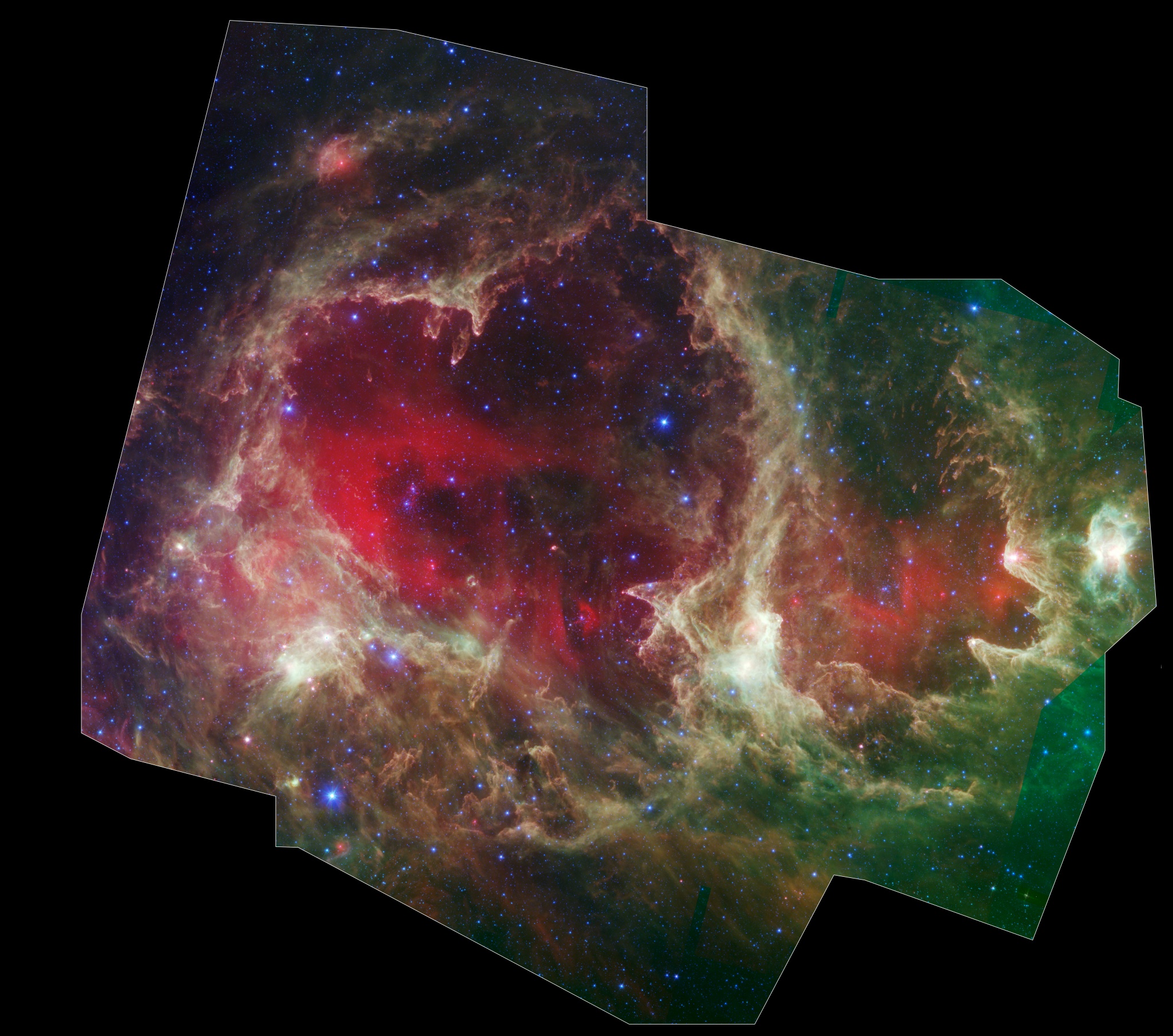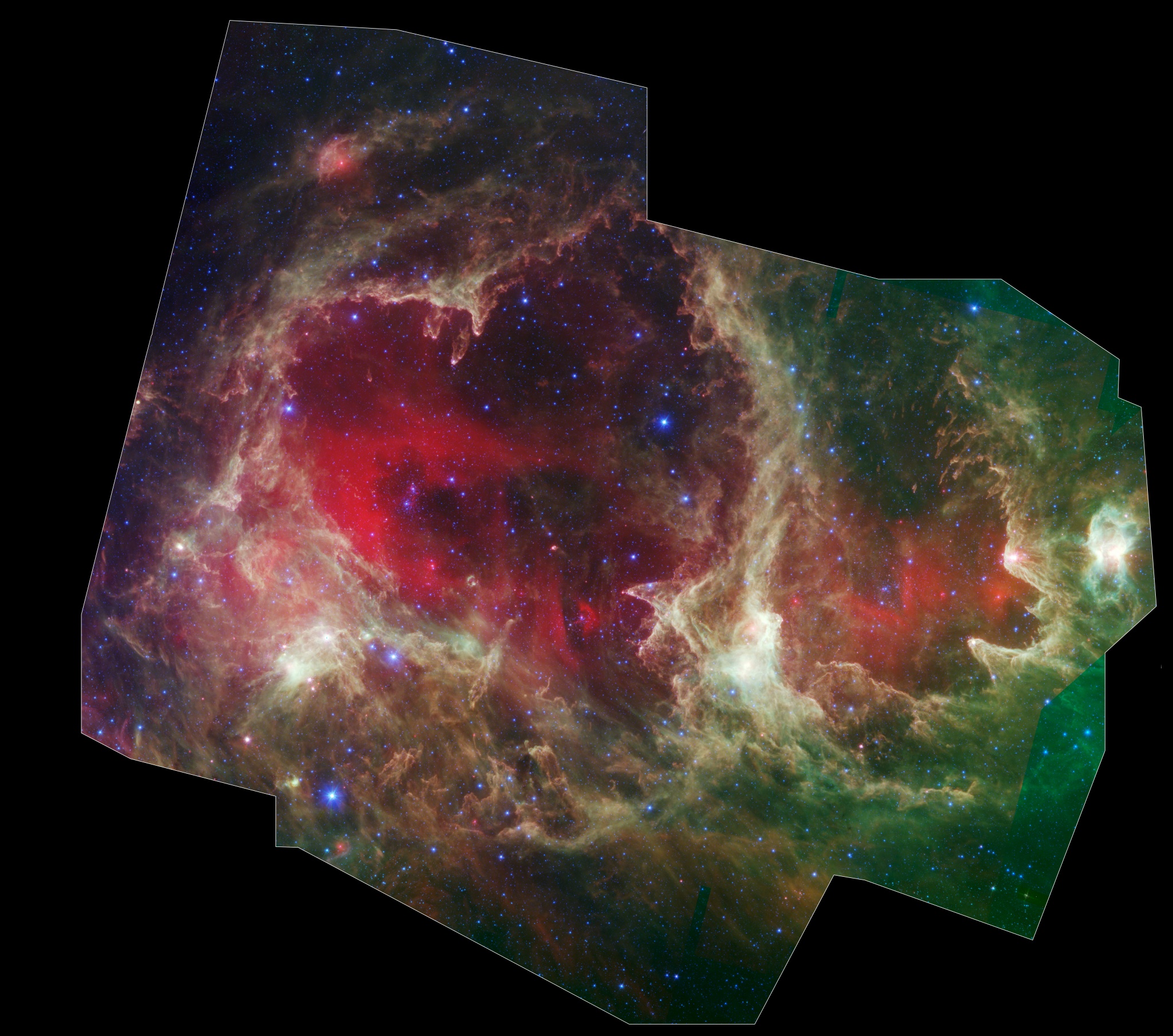
Giant star forming region W5 is over 200 light-years across and about 6,500 light-years away in the constellation Cassiopeia. W5's sculpted clouds of cold gas and dust seem to form fantastic shapes in this impressive mosaic of infrared images from the Spitzer Space Telescope. In fact, the area on the right includes the structures previously dubbed the Mountains of Creation. New evidence indicates that successive generations of stars formed in the W5 region in an expanding pattern of triggered star formation. The older, earlier generations of stars seem to cluster near the middle of the enormous cavities, with younger stars seen near the rims. Winds and radiation from the older, central stars likely carve out and compress surrounding interstellar material, triggering the collapse that gave rise to younger, later generations of stars farther out. In the false-color image, heated dust still within the cavities appears red, while the youngest stars are forming in the whitish areas. W5 is also known as IC 1848, and together with IC 1805 it is part of a complex region popularly dubbed the Heart and Soul Nebulae.
La región gigantesca de formación estelar W5 se extiende por más de 200 años luz de ancho y se encuentra a aproximadamente 6.500 años luz de distancia en la constelación de Casiopea. Las nubes esculpidas de gas frío y polvo de W5 parecen formar formas fantásticas en este impresionante mosaico de imágenes infrarrojas del Telescopio Espacial Spitzer. De hecho, el área de la derecha incluye las estructuras previamente denominadas Montañas de la Creación. Nuevas evidencias indican que sucesivas generaciones de estrellas se formaron en la región de W5 en un patrón expansivo de formación estelar disparada. Las generaciones anteriores y más antiguas de estrellas parecen agruparse cerca del centro de las enormes cavidades, mientras que las estrellas más jóvenes se observan cerca de los bordes. Los vientos y la radiación de las estrellas antiguas del centro probablemente cavan y comprimen el material interestelar circundante, disparando el colapso que dio origen a generaciones más jóvenes y posteriores de estrellas más alejadas. En la imagen de falso color, el polvo calentado aún dentro de las cavidades aparece en rojo, mientras que las estrellas más jóvenes se están formando en las áreas blanquecinas. W5 también se conoce como IC 1848 y, junto con IC 1805, forma parte de una región compleja popularmente denominada las Nebulosas del Corazón y el Alma.