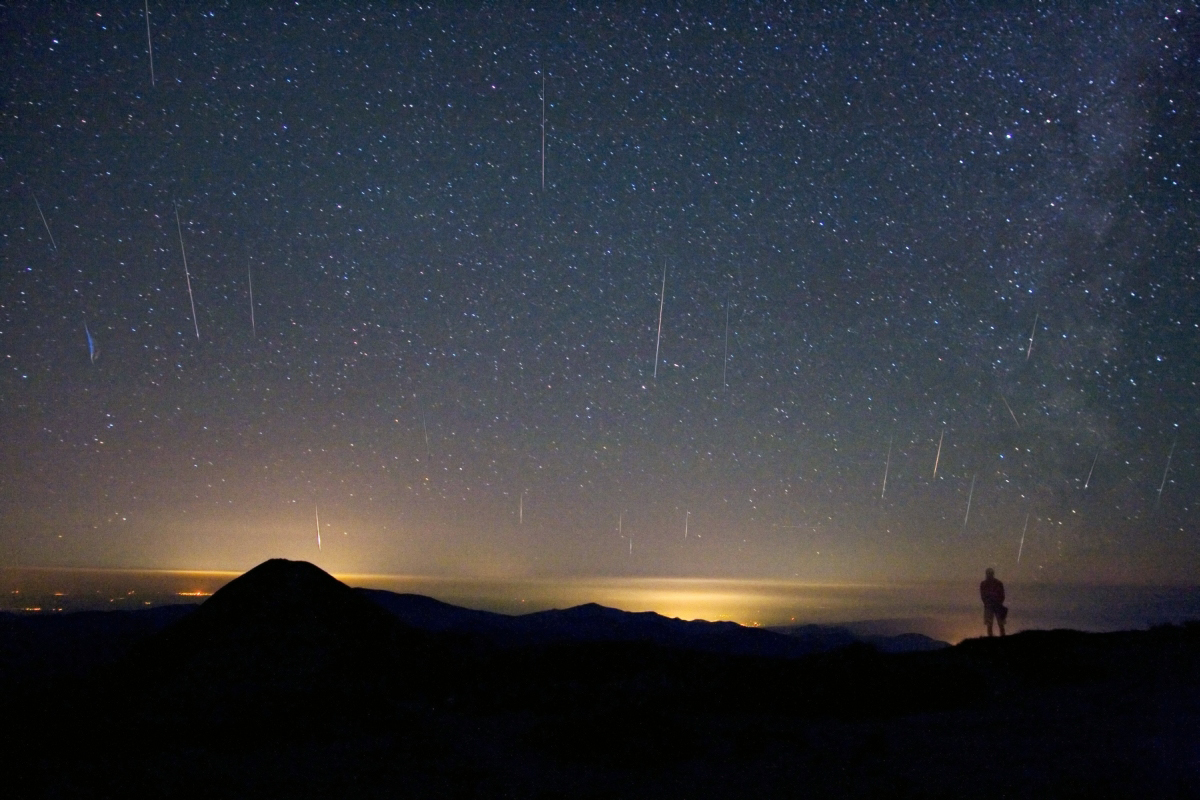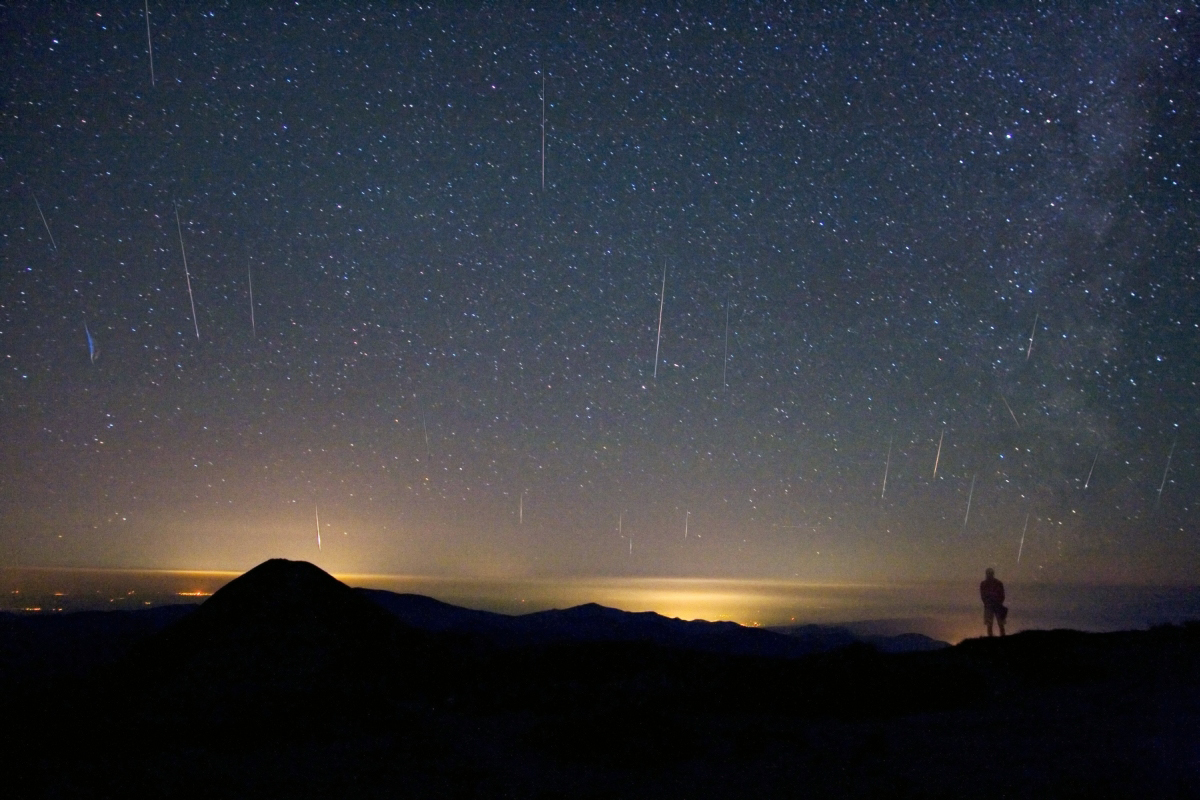
A mountain top above the clouds and light-polluted cities was a good place to go to watch this August's Perseid meteor shower. In fact, this composite picture from one of the highest points in Romania, the Omu summit (2,507 meters) in the Southern Carpathian Mountains, captures about 20 of the shower's bright streaks against a starry night sky. The cosmic debris stream that creates the shower is composed of dust particles moving along parallel paths, following the orbit of their parent comet Swift-Tuttle. Looking toward the shower's radiant point in the constellation Perseus, perspective causes the parallel meteor streaks to appear to diverge. But looking directly away from the radiant point, as in this view, perspective actually makes the Perseid meteors seem to be converging toward a point below the horizon.
Una cima de montaña por encima de las nubes y ciudades contaminadas por luz fue un buen lugar para observar la lluvia de meteoros Perseidas de agosto. De hecho, esta imagen compuesta tomada desde uno de los puntos más altos de Rumania, la cima de Omu (2.507 metros) en las Montañas de los Cárpatos Meridionales, captura aproximadamente 20 de los brillantes trazos de la lluvia contra un cielo nocturno estrellado. La corriente de escombros cósmicos que crea la lluvia está compuesta de partículas de polvo que se mueven a lo largo de trayectorias paralelas, siguiendo la órbita de su cometa progenitor Swift-Tuttle. Cuando miramos hacia el punto radiante de la lluvia en la constelación de Perseo, la perspectiva hace que los trazos de meteoros paralelos parezcan divergir. Sin embargo, cuando miramos directamente en la dirección opuesta al punto radiante, como en esta vista, la perspectiva hace que los meteoros Perseidas parezcan converger hacia un punto bajo el horizonte.