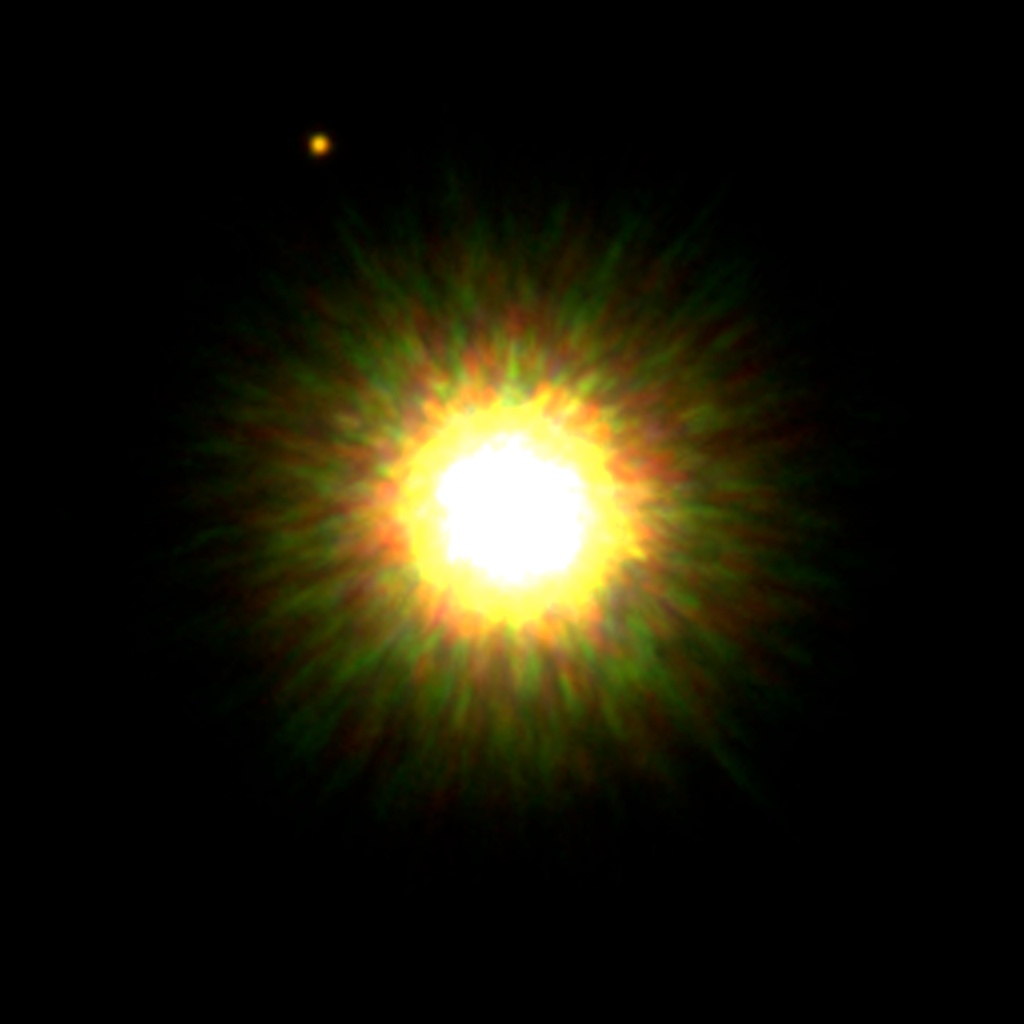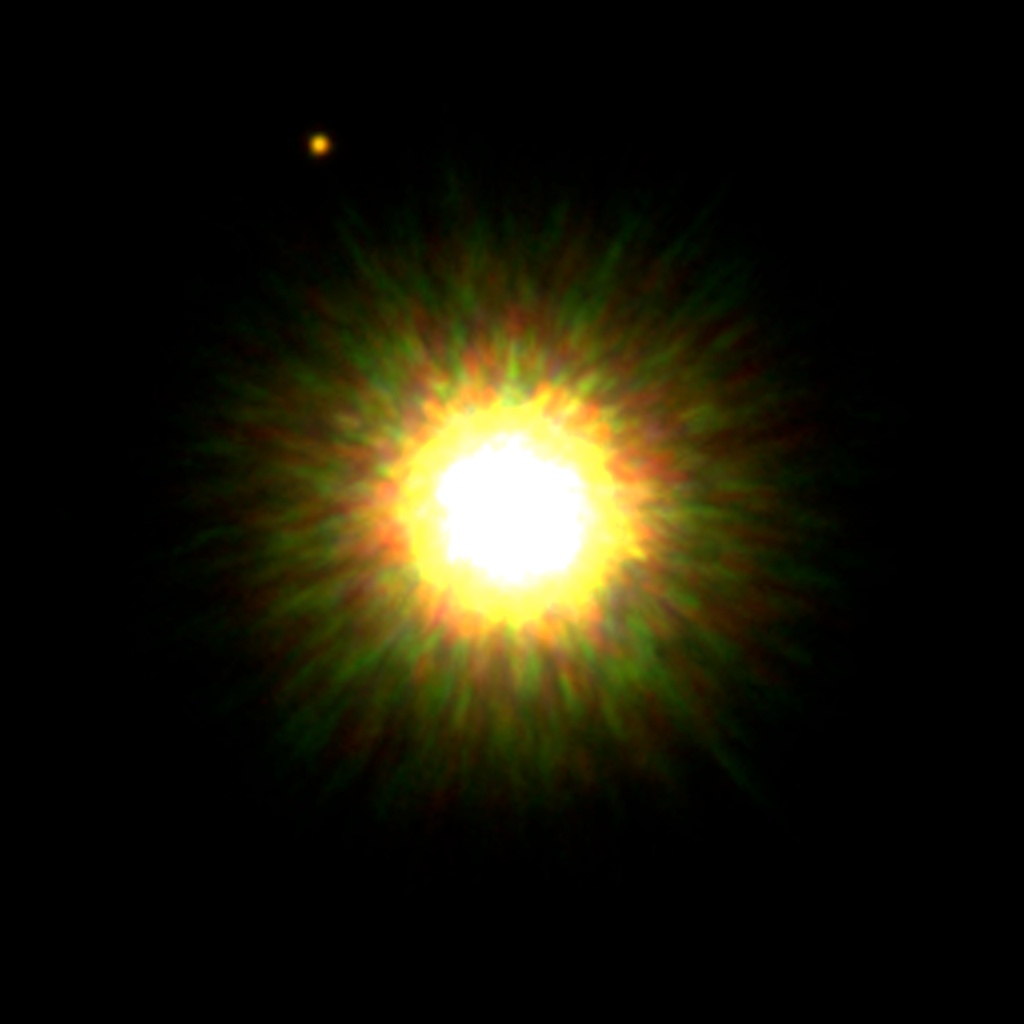
Located just 500 light-years away toward the constellation Scorpius, this star is only slightly less massive and a little cooler than the Sun. But it is much younger, a few million years old compared to the middle-aged Sun's 5 billion years. This sharp infrared image shows the young star has a likely companion positioned above and left - a hot planet with about 8 times the mass of Jupiter, orbiting a whopping 330 times the Earth-Sun distance from its parent star. The young planetary companion is still hot and relatively bright in infrared light due to the heat generated during its formation by gravitational contraction. In fact, such newborn planets are easier to detect before they age and cool, becoming much fainter. Though over 300 extrasolar planets have been found using other techniques, this picture likely represents the first direct image of a planet belonging to a star similar to the Sun.
Ubicada a tan solo 500 años luz de distancia hacia la constelación de Escorpio, esta estrella tiene una masa ligeramente inferior y es un poco más fría que el Sol. Sin embargo, es mucho más joven, con apenas algunos millones de años de edad en comparación con los 5 mil millones de años del Sol de mediana edad. Esta nítida imagen infrarroja muestra que la estrella joven tiene un probable compañero posicionado arriba y a la izquierda: un planeta caliente con aproximadamente 8 veces la masa de Júpiter, que orbita a una distancia de 330 veces la distancia Tierra-Sol de su estrella progenitora. El joven compañero planetario aún es caliente y relativamente brillante en luz infrarroja debido al calor generado durante su formación por contracción gravitacional. De hecho, tales planetas recién nacidos son más fáciles de detectar antes de que envejezcan y se enfríen, volviéndose mucho más débiles. Aunque se han encontrado más de 300 planetas extrasolares utilizando otras técnicas, esta imagen probablemente representa la primera imagen directa de un planeta perteneciente a una estrella similar al Sol.