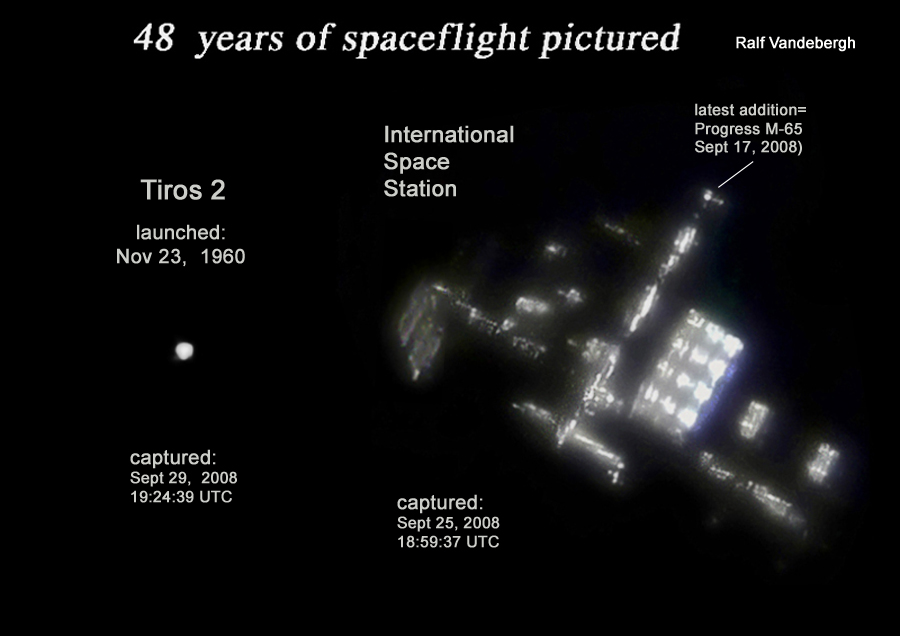
This year, NASA celebrated its 50th anniversary. Inspired to make his own contribution, astronomer Ralf Vandebergh set out to record images of some historic spacecraft in Earth orbit -- captured with his own modest equipment and a hand-guided, 10-inch, Newtonian reflecting telescope. One result is this intriguing composite effectively spanning 48 years of space flight! From a 1960 launch, on the left is the TIROS 2 satellite, one of the first successful weather satellites. While this TIROS (Television InfraRed Observation System) satellite stopped functioning in 1961, Vandebergh notes that if we could visit it now, we would still find video cameras and magnetic tape recorders. On the right, of course, is the ISS (International Space Station) including its recent addition, the Progress M-65 cargo vehicle, launched to the ISS just last month.
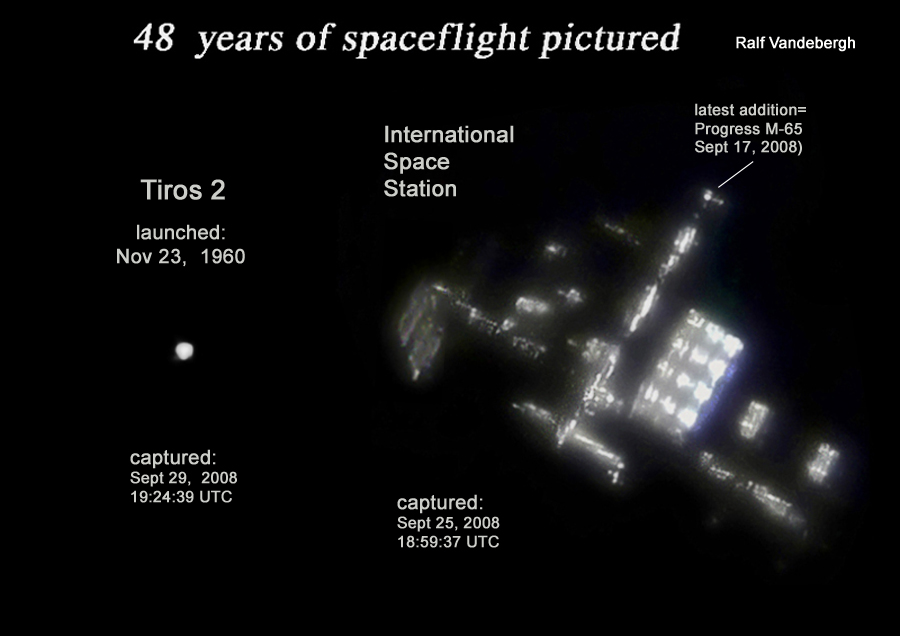
Este año, la NASA celebró su 50 aniversario. Inspirado para hacer su propia contribución, el astrónomo Ralf Vandebergh se propuso registrar imágenes de algunas naves espaciales históricas en órbita terrestre, capturadas con su propio equipo modesto y un telescopio reflector newtoniano de 10 pulgadas guiado manualmente. El resultado es este composite intrigante que abarca efectivamente 48 años de vuelo espacial. Lanzado en 1960, a la izquierda se encuentra el satélite TIROS 2, uno de los primeros satélites meteorológicos exitosos. Aunque este satélite TIROS (Sistema de Observación Infrarroja por Televisión) dejó de funcionar en 1961, Vandebergh señala que si pudiéramos visitarlo ahora, aún encontraríamos cámaras de video y grabadoras de cinta magnética. A la derecha, por supuesto, está la Estación Espacial Internacional (ISS), incluyendo su adición reciente, el vehículo de carga Progress M-65, lanzado a la ISS apenas el mes pasado.