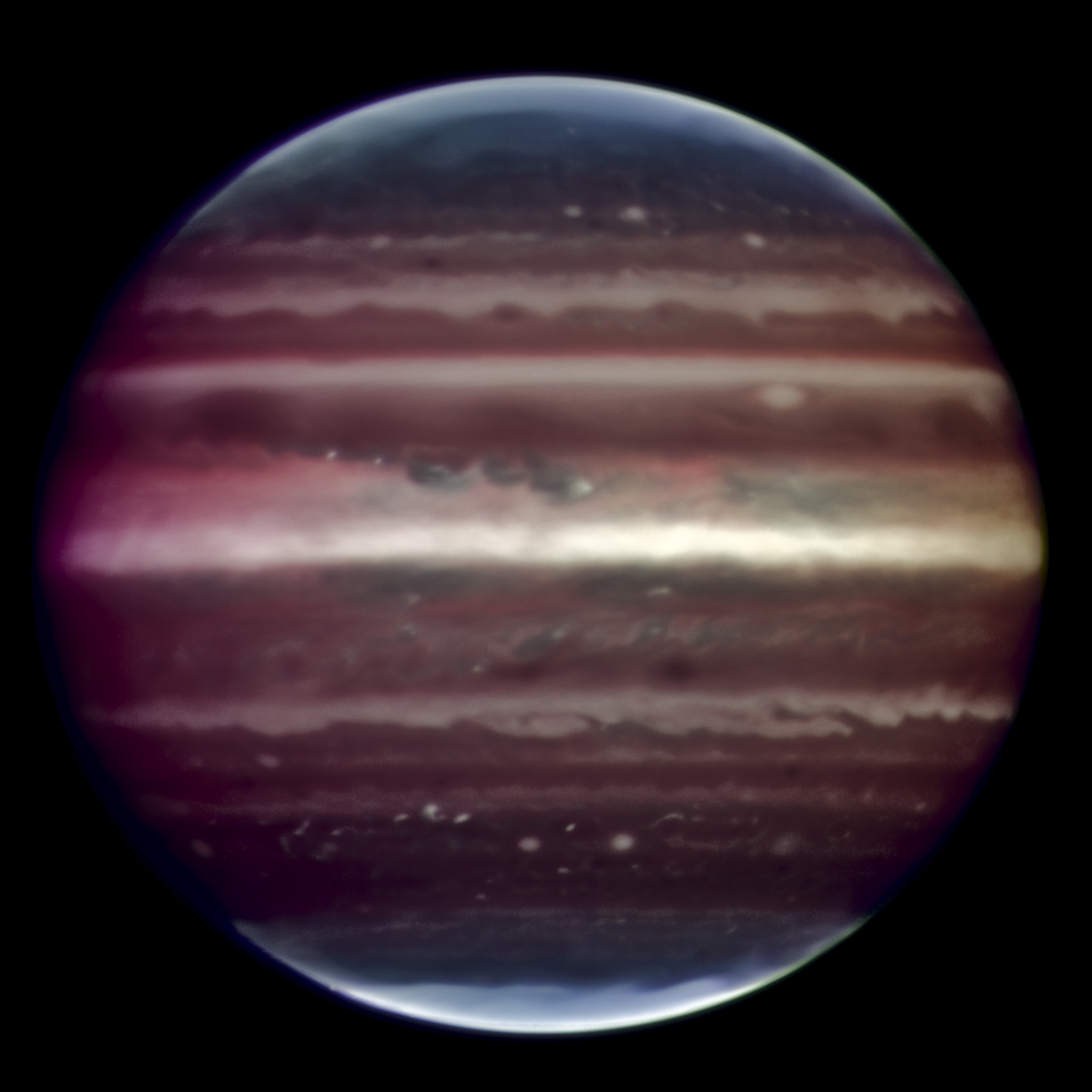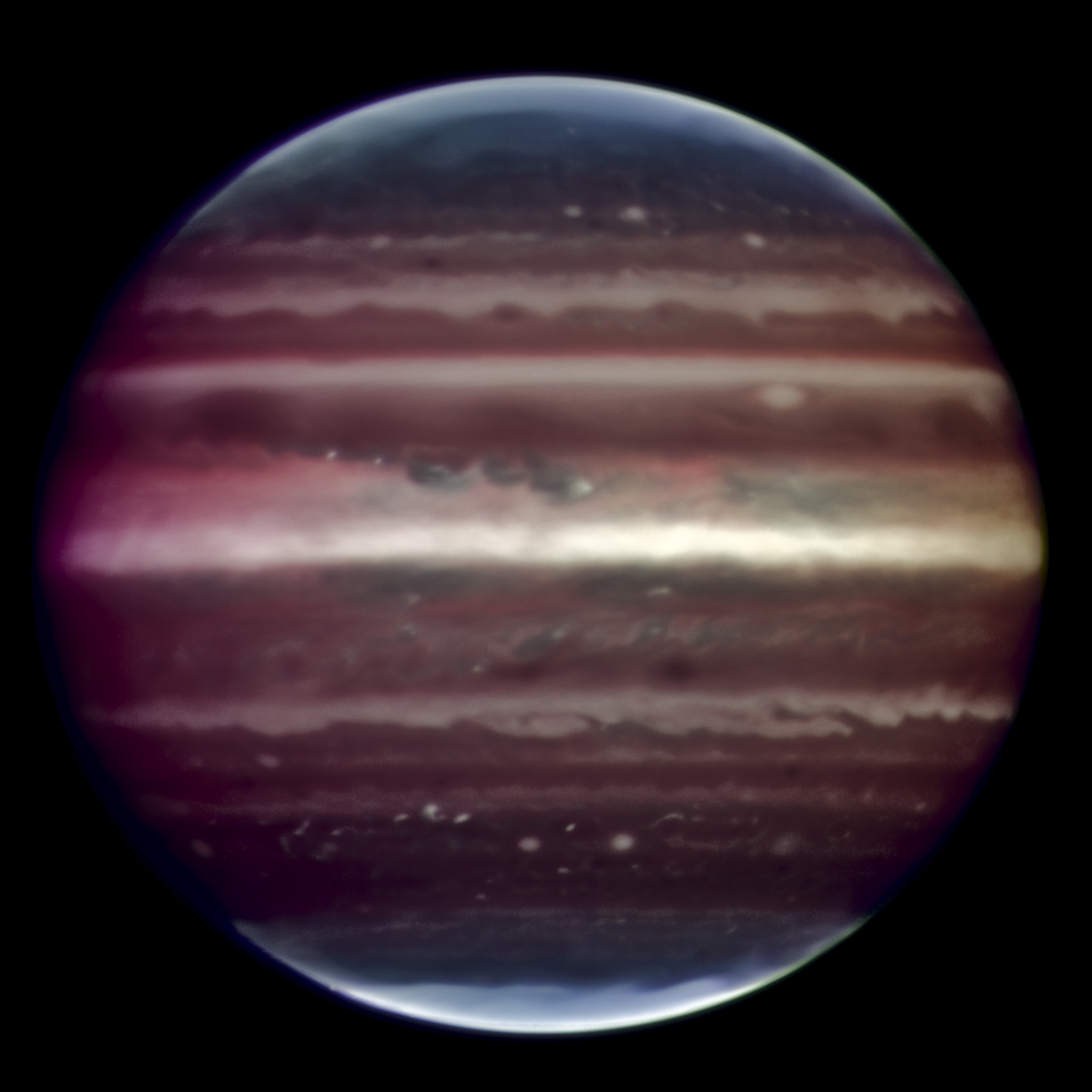
This dramatic image of Jupiter is touted as the sharpest picture of the entire gas giant ever taken from the ground. The picture was made using a prototype instrument known as MAD (Multi-conjugate Adaptive optics Demonstrator) mounted on one of the European Southern Observatory's 8-meter diameter Very Large Telescope units in Chile. Working at infrared wavelengths the MAD instrument removes atmospheric blurring, the bane of earthbound telescopes, by using multiple guide stars and deformable mirrors to sense and correct for the distortions produced by turbulence in Earth's atmosphere. Hydrogen and methane deep in Jupiter's own thick atmosphere absorb light at infrared wavelengths. So, this sharper view shows the infrared sunlight reflected from the giant planet's high level haze prominent in the equatorial regions and near the poles. It reveals features as small as 300 kilometers across. The promising technique can also be applied to imaging other extended objects like star clusters and nebulae. Take a survey on Aesthetics and Astronomy.
Esta imagen dramática de Júpiter es considerada la fotografía más nítida de todo el gigante gaseoso jamás obtenida desde tierra. La imagen fue capturada utilizando un instrumento prototipo conocido como MAD (Demostrador de Óptica Adaptativa Multi-conjugada) montado en una de las unidades de telescopio Very Large Telescope de 8 metros de diámetro del Observatorio Europeo Austral en Chile. Operando en longitudes de onda infrarroja, el instrumento MAD elimina el desenfoque atmosférico, la maldición de los telescopios terrestres, utilizando múltiples estrellas guía y espejos deformables para detectar y corregir las distorsiones producidas por la turbulencia en la atmósfera terrestre. El hidrógeno y el metano en lo profundo de la espesa atmósfera propia de Júpiter absorben la luz en longitudes de onda infrarroja. Por lo tanto, esta vista más nítida muestra la luz solar infrarroja reflejada desde la bruma de nivel superior del gigante planeta, prominente en las regiones ecuatoriales y cerca de los polos. Revela características tan pequeñas como 300 kilómetros de ancho. Esta técnica prometedora también puede aplicarse a la obtención de imágenes de otros objetos extendidos como cúmulos estelares y nebulosas.