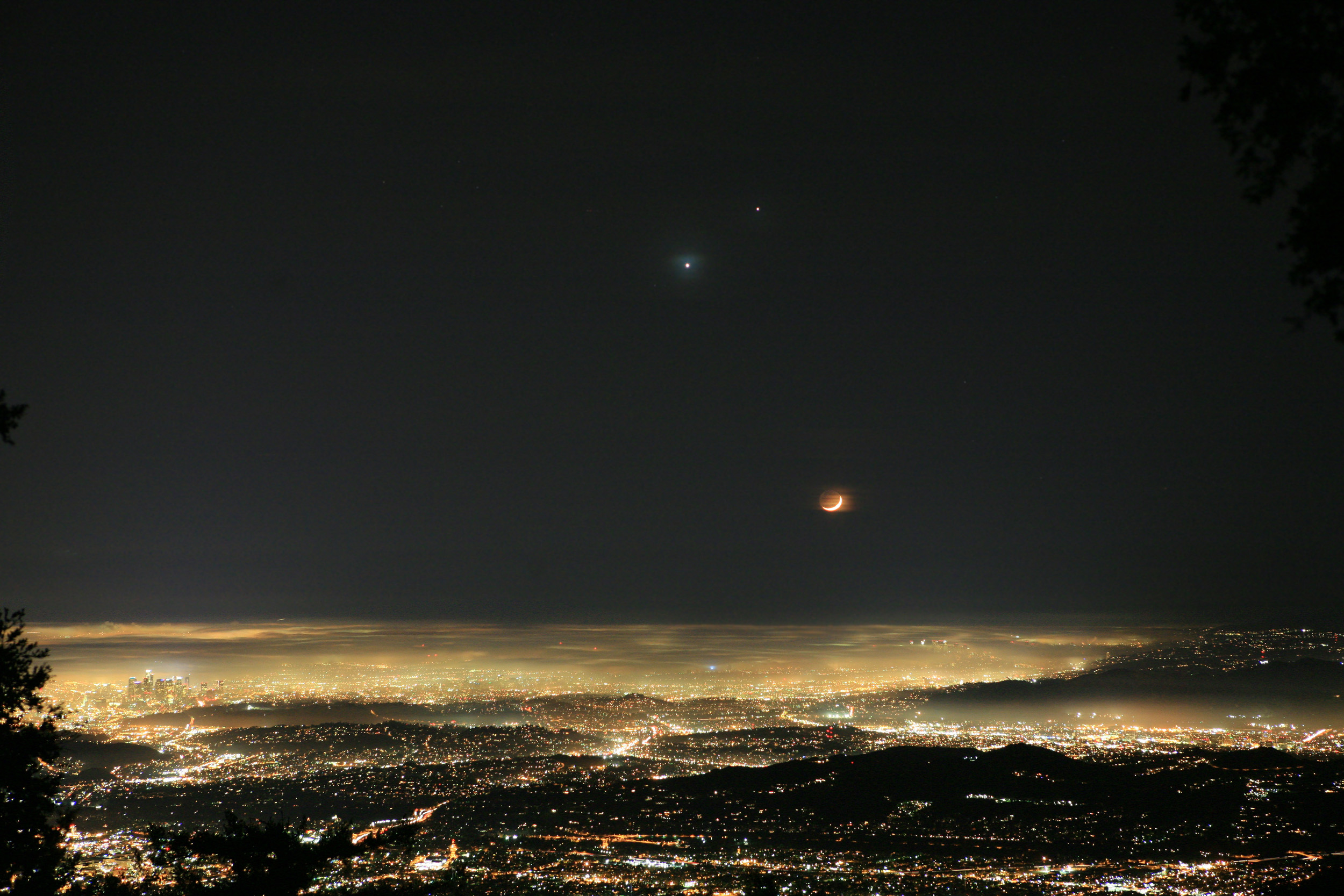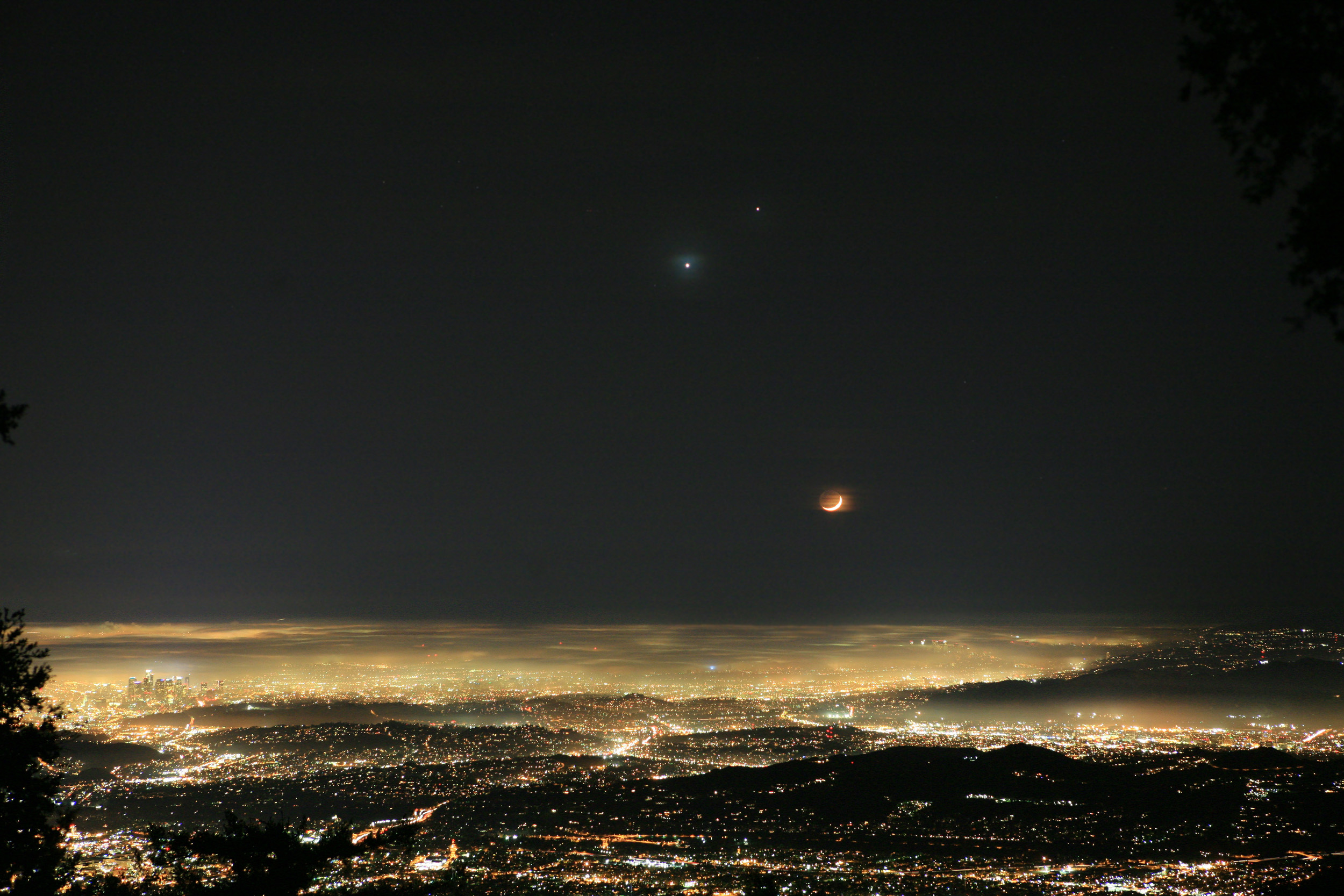
Sunday, the sky seemed to smile over much of planet Earth. Visible the world over was an unusual superposition of our Moon and the planets Venus and Jupiter. Pictures taken at the right time show a crescent Moon that appears to be a smile when paired with the planetary conjunction of seemingly nearby Jupiter and Venus. Pictured above is the scene as it appeared from Mt. Wilson Observatory overlooking Los Angeles, California, USA after sunset on 2008 November 30. Highest in the sky and farthest in the distance is the planet Jupiter. Significantly closer and visible to Jupiter's lower left is Venus, appearing through Earth's atmospheric clouds as unusually blue. On the far right, above the horizon, is our Moon, in a waxing crescent phase. Thin clouds illuminated by the Moon appear unusually orange. Sprawling across the bottom of the image are the hills of Los Angeles, many covered by a thin haze, while LA skyscrapers are visible on the far left. The conjunction of Venus and Jupiter will continue to be visible toward the west after sunset during much of this month. Hours after the taking of this image, however, the Moon approached the distant duo, briefly eclipsed Venus, and then moved on.
El domingo, el cielo parecía sonreír sobre gran parte del planeta Tierra. Visible en todo el mundo era una superposición inusual de nuestra Luna y los planetas Venus y Júpiter. Las fotografías tomadas en el momento adecuado muestran una Luna creciente que parece ser una sonrisa cuando se empareja con la conjunción planetaria de Júpiter y Venus aparentemente cercanos. La imagen superior muestra la escena tal como aparecía desde el Observatorio de Mt. Wilson dominando Los Ángeles, California, EE.UU. después de la puesta de sol el 30 de noviembre de 2008. El más alto en el cielo y el más lejano en la distancia es el planeta Júpiter. Significativamente más cerca y visible a la izquierda inferior de Júpiter se encuentra Venus, visible a través de las nubes de la atmósfera terrestre en un azul inusual. En el extremo derecho, sobre el horizonte, se encuentra nuestra Luna, en fase de cuarto creciente. Las nubes delgadas iluminadas por la Luna aparecen inusualmente anaranjadas. Extendiéndose por la parte inferior de la imagen se encuentran las colinas de Los Ángeles, muchas cubiertas por una neblina delgada, mientras que los rascacielos de Los Ángeles son visibles en el extremo izquierdo. La conjunción de Venus y Júpiter continuará siendo visible hacia el oeste después de la puesta de sol durante gran parte de este mes. Horas después de la toma de esta imagen, sin embargo, la Luna se aproximó al dúo distante, eclipsó brevemente a Venus y luego continuó su movimiento.