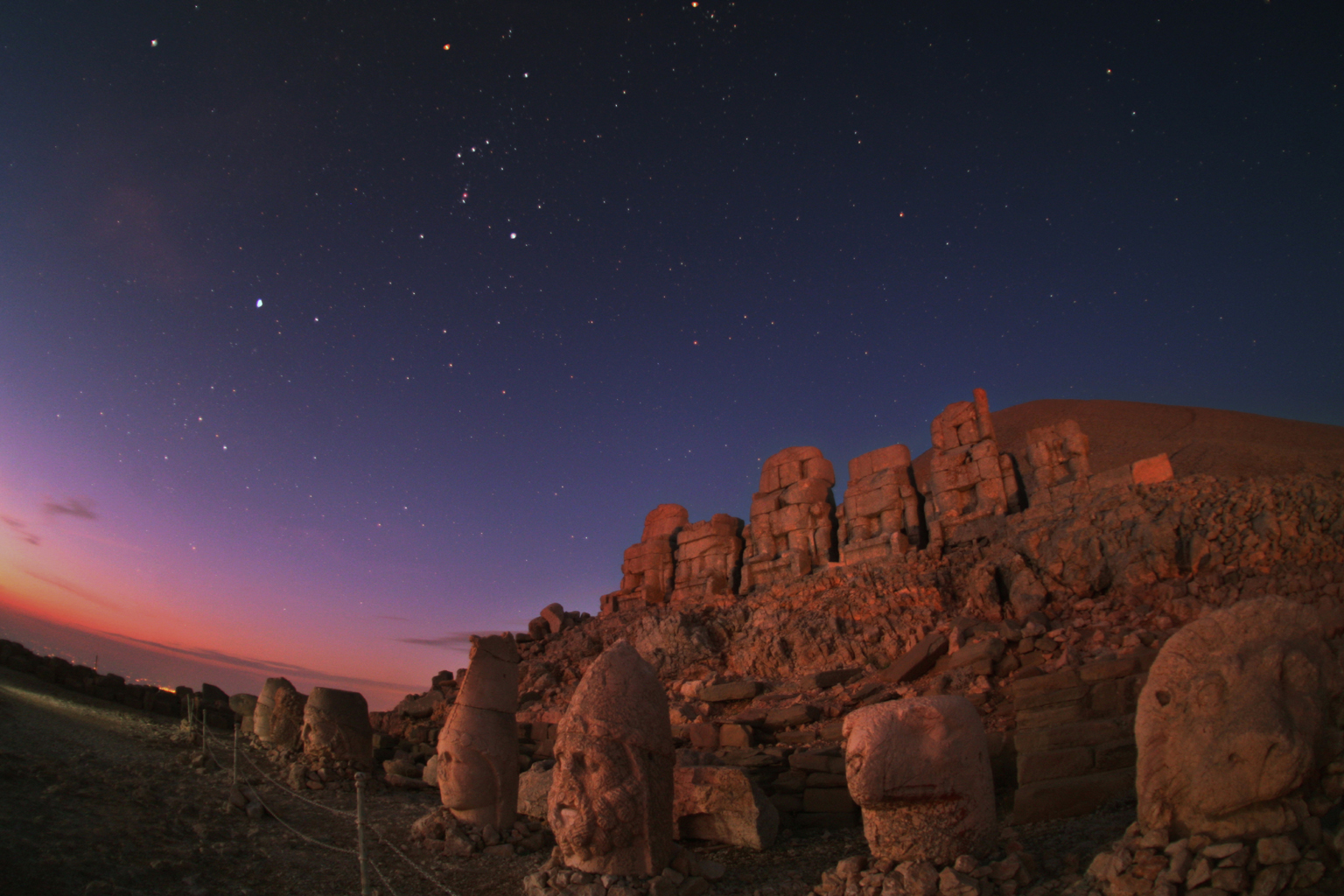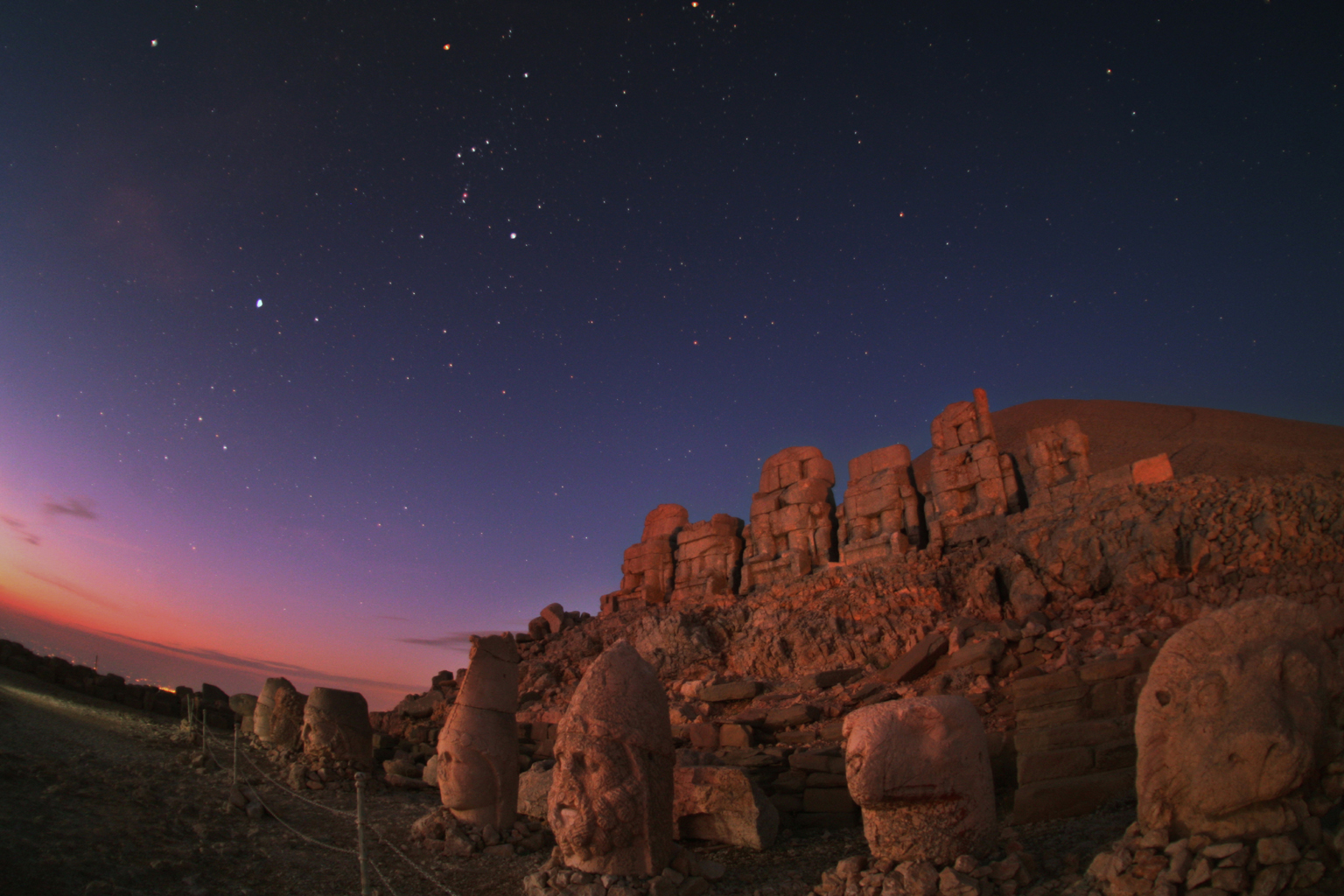
What's that in front of Orion? Forty kilometers north of Kahta, Turkey, lies Mount Nemrut, a mountain adorned with the fragments of vast statues built over 2000 years ago. The stone sculptures once stood nearly 10 meters high and depicted lions, eagles, various ancient gods, and King Antiochus I Theos, who ruled Commagene from 86 BC to 38 BC. Ruins of the bodies of several sitting figures are visible on the hill above, illuminated by moonlight. Zeus' head can be found near the above image's center, while the king's head is seen next closest to the horizon. Visible far in the distance in this image, taken three months ago, is the familiar constellation of Orion. The red patch just below Orion's belt is the Orion Nebula, while the bright star to the left of Orion is Sirius. On the far left, a red and brightening horizon announces that the Sun is beginning to rise. Note : APOD Editor to Speak in New York on Jan. 2
¿Qué hay frente a Orión? A cuarenta kilómetros al norte de Kahta, Turquía, se encuentra el Monte Nemrut, una montaña adornada con los fragmentos de vastas estatuas construidas hace más de 2000 años. Las esculturas de piedra una vez alcanzaron casi 10 metros de altura y representaban leones, águilas, varios dioses antiguos y al Rey Antíoco I Theos, quien gobernó Commagene desde el 86 a.C. hasta el 38 a.C. Las ruinas de los cuerpos de varias figuras sentadas son visibles en la colina anterior, iluminadas por la luz de la luna. La cabeza de Zeus se puede encontrar cerca del centro de la imagen anterior, mientras que la cabeza del rey se ve más cercana al horizonte. Visible a lo lejos en esta imagen, tomada hace tres meses, se encuentra la familiar constelación de Orión. La mancha roja justo debajo del cinturón de Orión es la Nebulosa de Orión, mientras que la estrella brillante a la izquierda de Orión es Sirio. En el extremo izquierdo, un horizonte rojo y cada vez más brillante anuncia que el Sol está comenzando a salir.