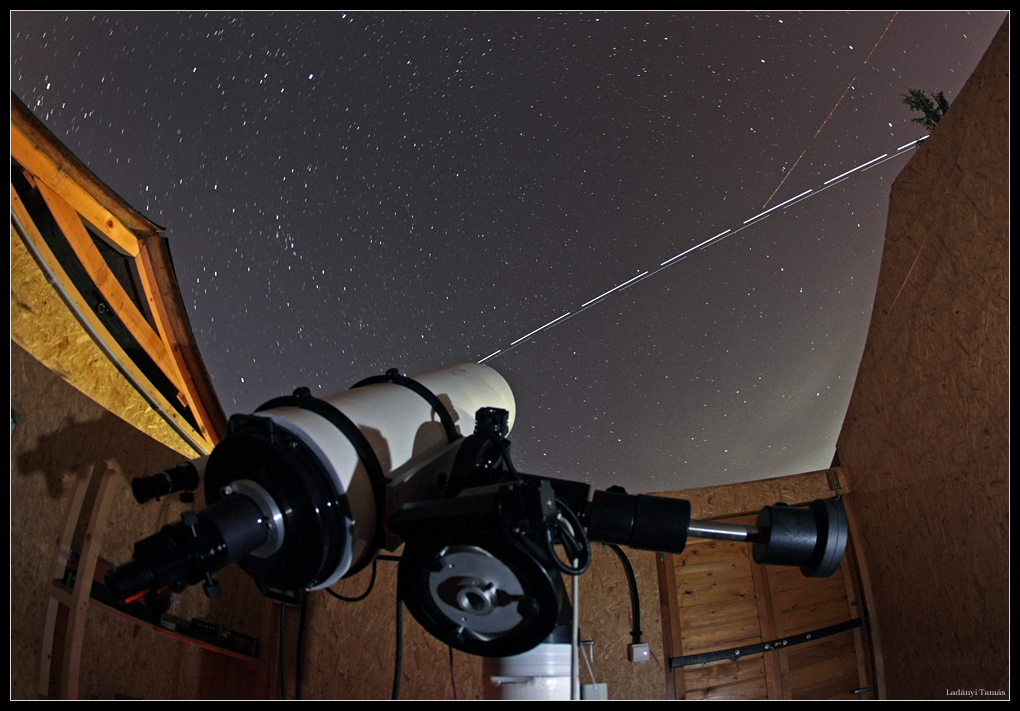
Today, 100 Hours of Astronomy begins, a cornerstone project of the International Year of Astronomy 2009 celebrating the 400th anniversary of Galileo's original telescopic exploration of the sky. Running from April 2 through April 5, many different public programs are planned worldwide as part of the project, starting with today's opening event at the Franklin Institute in Philadelphia. Featuring one of Galileo's two remaining telescopes, the event will be webcast live. Of course, the sky examined by Galileo can still be appreciated today, with much more capable instruments that are widely available. But this skyward view from a private observatory in Veszprem, Hungary also includes objects Galileo did not see when he gazed into the night. Recorded on March 26, the image captures the paired trails of the International Space Station (the brighter trail) and the shuttle orbiter Discovery in low Earth orbit, as well as the streak of a passing airplane.
Hoy comienza 100 Horas de Astronomía, un proyecto fundamental del Año Internacional de la Astronomía 2009 que celebra el 400 aniversario del primer estudio telescópico del cielo realizado por Galileo. Durante del 2 al 5 de abril, se han programado muchas actividades públicas en todo el mundo como parte del proyecto, comenzando con el evento inaugural de hoy en el Instituto Franklin en Filadelfia. El evento contará con una de las dos telescopios restantes de Galileo y será transmitido en directo por internet. Por supuesto, el cielo observado por Galileo aún puede apreciarse hoy en día, con instrumentos mucho más avanzados y ampliamente disponibles. Pero esta vista del cielo desde un observatorio privado en Veszprém, Hungría, también incluye objetos que Galileo no vio cuando miraba la noche. Registrada el 26 de marzo, la imagen captura las trayectorias dobles de la Estación Espacial Internacional (la más brillante) y del transbordador Discovery en órbita baja alrededor de la Tierra, así como la estela de un avión en vuelo.