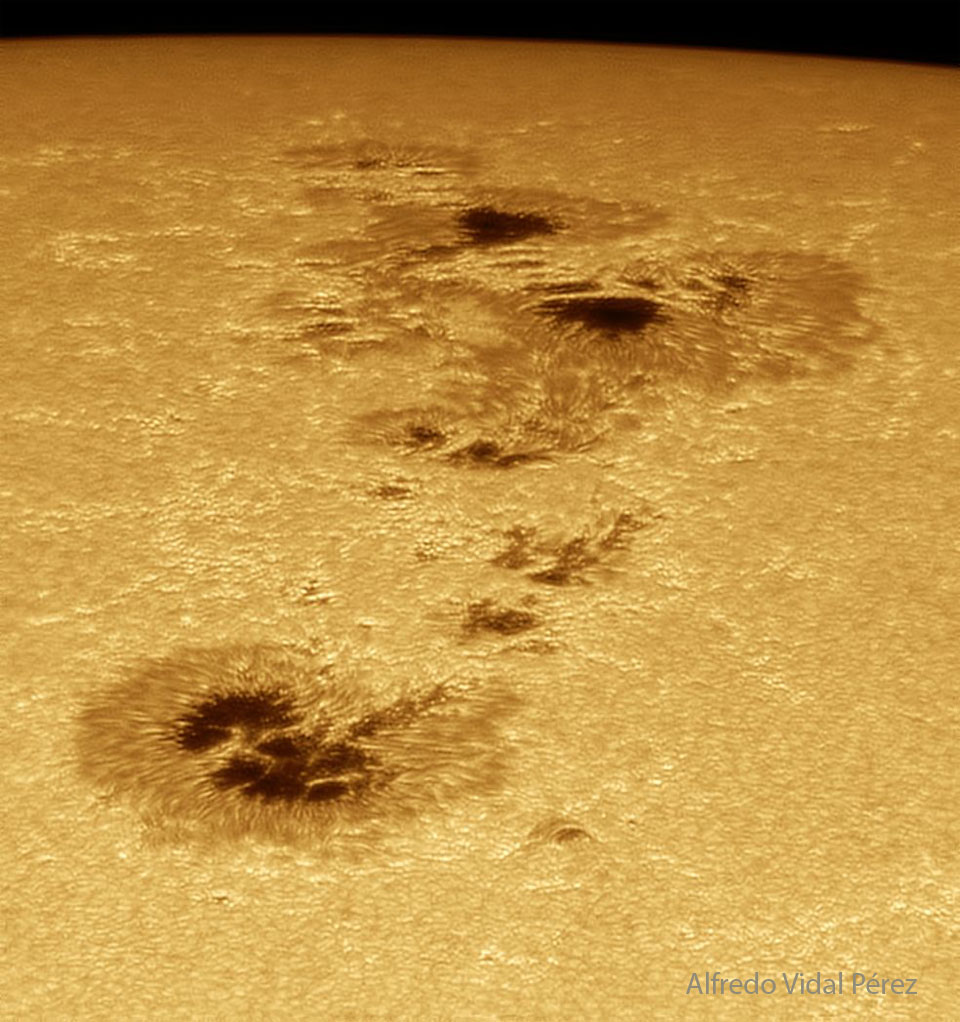
The Sun's surface keeps changing. Click the central arrow and watch how the Sun's surface oozes during a single hour. The Sun's photosphere has thousands of bumps called granules and usually a few dark depressions called sunspots. The above time-lapse movie centered on Sunspot 875 was taken in 2006 by the Vacuum Tower Telescope in the Canary Islands of Spain using adaptive optics to resolve details below 500 kilometers across. Each of the numerous granules is the size of an Earth continent, but much shorter lived. A granule slowly changes its shape over an hour, and can even completely disappear. Hot hydrogen gas rises in the bright center of a granule, and falls back into the Sun along a dark granule edge. The above movie and similar movies allows students and solar scientists to study how granules and sunspots evolve as well as how magnetic sunspot regions produce powerful solar flares. Note: Follow the Sun today as part of 100 Hours of Astronomy
La superficie del Sol está en constante cambio. Haz clic en la flecha central y observa cómo la superficie solar gotea durante una hora. La fotosfera solar tiene miles de protuberancias llamadas granulos y normalmente unos pocos depresiones oscuras llamadas manchas solares. La película de tiempo acelerado centrada en la mancha solar 875 fue tomada en 2006 por el Telescopio de Torre al Vacío en las Islas Canarias de España, utilizando óptica adaptativa para resolver detalles menores a 500 kilómetros. Cada uno de los numerosos granulos tiene el tamaño de un continente terrestre, pero es de vida mucho más breve. Un granulo cambia lentamente su forma durante una hora, y puede incluso desaparecer por completo. El gas hidrógeno caliente asciende en el centro brillante de un granulo, y vuelve a caer al Sol a lo largo de un borde oscuro del granulo. La película anterior y películas similares permiten a los estudiantes y científicos solares estudiar cómo evolucionan los granulos y las manchas solares, así como cómo las regiones magnéticas de manchas solares producen poderosas erupciones solares.