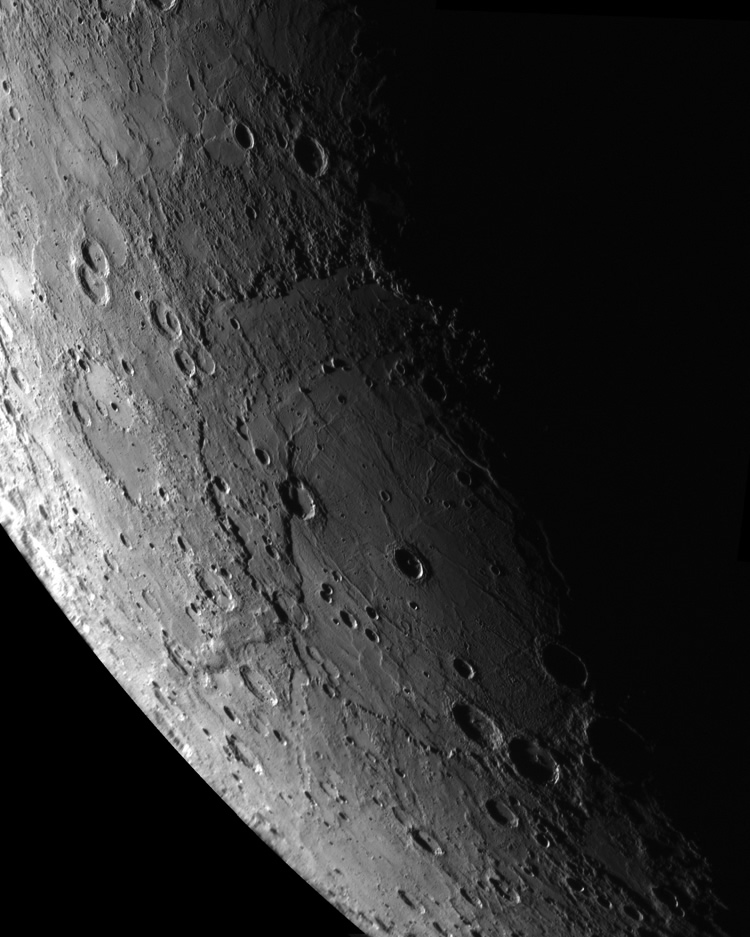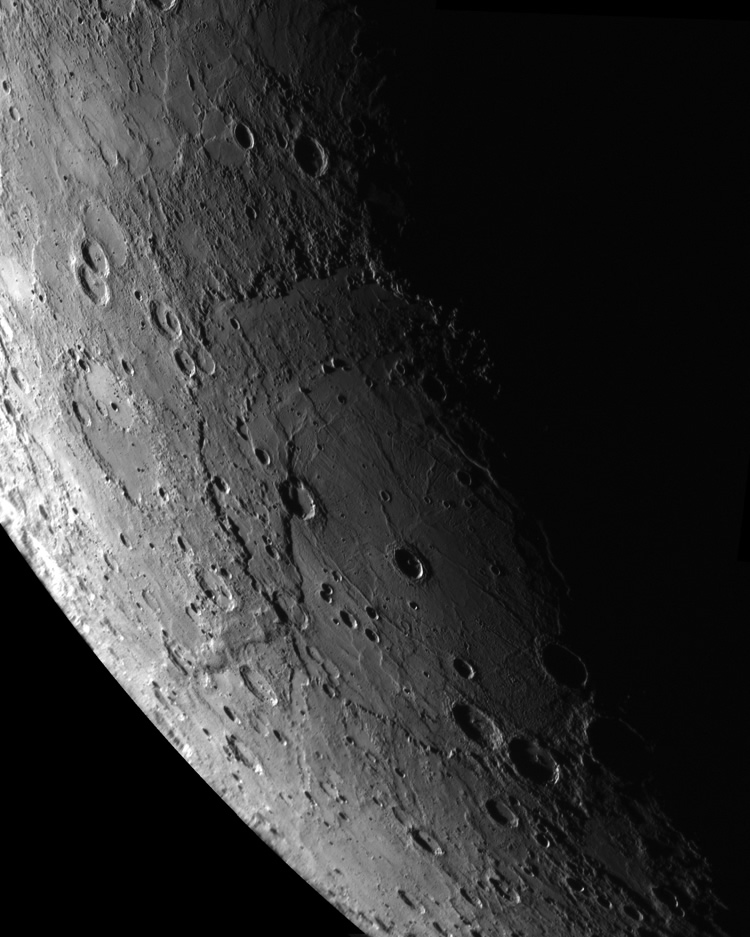
Why do portions of this huge crater on Mercury have so much iron? The unusual Rembrandt impact basin was discovered recently in images taken during the robotic MESSENGER spacecraft's 2008 October flyby of the Solar System's innermost planet. The unusual Rembrandt spans over 700 kilometers and at 4 billion years old is possibly the youngest large impact basin on the planet. Multicolored images of the crater floor, however, indicate reflections from areas containing unusually high amounts of iron and titanium. These elements indicate that some exposed materials have not been covered by more recent lava floes, and so might originate from an epoch of Mercury's formation. Data from Rembrandt and across Mercury are now being interpreted as indicating a relatively active and volcanic past for Mercury that includes surface tectonics. Close inspection of the above image will reveal rings of Mercury's Rembrandt impact basin circling around the image center. Mercury's limb is visible on the upper left, high cliffs and small craters are visible inside Rembrandt, and the terminator between night and day runs diagonally through the image. MESSENGER is on track to fly past Mercury again this September and enter orbit around Mercury in 2011.
¿Por qué tienen algunas porciones de este gran cráter en Mercurio tanta cantidad de hierro? La inusual basa de impacto Rembrandt fue descubierta recientemente en imágenes tomadas durante el sobrevuelo robótico de la nave espacial MESSENGER en octubre de 2008 del planeta más interno del Sistema Solar. Rembrandt, de características inusuales, tiene más de 700 kilómetros de diámetro y, con 4 mil millones de años, podría ser la basa de impacto más joven del planeta. Sin embargo, imágenes multicolores del fondo del cráter indican reflejos provenientes de áreas con cantidades inusualmente altas de hierro y titanio. Estos elementos sugieren que algunos materiales expuestos no han sido cubiertos por flujos de lava más recientes, y por lo tanto podrían provenir de una época de la formación de Mercurio. Los datos obtenidos de Rembrandt y de otras regiones de Mercurio se están interpretando ahora como indicadores de un pasado relativamente activo y volcánico para Mercurio, que incluye tectónica superficial. Una inspección detallada de la imagen anterior revelará anillos que rodean el centro de la imagen, correspondientes a la basa de impacto Rembrandt de Mercurio. El limbo de Mercurio es visible en la esquina superior izquierda, altas mesetas y pequeños cráteres son visibles dentro de Rembrandt, y el terminador entre la noche y el día atraviesa diagonalmente la imagen. MESSENGER está en camino de realizar otro sobrevuelo de Mercurio en septiembre de este año y de entrar en órbita alrededor del planeta en 2011.