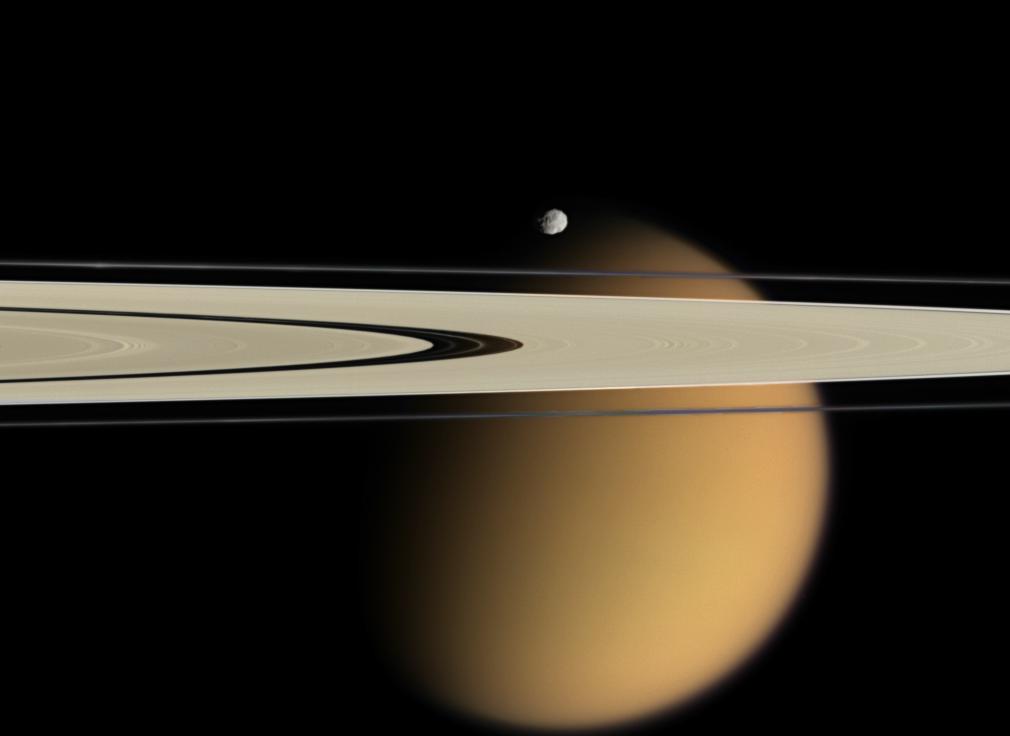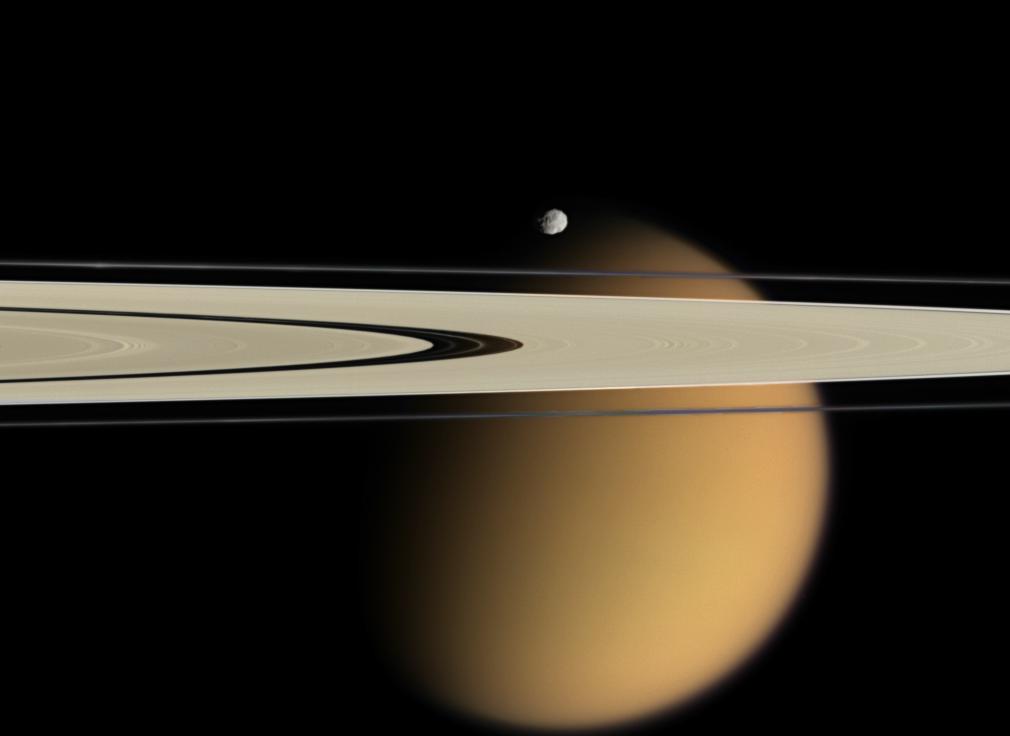
When orbiting Saturn, be sure to watch for breathtaking superpositions of moons and rings. One such picturesque vista was visible recently to the robot Cassini spacecraft now orbiting Saturn. In 2006 April, Cassini captured Saturn's A and F rings stretching in front of cloud-shrouded Titan. Near the rings and appearing just above Titan was Epimetheus, a moon which orbits just outside the F ring. The dark space in the A ring is called the Encke Gap, although several thin knotted ringlets and even the small moon Pan orbit there. Cassini and curious Earthlings await the coming Saturnian equinox this summer when the ring plane will point directly at the Sun. Mysterious spokes and telling shadows are expected to become visible that might give away more clues about the nature of Saturn's ring particles.
Cuando estás orbitando Saturno, asegúrate de observar las asombrosas superposiciones de lunas y anillos. Una de tales vistas pintorescas fue visible recientemente para la nave espacial robotizada Cassini, que ahora orbita Saturno. En abril de 2006, Cassini capturó los anillos A y F de Saturno extendiéndose frente a Titán, cuya superficie está cubierta por nubes. Cerca de los anillos y apareciendo justo encima de Titán estaba Epimeteo, una luna que orbita justo fuera del anillo F. El espacio oscuro en el anillo A se llama el hueco de Encke, aunque varios anillos delgados y enmarañados, e incluso la pequeña luna Pan, orbitan allí. Cassini y los curiosos terrícolas esperan la llegada del equinoccio satúrnico este verano, cuando el plano de los anillos apuntará directamente al Sol. Se espera que aparezcan misteriosas marcas y sombras reveladoras que podrían proporcionar más pistas sobre la naturaleza de las partículas de los anillos de Saturno.