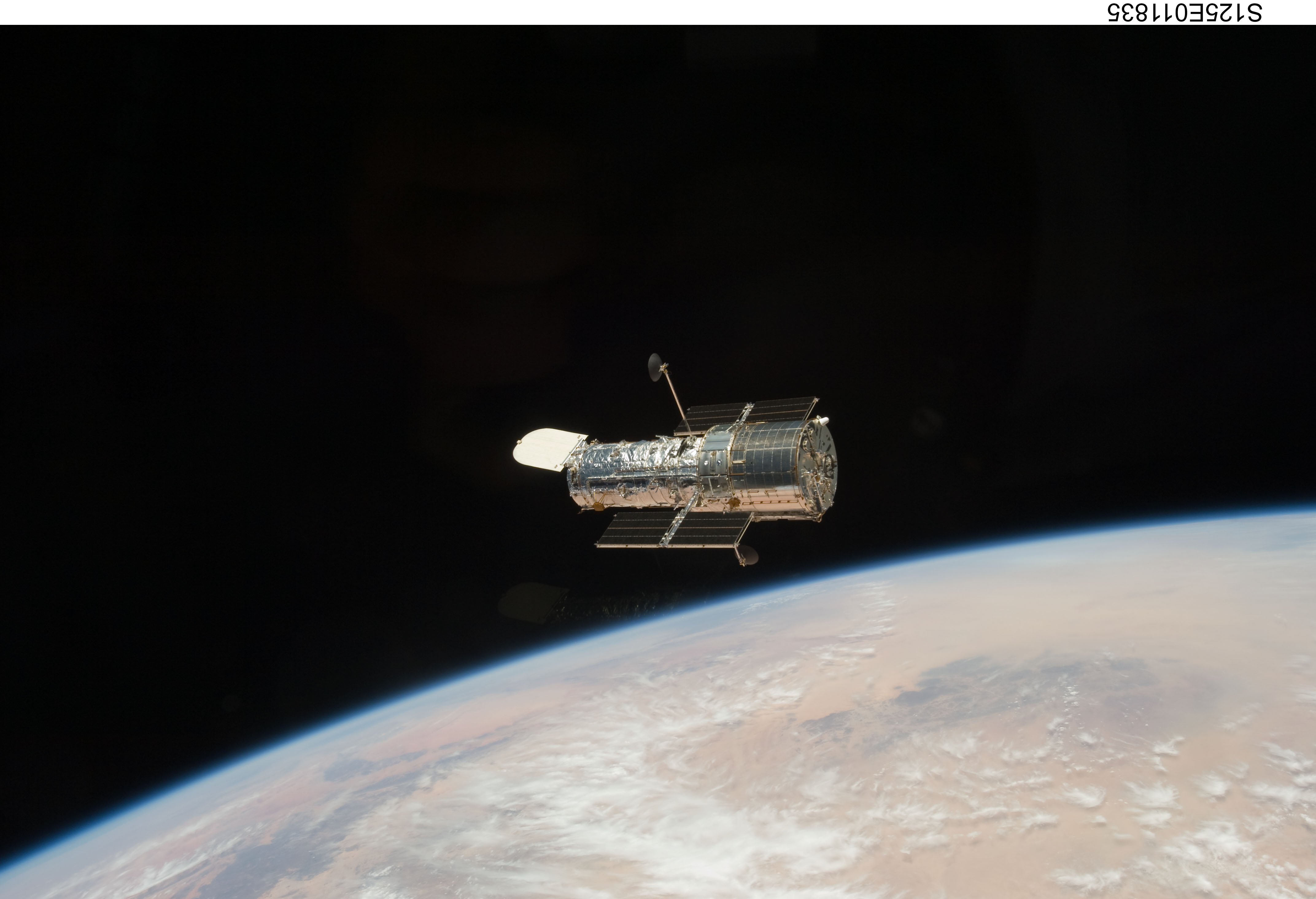
Why put observatories in space? Most telescopes are on the ground. On the ground, you can deploy a heavier telescope and fix it more easily. The trouble is that Earth-bound telescopes must look through the Earth's atmosphere. First, the Earth's atmosphere blocks out a broad range of the electromagnetic spectrum, allowing a narrow band of visible light to reach the surface. Telescopes which explore the Universe using light beyond the visible spectrum, such as those onboard the Chandra X-ray Observatory, and the Fermi Gamma Ray Space Telescope need to be carried above the absorbing atmosphere. Second, the Earth's atmosphere blurs the light it lets through. The blurring is caused by varying density and continual motion of air. By orbiting above the Earth's atmosphere, the Hubble Space Telescope, pictured above last week after being captured, refurbished, and released, can get clearer images. In fact, even though HST has a mirror 15 times smaller than large Earth-bound telescopes, it can still resolve finer details. A future large telescope for space, the James Webb Space Telescope is currently planned for launch in 2014.
¿Por qué colocar observatorios en el espacio? La mayoría de los telescopios están en tierra. En tierra, se puede desplegar un telescopio más pesado y repararlo con mayor facilidad. El problema es que los telescopios terrestres deben observar a través de la atmósfera terrestre. En primer lugar, la atmósfera terrestre bloquea un amplio rango del espectro electromagnético, permitiendo que solo una banda estrecha de luz visible llegue a la superficie. Los telescopios que exploran el universo utilizando luz fuera del rango visible, como los que se encuentran a bordo del Observatorio de Rayos X Chandra y del Telescopio Espacial de Rayos Gamma Fermi, deben colocarse por encima de la atmósfera absorbente. En segundo lugar, la atmósfera terrestre desenfoca la luz que permite pasar. Este desenfoque es causado por la variación de la densidad del aire y su movimiento constante. Al orbitar por encima de la atmósfera terrestre, el Telescopio Espacial Hubble, mostrado en la imagen de la semana pasada después de haber sido capturado, reparado y liberado, puede obtener imágenes más nítidas. De hecho, aunque el HST tiene un espejo 15 veces más pequeño que los telescopios terrestres grandes, aún puede resolver detalles más finos. Un futuro telescopio grande para el espacio, el Telescopio Espacial James Webb, está actualmente programado para su lanzamiento en 2014.