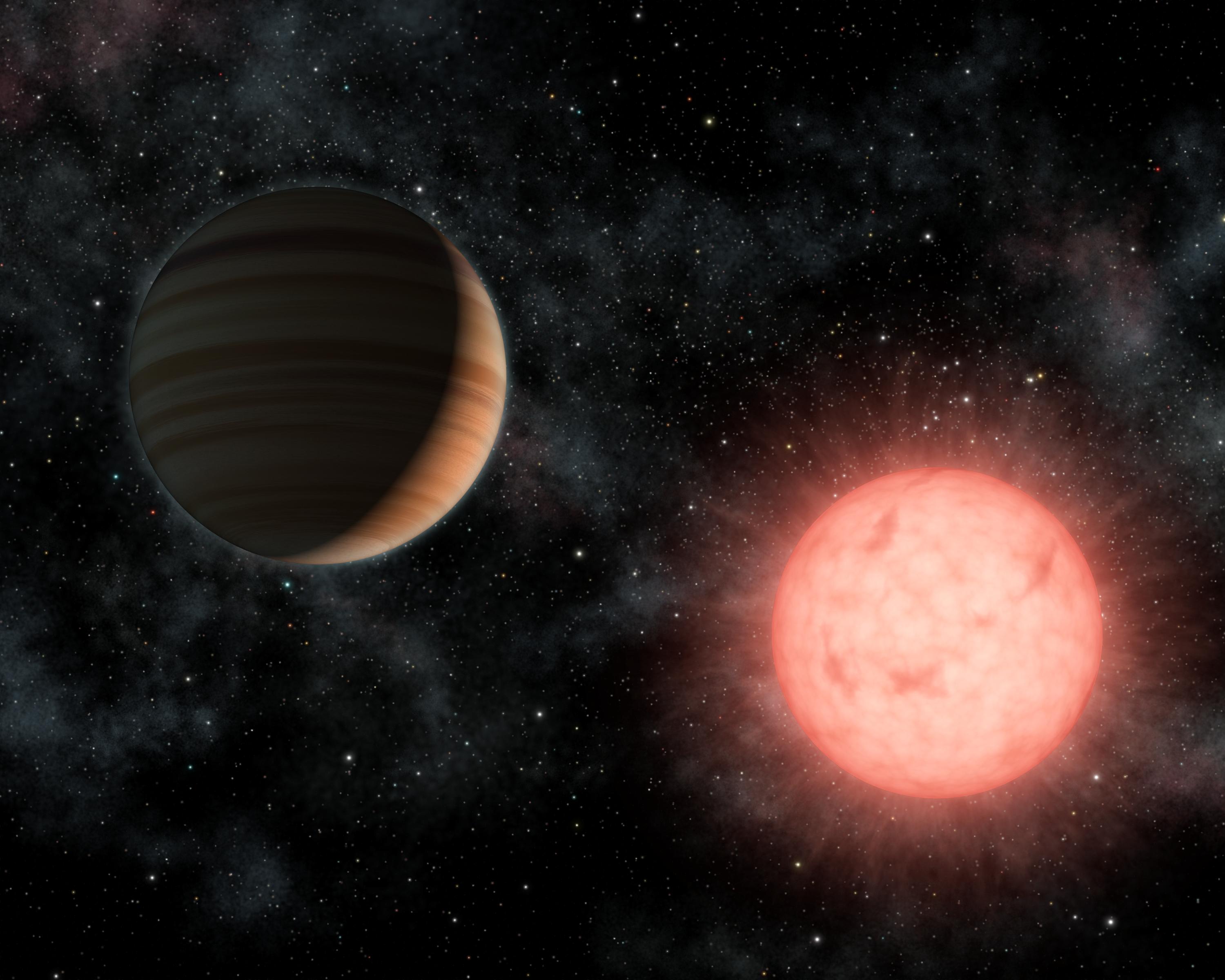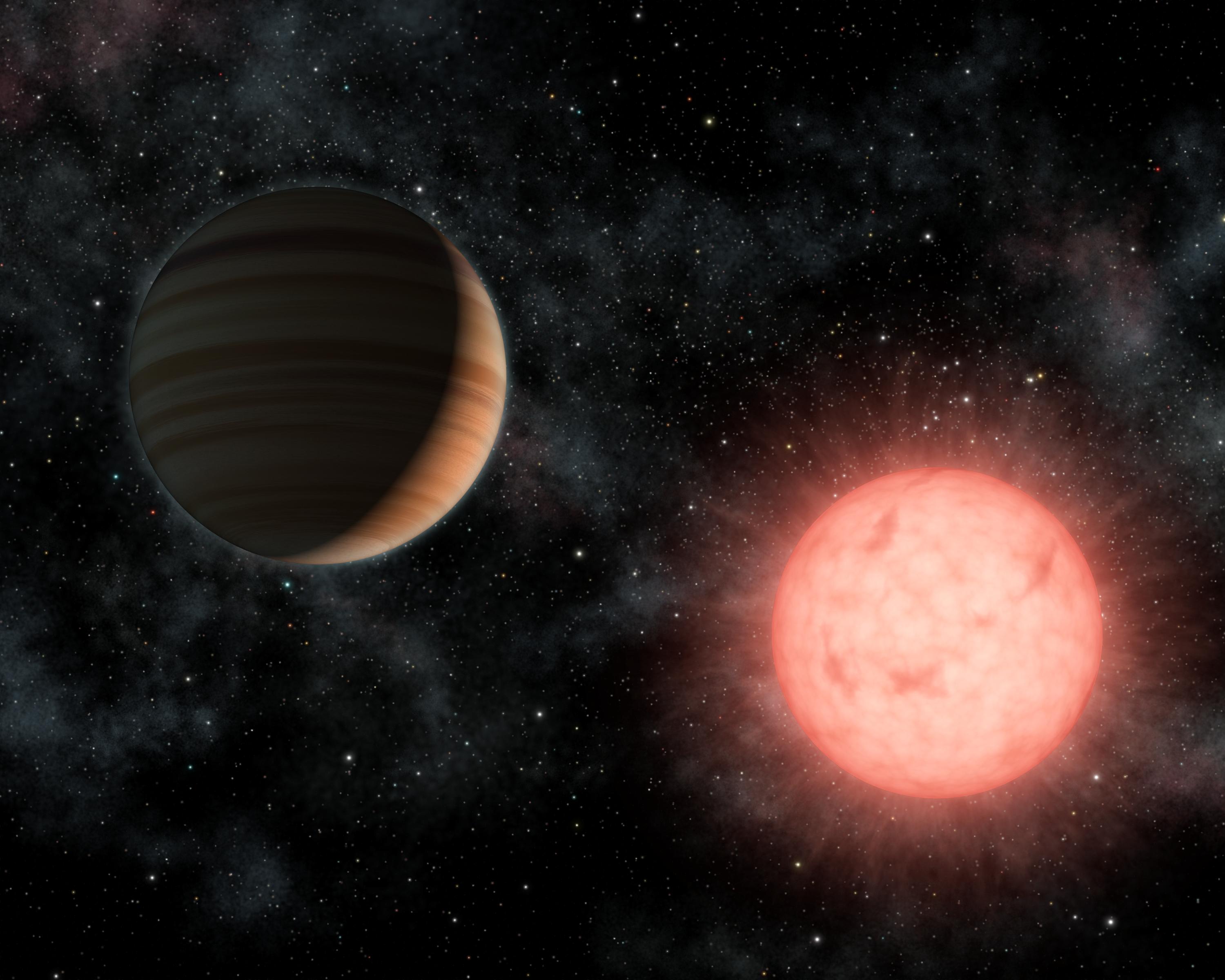
Can a planet be as large as the star that it orbits? Recent observations have discovered that nearby Van Biesbroeck's star might have just such a large planet. Although VB 10 lies only about 20 light years away, it is a small red dwarf star so dim, at 17th magnitude, that a telescope is needed to see it. Van Biesbroeck's star was previously known for its rapid proper motion across the sky -- it moves so fast it could cross a full moon in only about 1,000 years. By noting a wiggle in VB 10's sky trajectory, astronomers were able to infer the existence of a planet several times the mass of Jupiter. Although the star VB 10 is perhaps 10 times more massive than the discovered planet VB 10b, the star is likely more highly compressed and so the two might be closely matched in size. Such a system is envisioned above with an artist's illustration. Since faint M-type stars like VB 10 are so common, planetary systems surrounding them, including planets larger than their parent star, might be more common than planetary systems like our own Solar System. Free Lecture: An APOD editor will review great space images this Friday in Kalamazoo, Michigan.
¿Puede un planeta ser tan grande como la estrella que orbita? Observaciones recientes han descubierto que la estrella cercana de Van Biesbroeck podría tener precisamente tal planeta grande. Aunque VB 10 se encuentra a solo unos 20 años luz de distancia, es una estrella enana roja muy pequeña y tenue, de magnitud 17, por lo que se necesita un telescopio para verla. La estrella de Van Biesbroeck se conocía anteriormente por su rápida movimiento propio a través del cielo: se mueve tan rápido que podría cruzar una luna llena en solo unos 1000 años. Al notar un ligero balanceo en la trayectoria de VB 10 en el cielo, los astrónomos pudieron inferir la existencia de un planeta varias veces más masivo que Júpiter. Aunque la estrella VB 10 es quizás 10 veces más masiva que el planeta descubierto VB 10b, la estrella probablemente esté más comprimida, por lo que ambos podrían ser muy similares en tamaño. Un sistema como este se muestra arriba en una ilustración artística. Dado que las estrellas de tipo M tenues como VB 10 son tan comunes, los sistemas planetarios que las rodean, incluyendo planetas más grandes que sus estrellas anfitrionas, podrían ser más comunes que los sistemas planetarios similares al nuestro Sistema Solar.