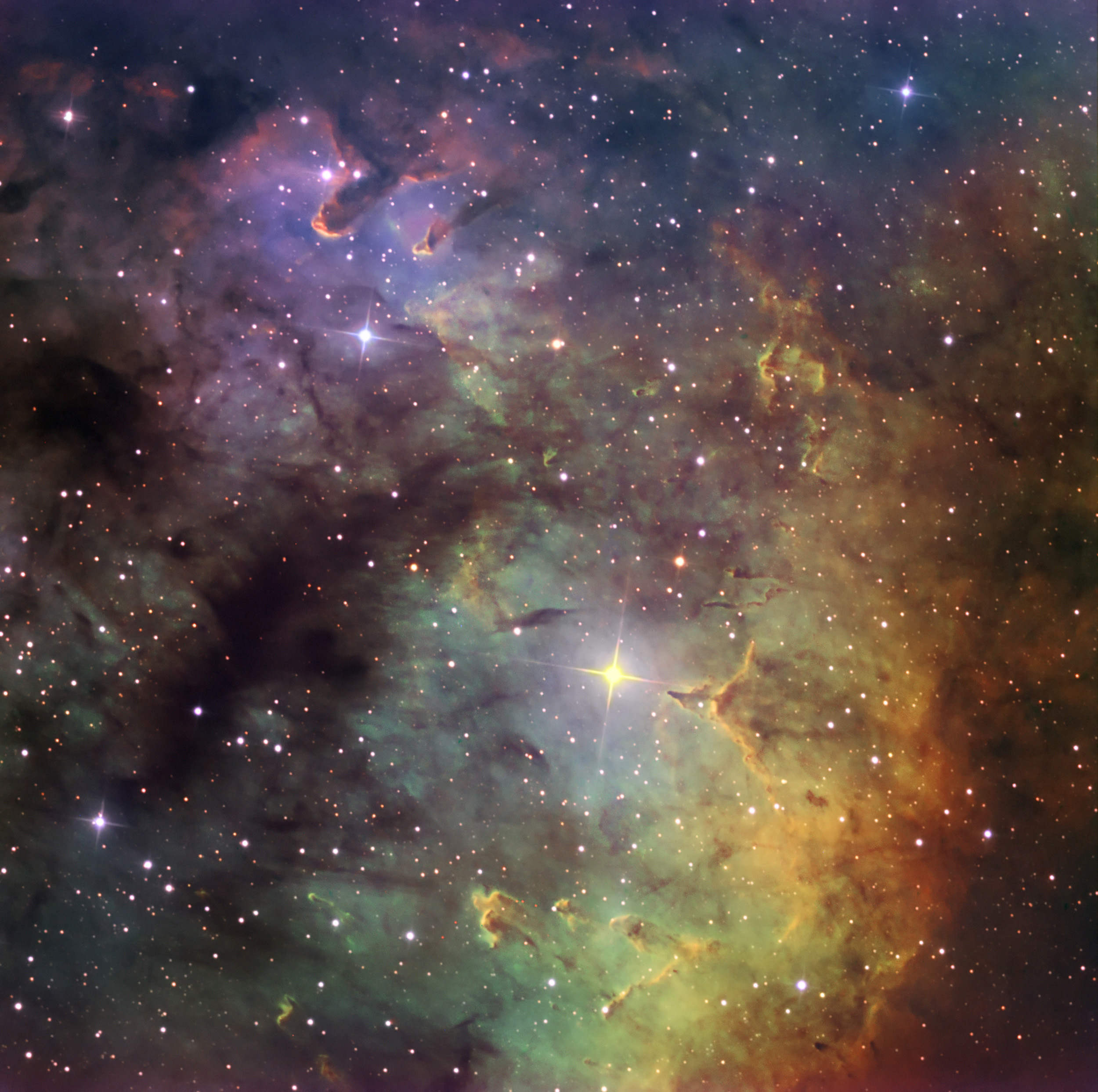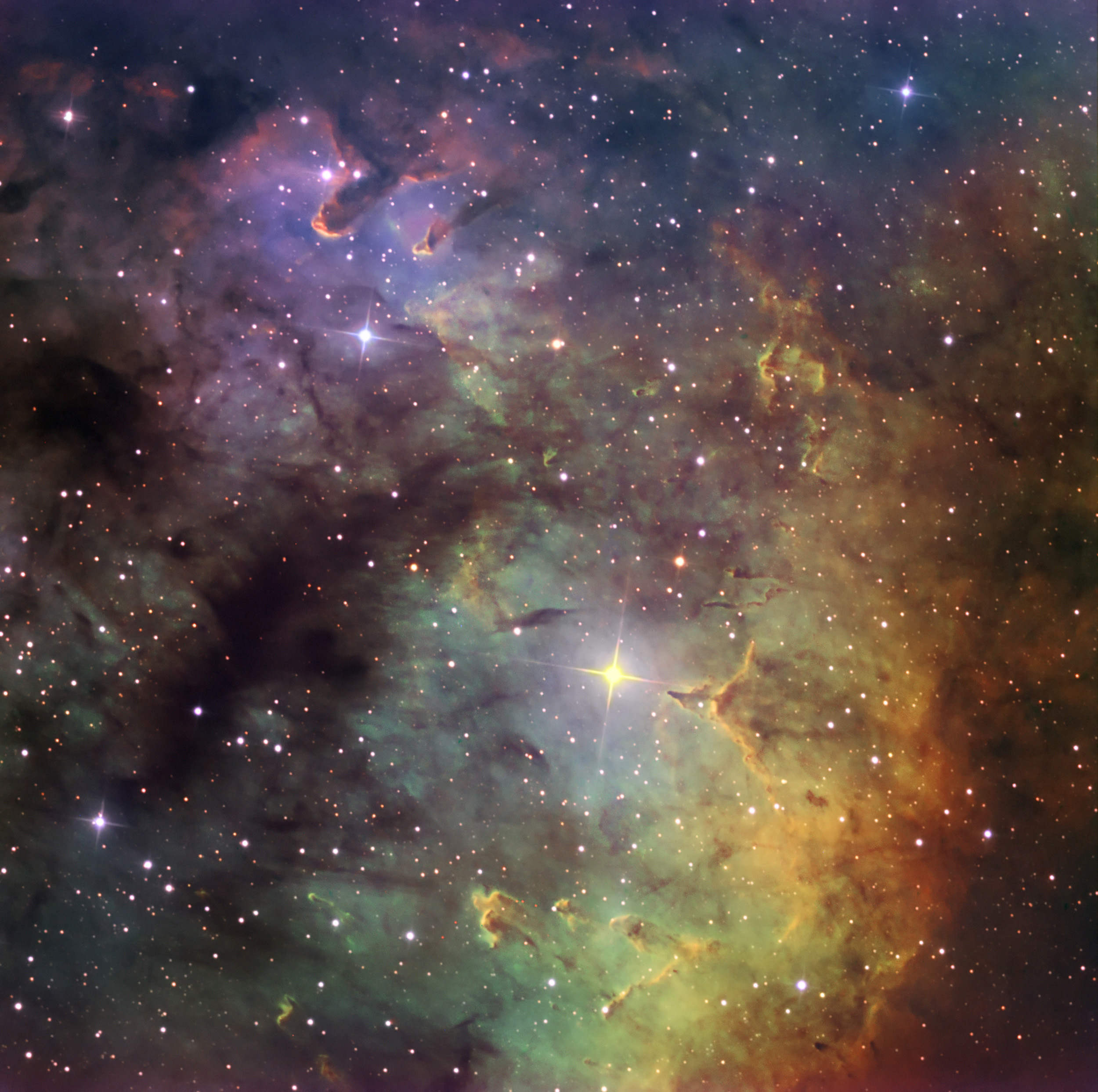
Pillars of gas, dust, and young, hot stars fill the center of NGC 7822. At the edge of a giant molecular cloud toward the northern constellation Cepheus, the glowing star forming region lies about 3,000 light-years away. Within the nebula, bright edges and tantalizing shapes are highlighted in this colorful skyscape. The image includes data from both broadband and narrowband filters, mapping emission from atomic oxygen, hydrogen, and sulfur into blue, green, and red hues. The atomic emission is powered by the energetic radiation from the hot stars, whose powerful winds and radiation also sculpt and erode the denser pillar shapes. Stars could still be forming inside the pillars by gravitational collapse, but as the pillars are eroded away, any forming stars will ultimately be cutoff from their reservoir of star stuff. This field spans around 30 light-years at the estimated distance of NGC 7822.
Pilares de gas, polvo y estrellas jóvenes y calientes llenan el centro de NGC 7822. En el borde de una nube molecular gigante hacia la constelación norteña de Cefeo, la región de formación estelar brillante se encuentra a unos 3000 años luz de distancia. Dentro de la nebulosa, bordes brillantes y formas sugerentes se destacan en esta escena colorida del cielo. La imagen incluye datos obtenidos con filtros de banda ancha y banda estrecha, mapeando la emisión de oxígeno, hidrógeno y azufre atómicos en tonos azul, verde y rojo. La emisión atómica es impulsada por la radiación energética de las estrellas calientes, cuyos vientos y radiación también moldean y erosionan las formas más densas de los pilares. Es posible que aún se estén formando estrellas dentro de los pilares por colapso gravitacional, pero a medida que los pilares se erosionan, cualquier estrella en formación finalmente será cortada de su reservorio de materia estelar. Este campo abarca aproximadamente 30 años luz a la distancia estimada de NGC 7822.