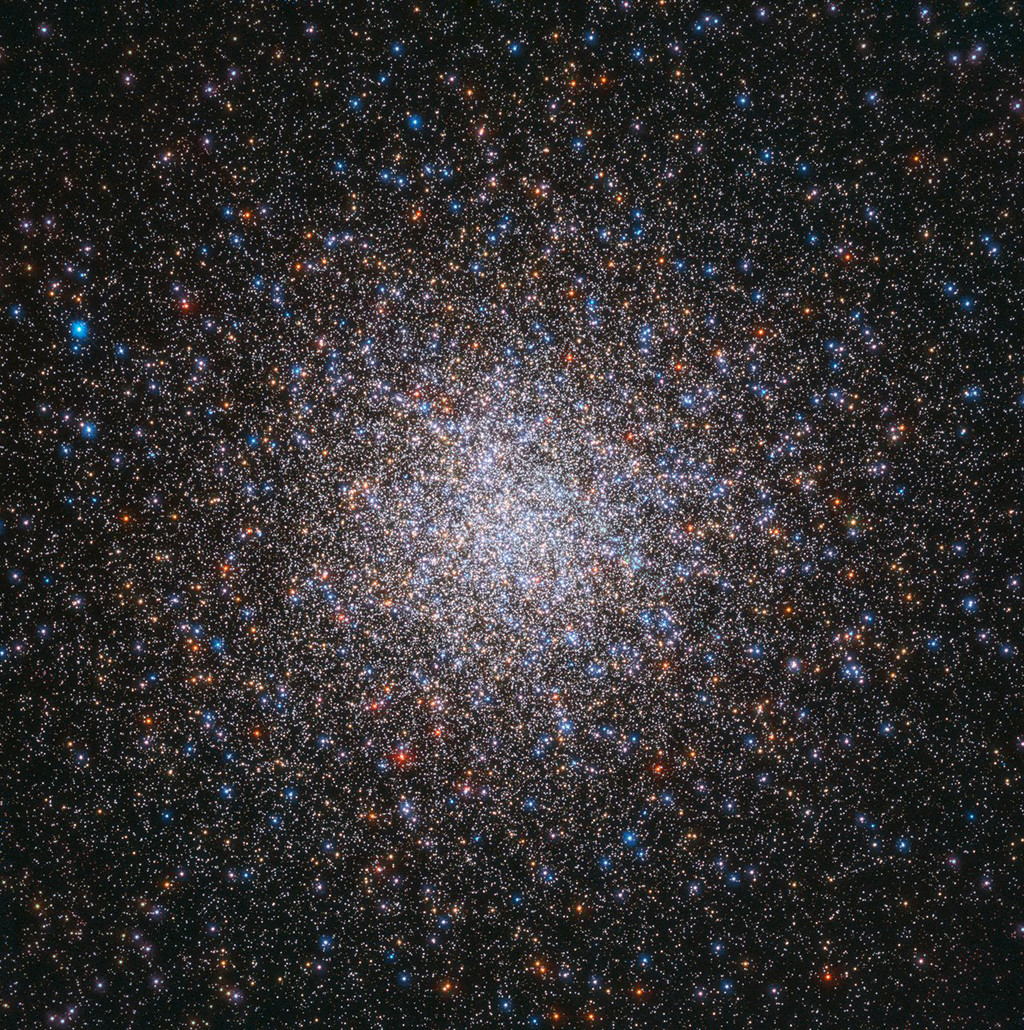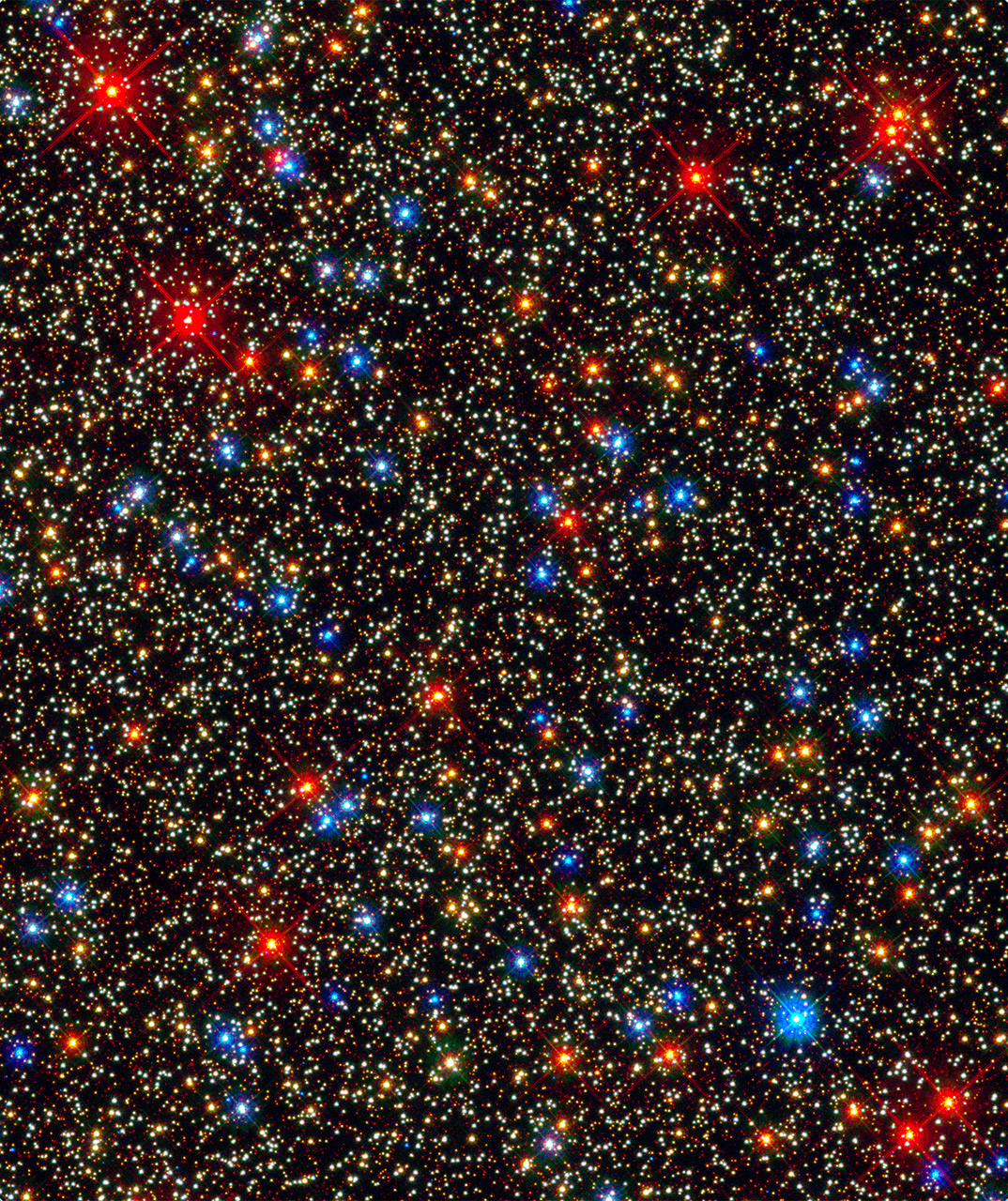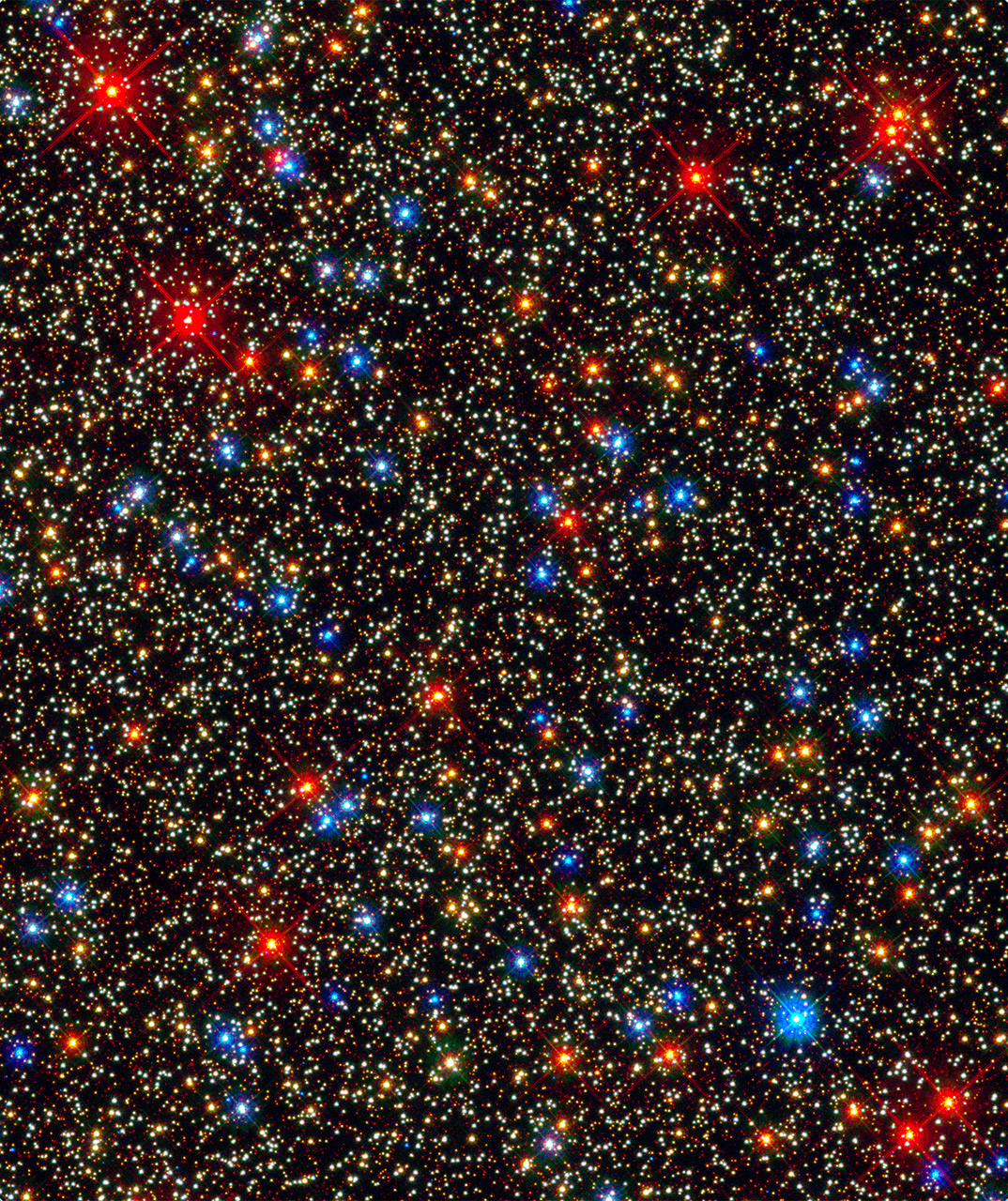
What is left over after stars collide? To help answer this question, astronomers have been studying the center of the most massive ball of stars in our Milky Way Galaxy. In the center of globular cluster Omega Centauri, stars are packed in 10,000 times more densely than near our Sun. Pictured above, the newly upgraded Hubble Space Telescope has resolved the very center of Omega Centauri into individual stars. Visible are many faint yellow-white stars that are smaller than our Sun, several yellow-orange stars that are Red Giants, and an occasional blue star. When two stars collide they likely either combine to form one more massive star, or they stick, forming a new binary star system. Close binary stars interact, sometimes emitting ultraviolet or X-ray light when gas falls from one star onto the surface of a compact companion such as a white dwarf or neutron star. Two such binaries have now been located in Omega Centauri's center. The star cluster lies about 15,000 light-years away and is visible toward the constellation of Centaurus.
¿Qué queda después de que las estrellas colisionen? Para ayudar a responder esta pregunta, los astrónomos han estado estudiando el centro del objeto más masivo en forma de bola de estrellas en nuestra Galaxia Vía Láctea. En el centro del cúmulo globular Omega Centauri, las estrellas están empaquetadas 10 000 veces más densamente que cerca de nuestro Sol. En la imagen de arriba, el recientemente actualizado Telescopio Espacial Hubble ha resuelto el centro mismo de Omega Centauri en estrellas individuales. Se ven muchas estrellas amarillo-pálidas tenues que son más pequeñas que nuestro Sol, varias estrellas amarillo-anaranjadas que son gigantes rojas, y ocasionalmente estrellas azules. Cuando dos estrellas colisionan, probablemente se combinen para formar una estrella más masiva, o se adhieran, formando un nuevo sistema binario. Las estrellas binarias cercanas interactúan, a veces emitiendo luz ultravioleta o de rayos X cuando gas cae desde una estrella sobre la superficie de un compañero compacto como una enana blanca o una estrella de neutrones. Se han localizado ahora dos de tales binarias en el centro de Omega Centauri. El cúmulo de estrellas se encuentra a unos 15 000 años luz de distancia y es visible hacia la constelación de Centauro.