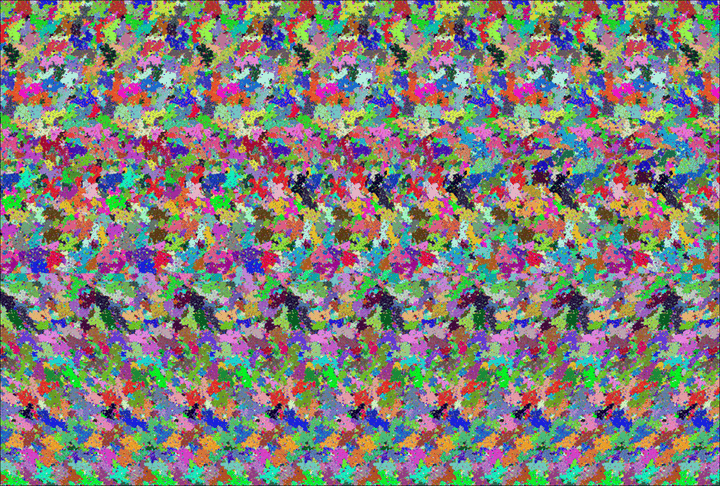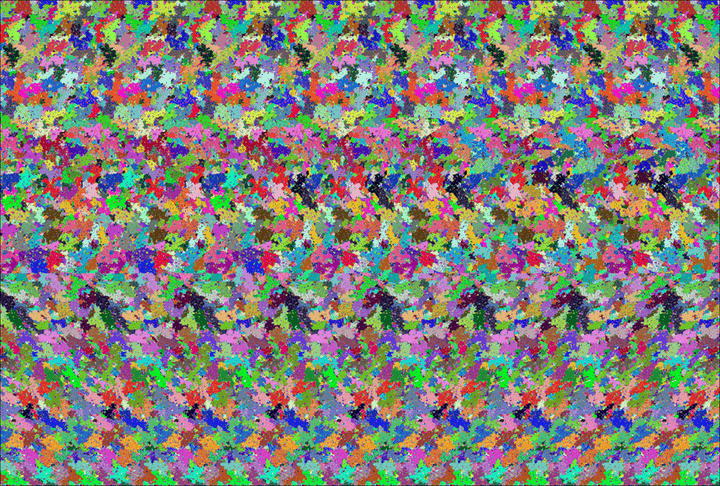
Is this picture worth a thousand words? According to the Holographic Principle, the most information you can get from this image is about 3 x 1065 bits for a normal sized computer monitor. The Holographic Principle, yet unproven, states that there is a maximum amount of information content held by regions adjacent to any surface. Therefore, counter-intuitively, the information content inside a room depends not on the volume of the room but on the area of the bounding walls. The principle derives from the idea that the Planck length, the length scale where quantum mechanics begins to dominate classical gravity, is one side of an area that can hold only about one bit of information. The limit was first postulated by physicist Gerard 't Hooft in 1993. It can arise from generalizations from seemingly distant speculation that the information held by a black hole is determined not by its enclosed volume but by the surface area of its event horizon. The term "holographic" arises from a hologram analogy where three-dimension images are created by projecting light though a flat screen. Beware, other people looking at the above image may not claim to see 3 x 1065 bits -- they might claim to see a teapot.
¿Esta imagen vale mil palabras? Según el Principio Holográfico, la cantidad máxima de información que se puede obtener de esta imagen es de aproximadamente 3 × 10⁶⁵ bits para una pantalla de tamaño normal de computadora. El Principio Holográfico, aún no demostrado, afirma que existe un límite máximo en la cantidad de información que pueden contener las regiones adyacentes a cualquier superficie. Por lo tanto, y de manera contraintuitiva, el contenido de información dentro de una habitación depende no del volumen de la habitación, sino del área de sus paredes limitantes. El principio se deriva de la idea de que la longitud de Planck, la escala de longitud donde la mecánica cuántica comienza a dominar la gravedad clásica, es un lado de un área que puede contener aproximadamente un solo bit de información. Este límite fue postulado por primera vez por el físico Gerard 't Hooft en 1993. Puede surgir de generalizaciones de especulaciones aparentemente distantes, según las cuales la información contenida por un agujero negro no está determinada por su volumen encerrado, sino por el área de su horizonte de sucesos. El término "holográfico" surge de la analogía con un holograma, donde imágenes tridimensionales se crean proyectando luz a través de una pantalla plana. Tenga cuidado, otras personas que miren la imagen anterior pueden no afirmar ver 3 × 10⁶⁵ bits — podrían afirmar ver una tetera.