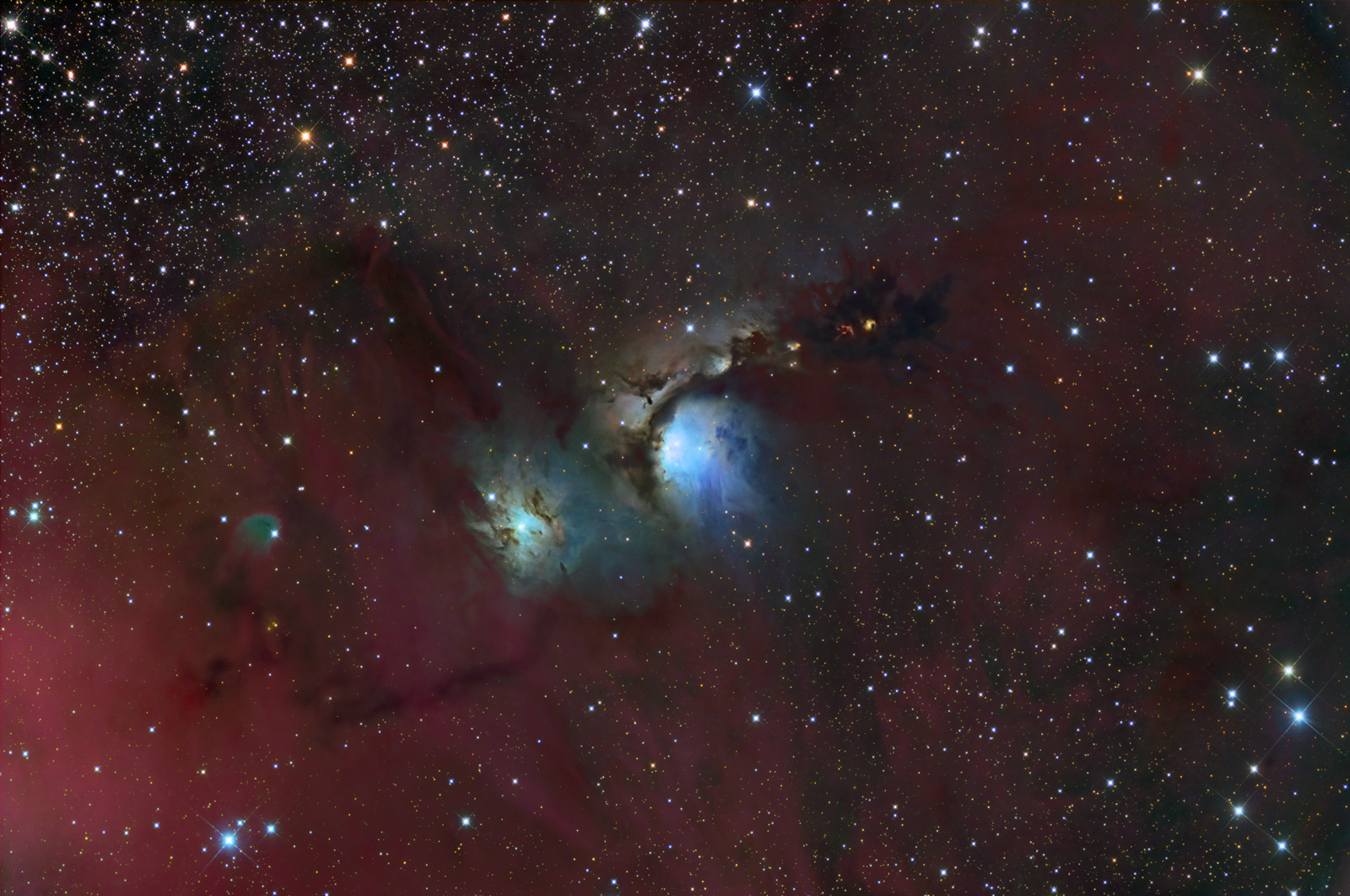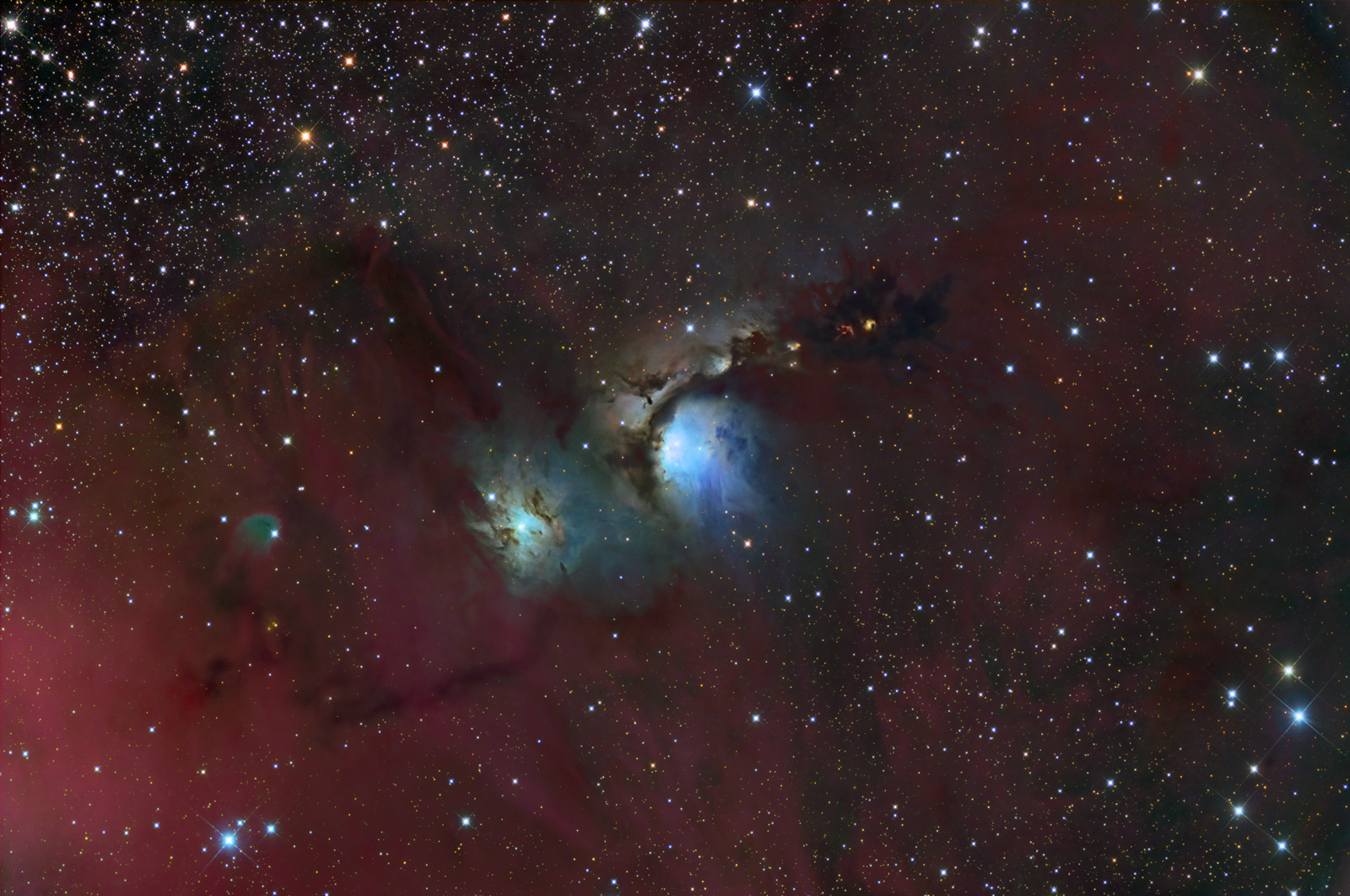
Interstellar dust clouds and glowing nebulae abound in the fertile constellation of Orion. One of the brightest, M78, is centered in this colorful, wide field view, covering an area north of Orion's belt. At a distance of about 1,500 light-years, the bluish reflection nebula is around 5 light-years across. Its tint is due to dust preferentially reflecting the blue light of hot, young stars. Reflection nebula NGC 2071 is just to the left of M78. To the right of M78 and much more compact in appearance, the intriguing McNeil's Nebula is a recently recognized variable nebula associated with the formation of a sun-like star. The remarkably deep exposure also brings out the region's faint but pervasive reddish glow of atomic hydrogen gas.
Las nubes de polvo interestelar y las nebulosas brillantes abundan en la fértil constelación de Orión. Una de las más brillantes, M78, se encuentra centrada en esta colorida vista de campo amplio, que abarca un área al norte de la cintura de Orión. A una distancia de aproximadamente 1500 años luz, la nebulosa de reflexión azulada tiene un tamaño de unos 5 años luz. Su color se debe a que el polvo refleja preferentemente la luz azul de estrellas jóvenes y calientes. La nebulosa de reflexión NGC 2071 se encuentra justo a la izquierda de M78. A la derecha de M78 y con un aspecto mucho más compacto, la intrigante Nebulosa de McNeil es una nebulosa variable recientemente reconocida asociada con la formación de una estrella similar al Sol. La exposición notablemente profunda también revela el tenue pero extendido brillo rojizo del gas de hidrógeno atómico en la región.