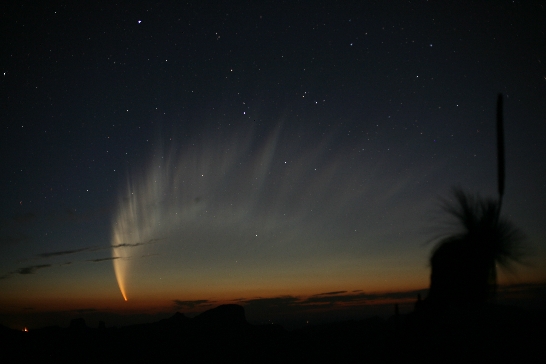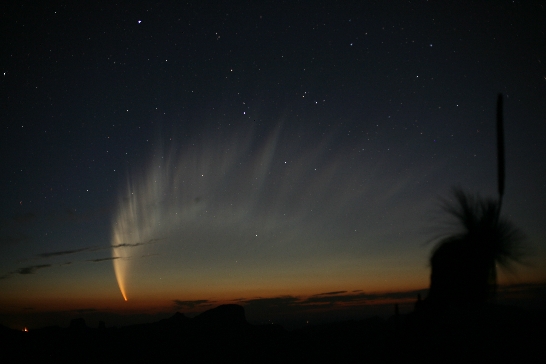
Comet McNaught, the Great Comet of 2007, was the brightest comet of the last 40 years. Its spectacular tail spread across the sky and was breathtaking to behold from dark locations for many Southern Hemisphere observers. The head of the comet remained quite bright and was easily visible to even city observers without any optical aide. Part of the spectacular tail was visible just above the horizon after sunset for many northern observers as well. Comet C/2006 P1 (McNaught), which reached an estimated peak brightness of magnitude -6 (minus six), was caught by the comet's discoverer in the above image soon after sunset in 2007 January from Siding Spring Observatory in Australia. The robotic Ulysses spacecraft fortuitously flew through Comet McNaught's tail and found, unexpectedly, that the speed of the solar wind dropped significantly.
El cometa McNaught, el Gran Cometa de 2007, fue el cometa más brillante de los últimos 40 años. Su cola espectacular se extendía a través del cielo y era impresionante de observar desde lugares oscuros para muchos observadores del hemisferio sur. La cabeza del cometa permaneció bastante brillante y era fácilmente visible incluso para observadores en ciudades sin necesidad de ayuda óptica. Parte de la espectacular cola era visible justo por encima del horizonte después del atardecer para muchos observadores del norte también. El cometa C/2006 P1 (McNaught), que alcanzó un brillo máximo estimado de magnitud -6 (menos seis), fue capturado por el descubridor del cometa en la imagen superior poco después del atardecer en enero de 2007 desde la Siding Spring Observatory en Australia. La nave espacial robótica Ulysses atravesó fortuitamente la cola del cometa McNaught y descubrió, inesperadamente, que la velocidad del viento solar disminuyó significativamente.