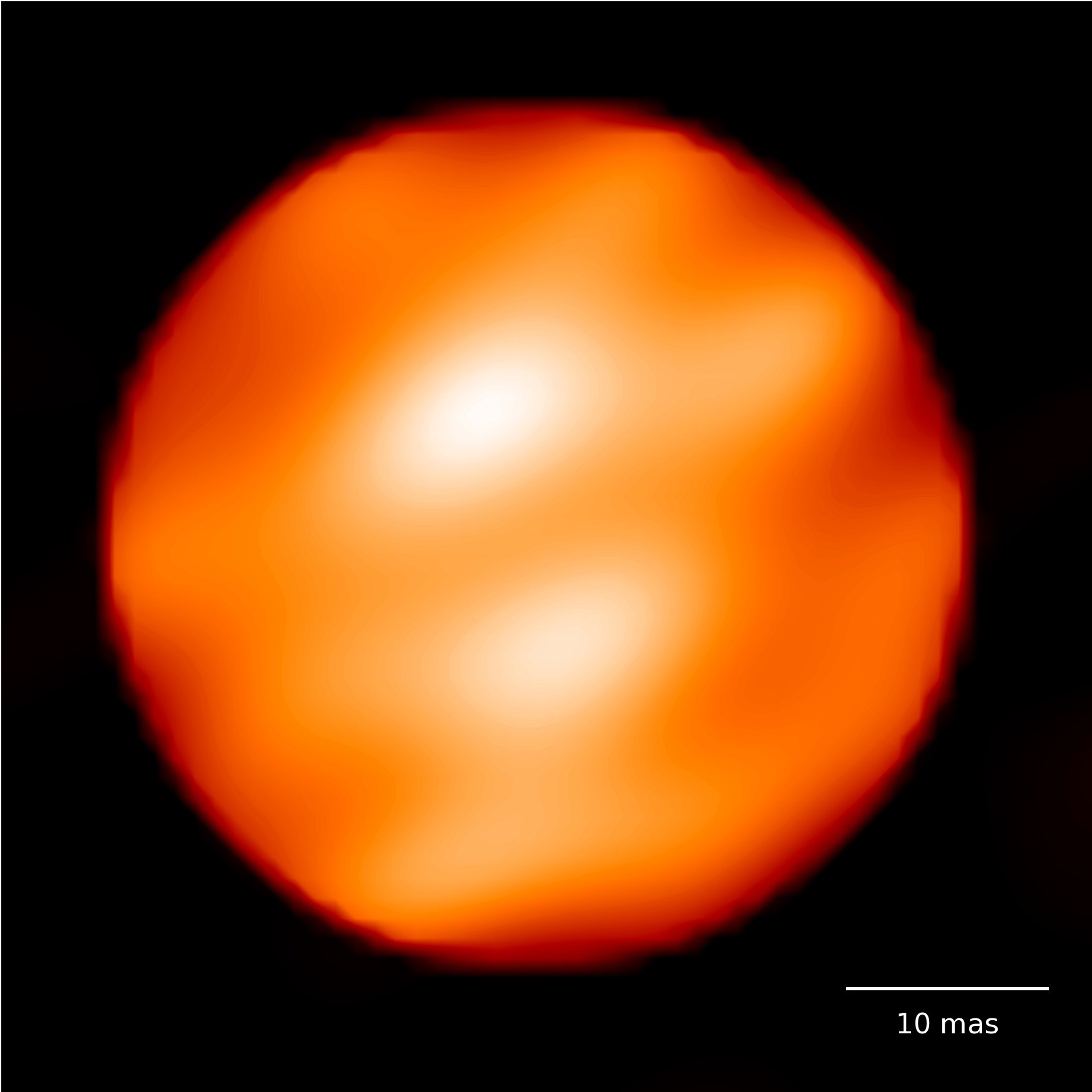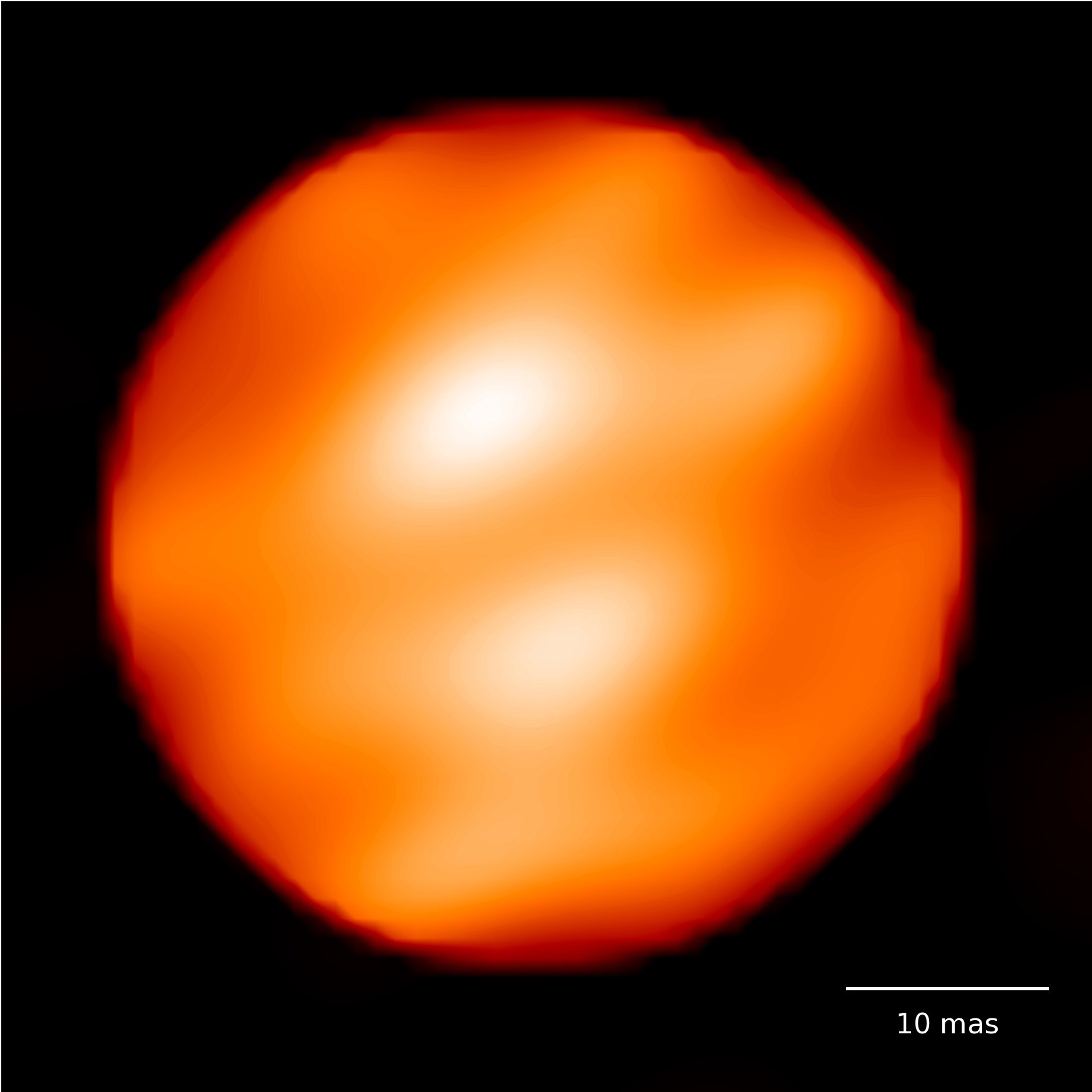
Betelgeuse really is a big star. If placed at the center of our Solar System it would extend to the orbit of Jupiter. But like all stars except the Sun, Betelgeuse is so distant it usually appears as a single point of light, even in large telescopes. Still, astronomers using interferometry at infrared wavelengths can resolve the surface of Betelgeuse and reconstructed this image of the red supergiant. The intriguing picture shows two, large, bright, star spots. The spots potentially represent enormous convective cells rising from below the supergiant's surface. They are bright because they're hotter than the rest of the surface, but both spots and surface are cooler than the Sun. Also known as Alpha Orionis, Betelgeuse is about 600 light-years away. Note: An APOD editor will review astronomy images of 2009, hosted by the Amateur Astronomers Association of New York on Friday, January 8 at the American Museum of Natural History, NYC.
Betelgeuse realmente es una estrella muy grande. Si se colocara en el centro de nuestro Sistema Solar, llegaría hasta la órbita de Júpiter. Sin embargo, al igual que todas las estrellas excepto el Sol, Betelgeuse está tan lejos que normalmente aparece como un único punto de luz, incluso en telescopios grandes. Sin embargo, los astrónomos que utilizan interferometría en longitudes de onda infrarrojas pueden resolver la superficie de Betelgeuse y reconstruir esta imagen de la supergigante roja. La imagen intrigante muestra dos grandes manchas brillantes. Estas manchas podrían representar enormes celdas convectivas que emergen desde debajo de la superficie de la supergigante. Están brillantes porque son más calientes que el resto de la superficie, pero tanto las manchas como la superficie son más frías que el Sol. También conocida como Alfa de Orión, Betelgeuse está a unos 600 años luz de distancia.