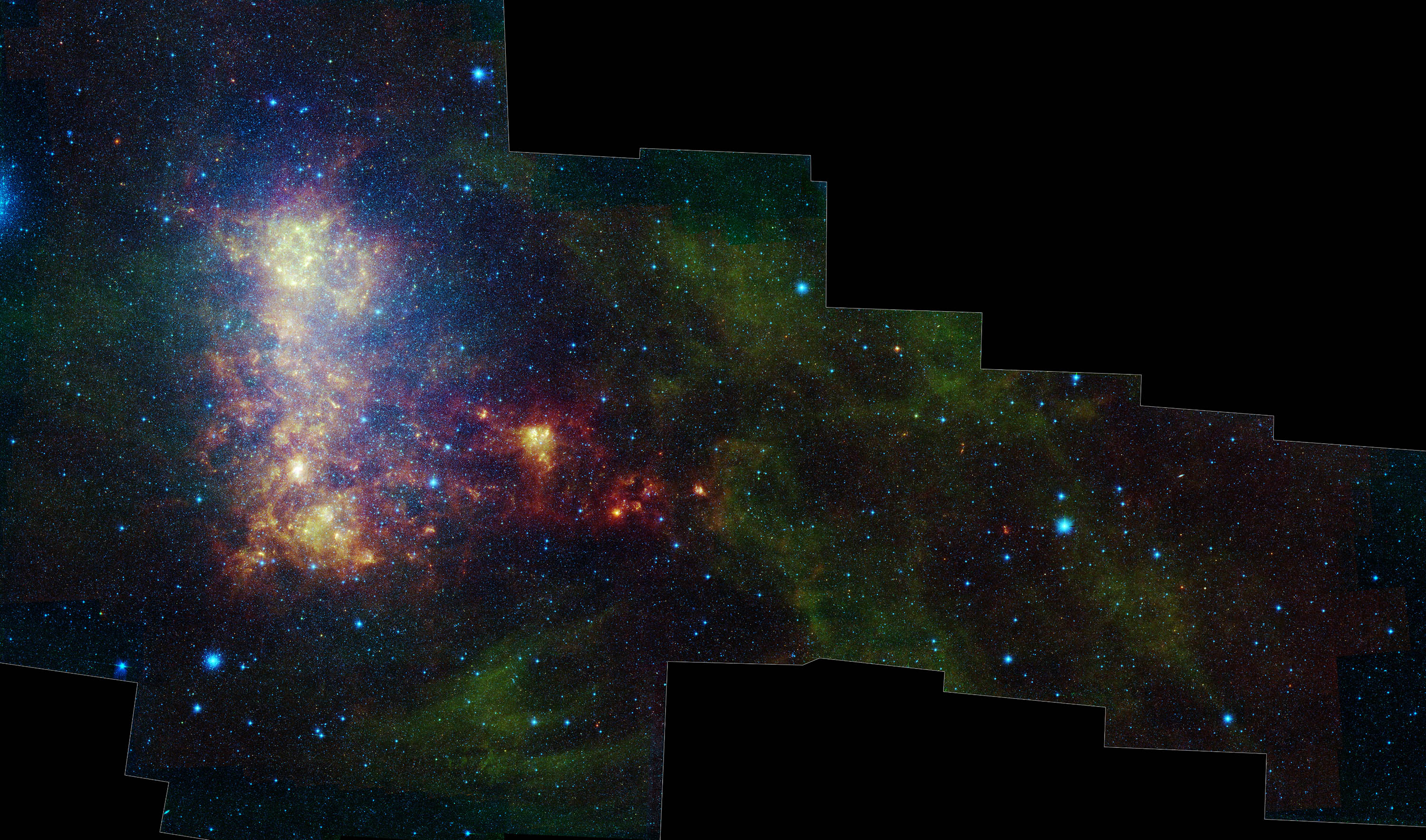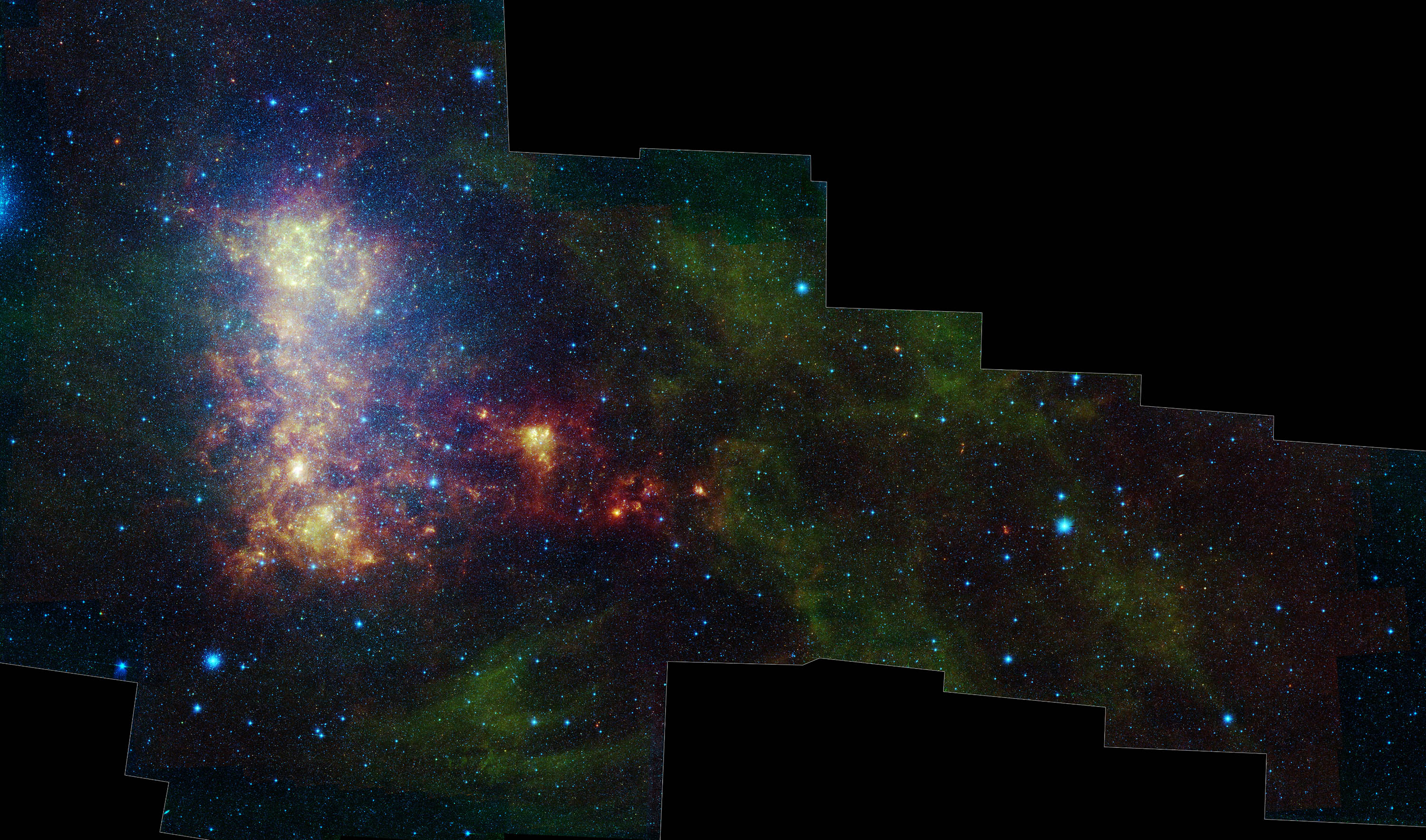
A satellite galaxy of our Milky Way, the Small Magellanic Cloud is wonder of the southern sky, named for 16th century Portuguese circumnavigator Ferdinand Magellan. Some 200,000 light-years distant in the constellation Tucana, the small irregular galaxy's stars, gas, and dust that lie along a bar and extended "wing", are familiar in images from optical telescopes. But the galaxy also has a tail. Explored in this false-color, infrared mosaic from the Spitzer Space Telescope, the tail extends to the right of the more familiar bar and wing. Likely stripped from the galaxy by gravitational tides, the tail contains mostly gas, dust, and newly formed stars. Two clusters of newly formed stars, warming their surrounding natal dust clouds, are seen in the tail as red spots. Note: An APOD editor will review astronomy images of 2009, hosted by the Amateur Astronomers Association of New York on Friday, January 8 at the American Museum of Natural History, NYC.
Una galaxia satélite de nuestra Vía Láctea, la Pequeña Nube Magallánica es una maravilla del cielo austral, nombrada en honor al navegante portugués del siglo XVI, Fernando Magallanes. A unos 200,000 años luz de distancia en la constelación de Tucán, las estrellas, el gas y el polvo de esta pequeña galaxia irregular que se encuentran a lo largo de una barra y una extensa 'ala' son familiares en imágenes obtenidas por telescopios ópticos. Pero la galaxia también tiene una cola. Explorada en esta imagen en falso color y en infrarrojo, mosaico del Telescopio Espacial Spitzer, la cola se extiende hacia la derecha de la barra y la ala más familiares. Probablemente arrancada de la galaxia por mareas gravitacionales, la cola contiene principalmente gas, polvo y estrellas recién formadas. Dos grupos de estrellas recién formadas, que calientan las nubes de polvo que las rodean, se ven en la cola como manchas rojas.