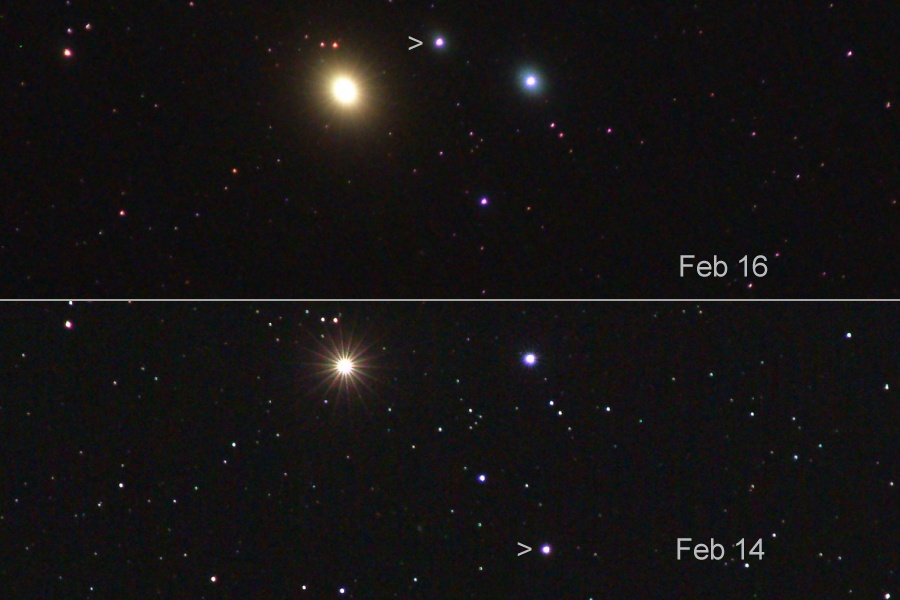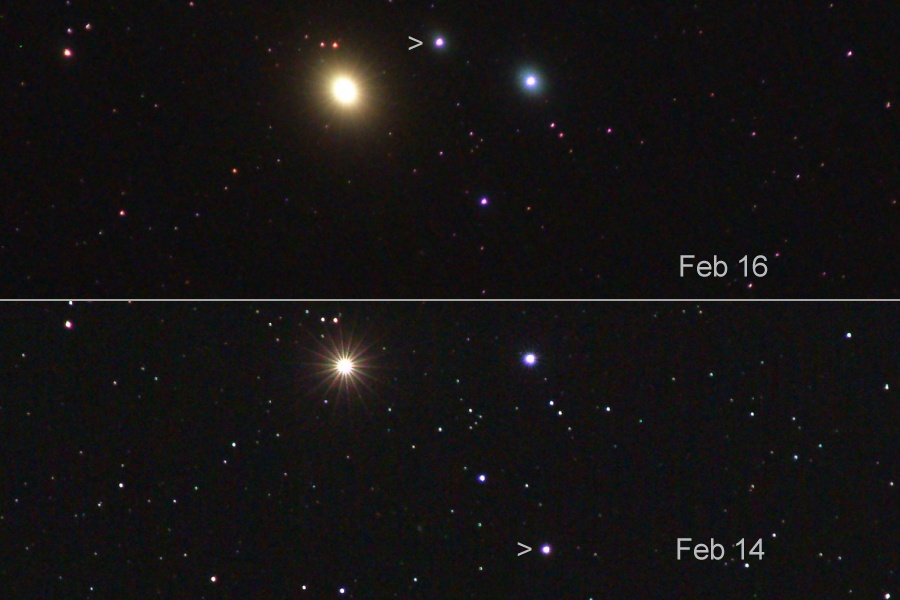
Main belt asteroid 4 Vesta is at its brightest now. The small world is near opposition (opposite the Sun in the sky) and closest to Earth. But even at its brightest, Vesta is just too faint to spot with the naked-eye. Still, over the next few days it will be relatively easy to find in the constellation Leo, sharing a typical binocular field of view with bright star Gamma Leonis (aka Algieba). In fact on February 16 Vesta passed between Gamma Leonis and close neighbor on the sky 40 Leonis. Gamma Leonis is the brightest star in these two panels, while the second brightest star, 40 Leonis, is directy to its right. As marked, Vesta is the third brightest "star" in the field. Vesta shifts position between the two panels from well below 40 Leonis on Feb. 14 to near the top of the frame from Feb. 16, shooting the gap between the close Gamma/40 Leonis pair. Of course, premier close-up views of the asteroid will be possible after the ion-powered Dawn spacecraft arrives at Vesta in August of 2011.
El asteroide 4 Vesta del cinturón principal está ahora en su punto más brillante. El pequeño mundo está cerca de la oposición (opuesto al Sol en el cielo) y más cercano a la Tierra. Pero incluso en su punto más brillante, Vesta es demasiado tenue para ser visto a simple vista. Sin embargo, durante los próximos días será relativamente fácil de encontrar en la constelación de Leo, compartiendo un campo típico de visión de binoculares con la brillante estrella Gamma Leonis (también conocida como Algieba). De hecho, el 16 de febrero Vesta pasó entre Gamma Leonis y su vecina cercana en el cielo, 40 Leonis. Gamma Leonis es la estrella más brillante en estos dos paneles, mientras que la segunda estrella más brillante, 40 Leonis, está directamente a su derecha. Como se marca, Vesta es la tercera estrella más brillante en el campo. Vesta cambia de posición entre los dos paneles, desde bien por debajo de 40 Leonis el 14 de febrero hasta cerca de la parte superior del marco el 16 de febrero, atravesando el espacio entre el par cercano de Gamma/40 Leonis. Por supuesto, las vistas más cercanas y detalladas del asteroide serán posibles después de que la nave espacial Dawn, propulsada por iones, llegue a Vesta en agosto de 2011.