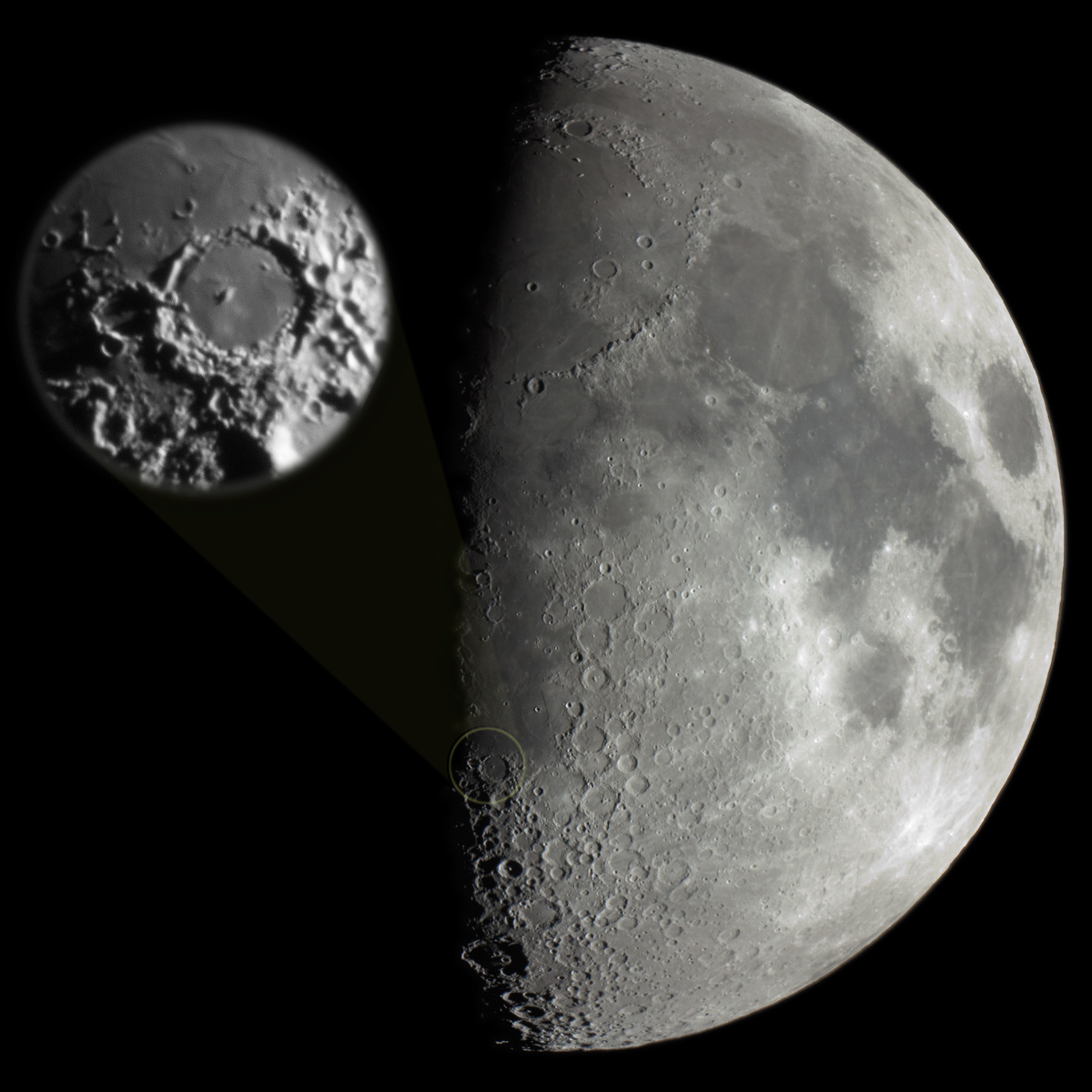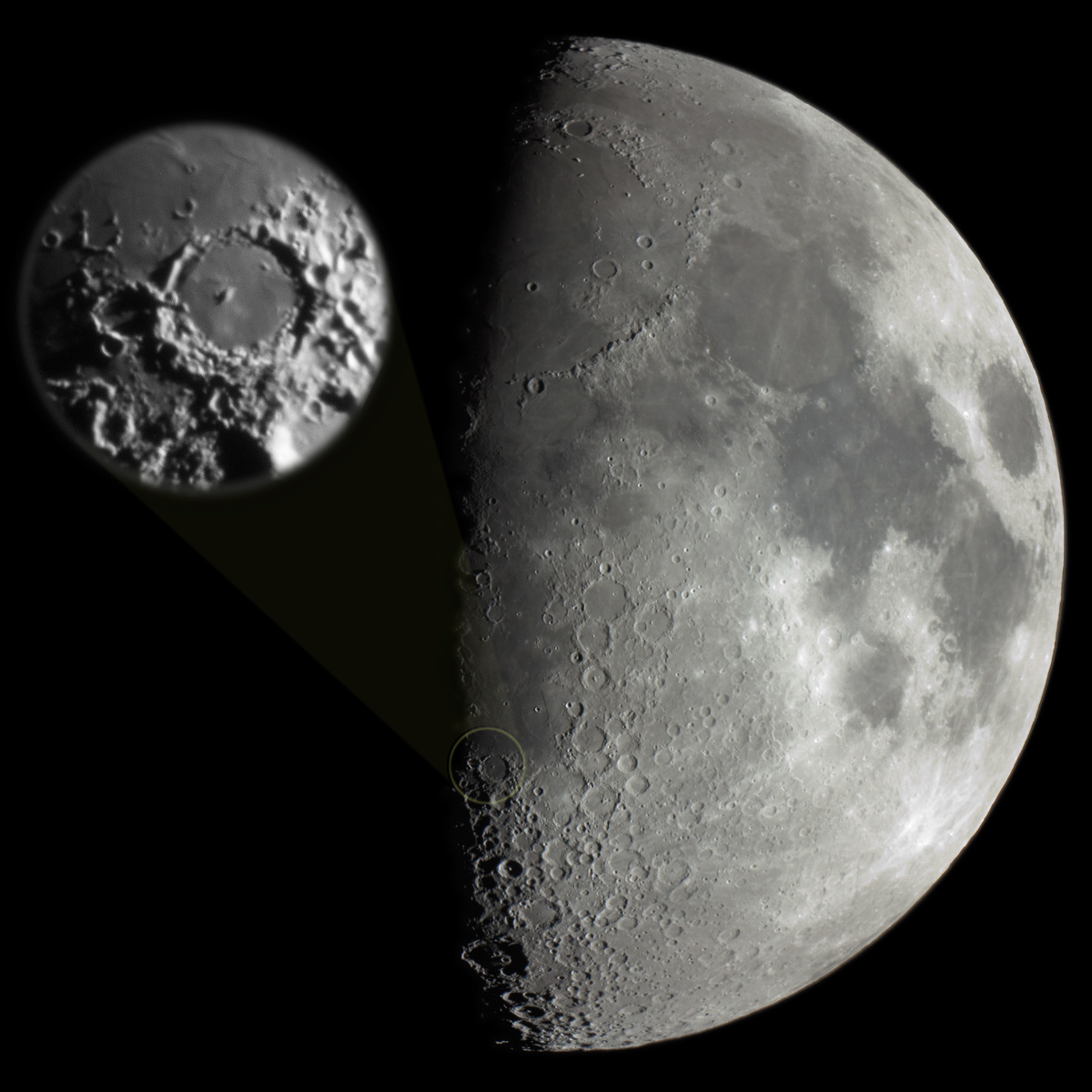
Stark shadows of mountains and crater walls stand out along the lunar terminator, or shadow line between night and day, in this telescopic image. Of course, if viewed from the lunar surface near the terminator line, the Sun would be rising and still close to the lunar horizon. But the picture's inset at the left highlights a more elusive lunar sunrise phenomenon. Streaming through a gap in the eastern wall of 45 kilometer wide Hesiodus crater, the low-angle sunlight produces a long sunrise ray playing along the otherwise shadowed crater floor. Sunrise rays are short-lived and can be rewarding to spot for Moon enthusiasts with telescopes. Seen in Hesiodus and other craters, the ray timing can be calculated based on the observer's location. This picture of a first quarter Moon was recorded at 23:45 UT on February 22nd from Stuttgart, Germany. In the inset, the larger crater Pitatus is at the right. For location, Hesiodus and Pitatus are circled at the bottom of the picture.
Las sombras nítidas de montañas y paredes de cráteres destacan a lo largo del terminator lunar, o línea de sombra entre la noche y el día, en esta imagen obtenida con telescopio. Por supuesto, si se observara desde la superficie lunar cerca de la línea del terminator, el Sol estaría en ascenso y aún cerca del horizonte lunar. Pero la imagen inserta a la izquierda resalta un fenómeno más elusivo del amanecer lunar. A través de un hueco en la pared oriental del cráter Hesiodus, que tiene 45 kilómetros de ancho, la luz solar de bajo ángulo produce un largo rayo de amanecer que se extiende por el suelo del cráter, que de otro modo estaría en sombra. Los rayos de amanecer son efímeros y pueden ser gratos de observar para los entusiastas de la Luna con telescopios. Vistos en Hesiodus y otros cráteres, el momento exacto del rayo puede calcularse en función de la ubicación del observador. Esta imagen de una Luna en cuarto creciente fue registrada a las 23:45 UTC del 22 de febrero desde Stuttgart, Alemania. En la imagen inserta, el cráter más grande Pitatus se encuentra a la derecha. Para localización, Hesiodus y Pitatus están señalados en la parte inferior de la imagen.