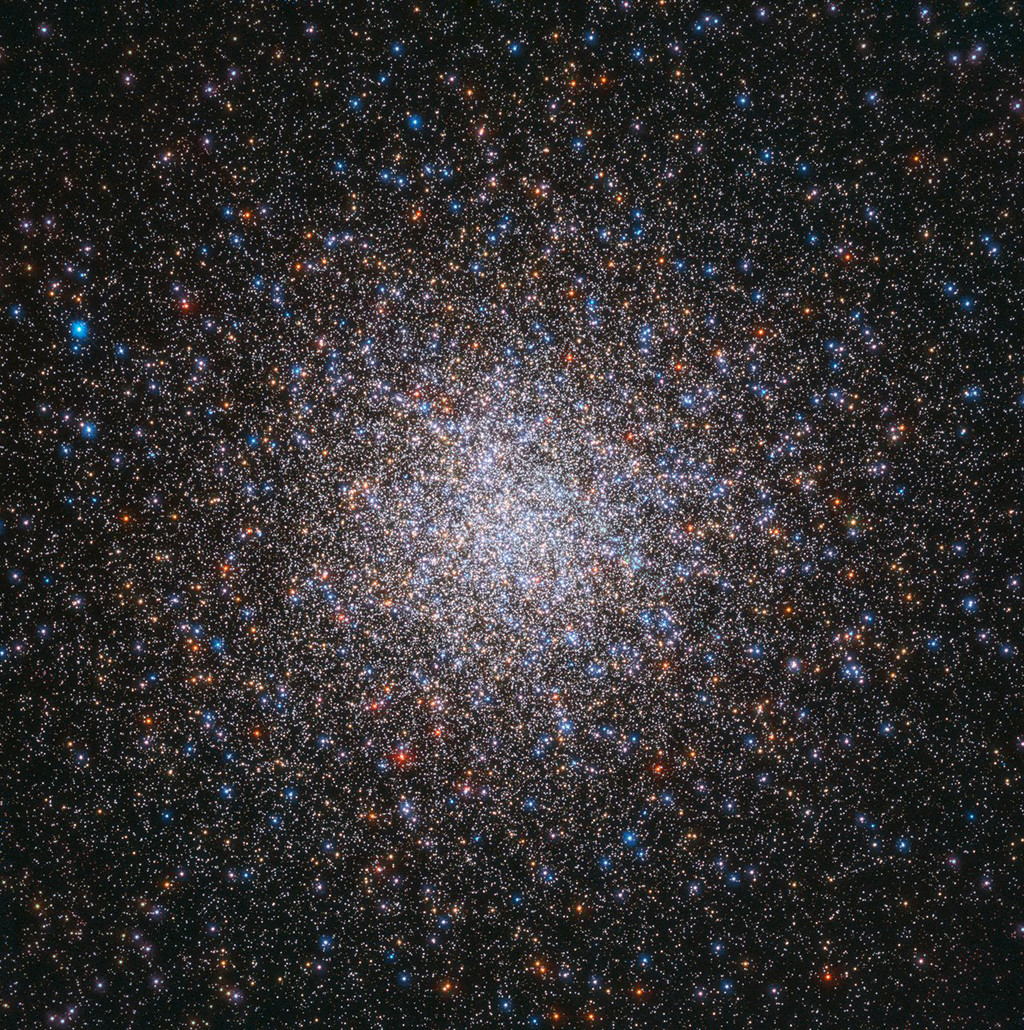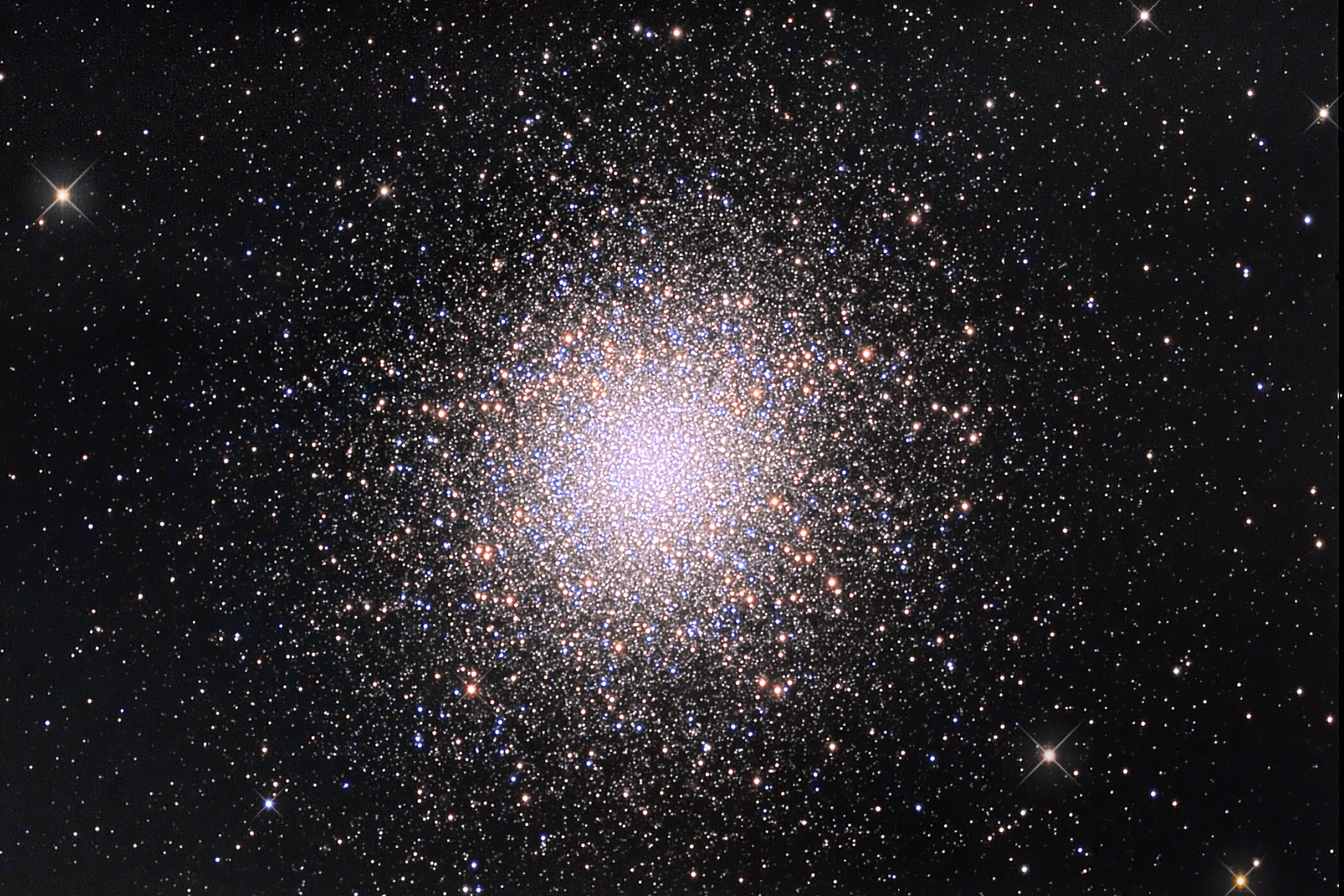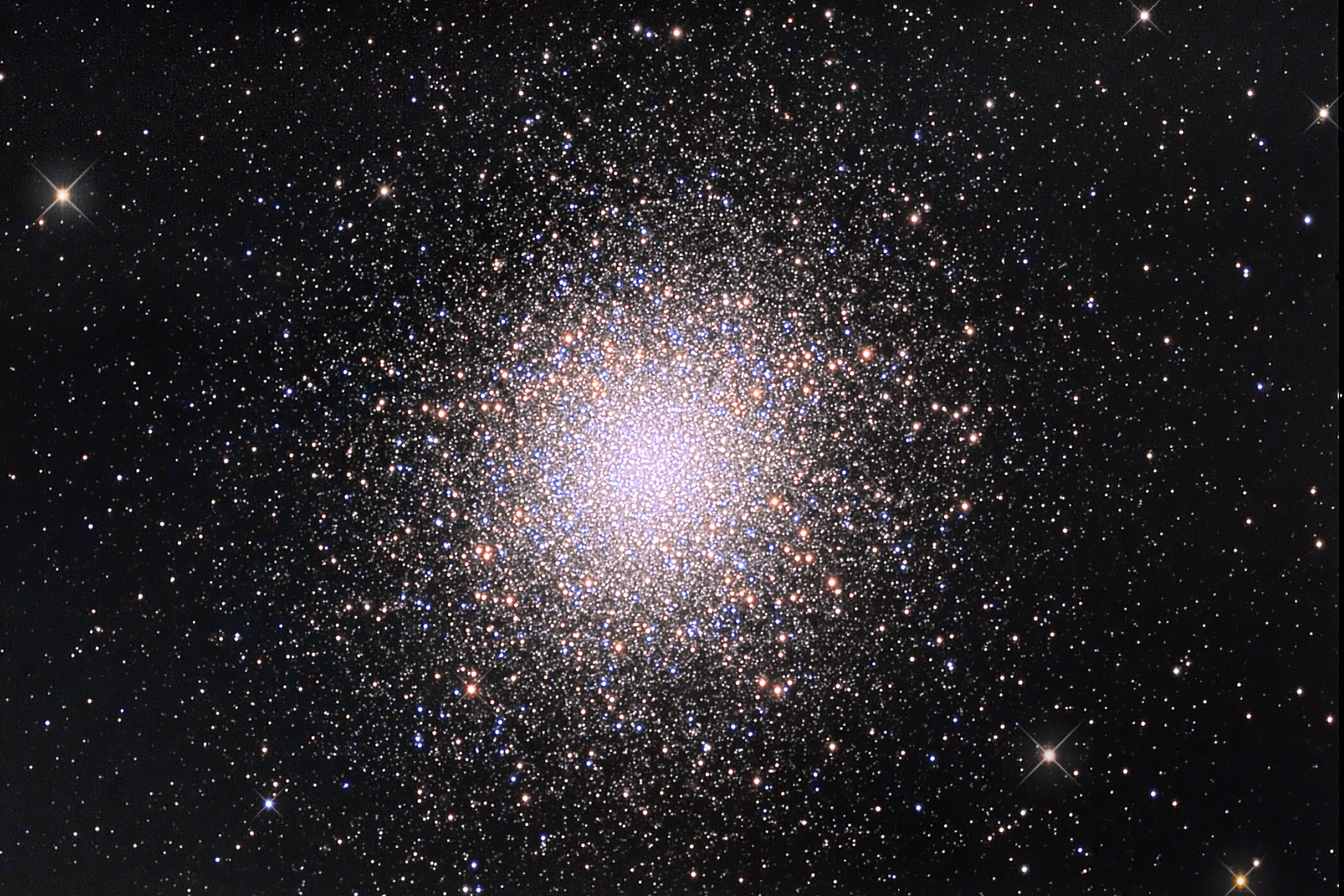
In 1716, English astronomer Edmond Halley noted, "This is but a little Patch, but it shews itself to the naked Eye, when the Sky is serene and the Moon absent." Of course, M13 is now modestly recognized as the Great Globular Cluster in Hercules, one of the brightest globular star clusters in the northern sky. Telescopic views reveal the spectacular cluster's hundreds of thousands of stars. At a distance of 25,000 light-years, the cluster stars crowd into a region 150 light-years in diameter, but approaching the cluster core upwards of 100 stars could be contained in a cube just 3 light-years on a side. For comparison, the closest star to the Sun is over 4 light-years away. Along with the cluster's dense core, the outer reaches of M13 are highlighted in this sharp color image. The cluster's evolved red and blue giant stars show up in yellowish and blue tints.
En 1716, el astrónomo inglés Edmond Halley observó, 'Este es solo un pequeño parche, pero se muestra al ojo desnudo cuando el cielo está sereno y la Luna ausente'. Por supuesto, M13 es ahora modestamente reconocido como el Gran Cúmulo Globular en Hércules, uno de los cúmulos globulares más brillantes del cielo norte. Las vistas telescópicas revelan los cientos de miles de estrellas del espectacular cúmulo. A una distancia de 25 000 años luz, las estrellas del cúmulo se apiñan en una región de 150 años luz de diámetro, pero al acercarse al núcleo del cúmulo, más de 100 estrellas podrían contenerse en un cubo de solo 3 años luz de lado. Para comparar, la estrella más cercana al Sol está a más de 4 años luz de distancia. Junto con el denso núcleo del cúmulo, las zonas externas de M13 se destacan en esta nítida imagen en color. Las estrellas gigantes rojas y azules evolucionadas del cúmulo aparecen con tonos amarillentos y azules.