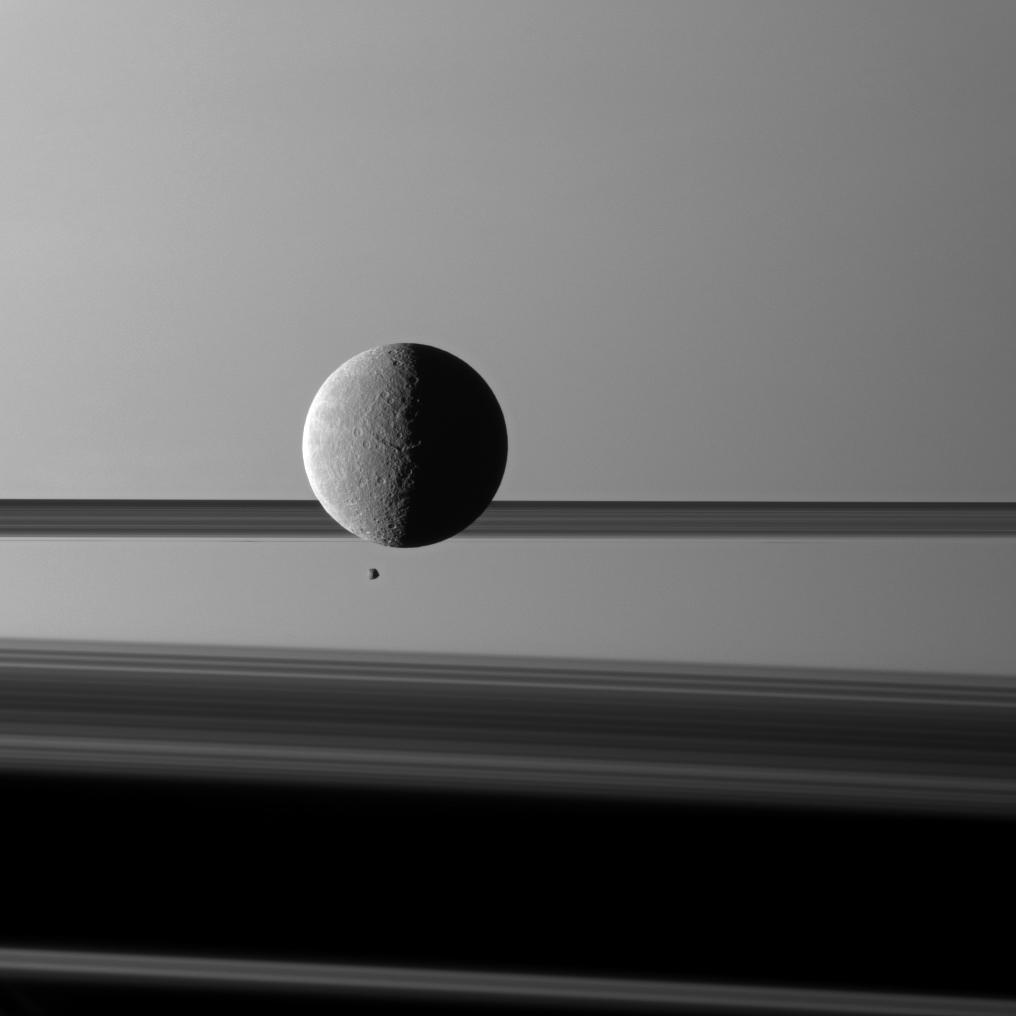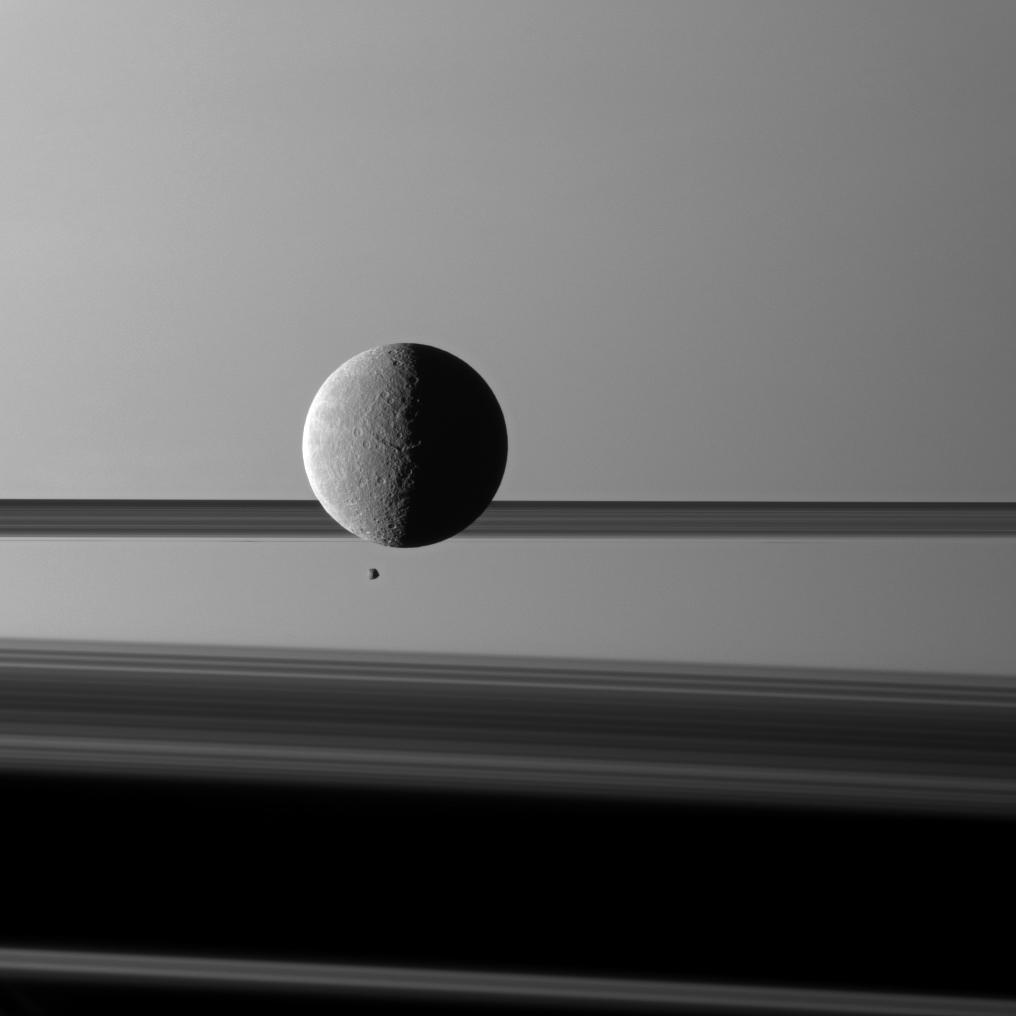
While cruising around Saturn, be on the lookout for picturesque juxtapositions of moons and rings. Another striking alignment occurred last March in the view of humanity's Saturn-orbiting Cassini spacecraft. Rhea, one of Saturn's larger moons, was caught passing Epimetheus, one of Saturn's smaller moons. Epimetheus, as pictured above, is actually well behind the heavily cratered Rhea. Further back, several of the complex rings of Saturn can be seen crossing the image horizontally. Behind both the moons and rings is giant Saturn itself, showing expansive but featureless clouds in the green light where the above image was taken. The Cassini mission around Saturn has now been extended to 2017 to better study the complex planetary system as its season changes from equinox to solstice.
Mientras navega alrededor de Saturno, manténgase alerta para observar combinaciones pictóricas de lunas y anillos. Otra alineación llamativa tuvo lugar en marzo pasado en la imagen capturada por la nave Cassini de la NASA, que orbita Saturno. Rhea, una de las lunas más grandes de Saturno, fue captada pasando junto a Epimetheus, una de las lunas más pequeñas de Saturno. Como se muestra en la imagen, Epimetheus está en realidad bastante atrás de la muy craterizada Rhea. Más atrás aún, se pueden ver varios de los complejos anillos de Saturno atravesando la imagen horizontalmente. Detrás de ambas lunas y anillos se encuentra Saturno mismo, mostrando nubes extensas pero sin características en la luz verde en la que se tomó la imagen. La misión Cassini alrededor de Saturno ha sido extendida ahora hasta 2017 para estudiar mejor el complejo sistema planetario a medida que cambia de equinoccio a solsticio.