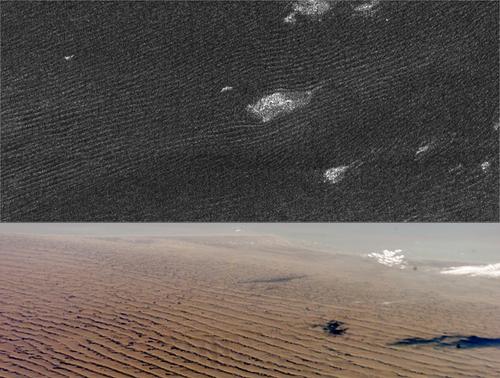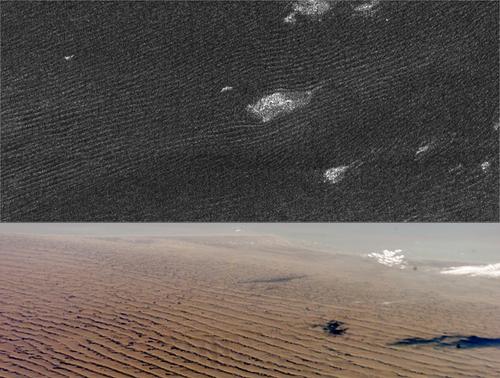
Why do some sand dunes on Titan appear backwards? Central Titan, it turns out, is covered by sand, some of which appears strange. Images from the Cassini spacecraft currently orbiting Saturn have uncovered long rows of huge sand dunes near Titan's equator that rise as high as 300 meters. Shadows indicate that most dune shapes are created by wind blowing from the west. The problem is, the typical wind at Titan's equator blows from the east. One recent hypothesis that might solve this grainy conundrum posits that the only winds strong enough to move sand and create dunes occur during rare equinoxes and blow strongly from the west. The above images show a radar swath of Titan's equatorial sand dunes at the top, while similar sand dunes that formed in Namibia on Earth at the bottom. Why central Titan is even covered by so much sand is still being investigated.
¿Por qué algunas dunas de arena en Titán parecen estar invertidas? Resulta que el centro de Titán está cubierto de arena, parte de la cual parece extraña. Imágenes del orbitador Cassini, actualmente en órbita alrededor de Saturno, han revelado filas largas de enormes dunas de arena cerca del ecuador de Titán que se elevan hasta 300 metros de altura. Las sombras indican que la mayoría de las formas de las dunas son creadas por vientos que soplan desde el oeste. El problema es que el viento típico en el ecuador de Titán sopla desde el este. Una hipótesis reciente que podría resolver este enigma granular sugiere que los únicos vientos lo suficientemente fuertes como para mover la arena y crear dunas ocurren durante equinoccios raros y soplan con fuerza desde el oeste. Las imágenes anteriores muestran un recorrido de radar de las dunas ecuatoriales de arena de Titán en la parte superior, mientras que similares dunas de arena formadas en Namibia en la Tierra aparecen en la parte inferior. Aún se está investigando por qué el centro de Titán está cubierto por tanta arena.