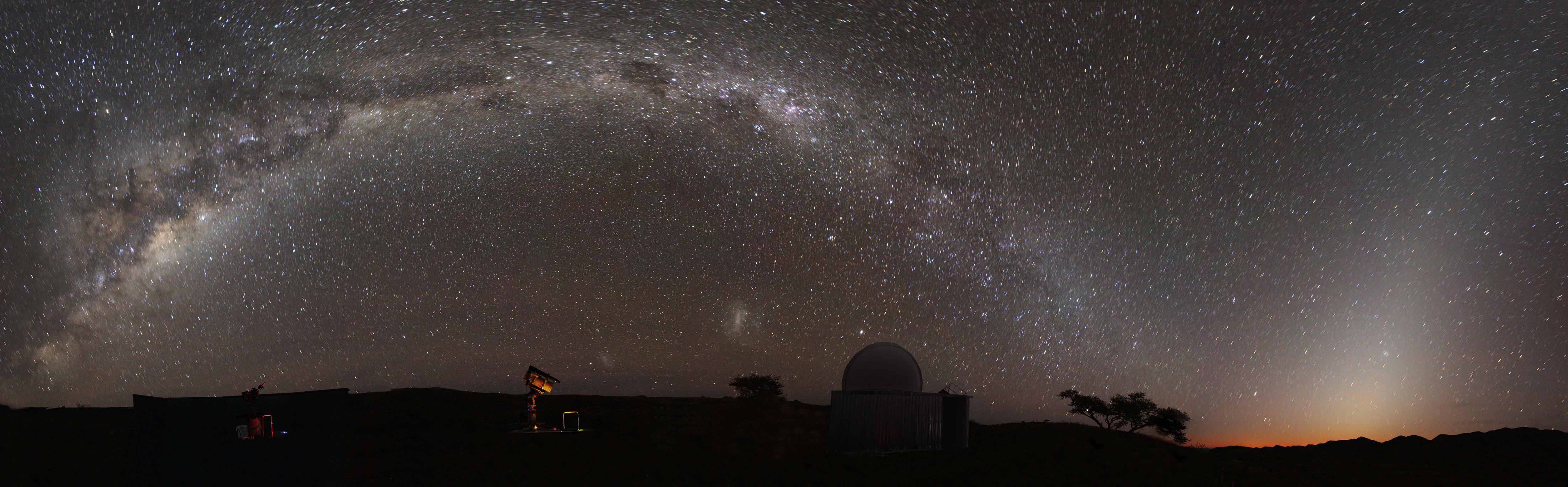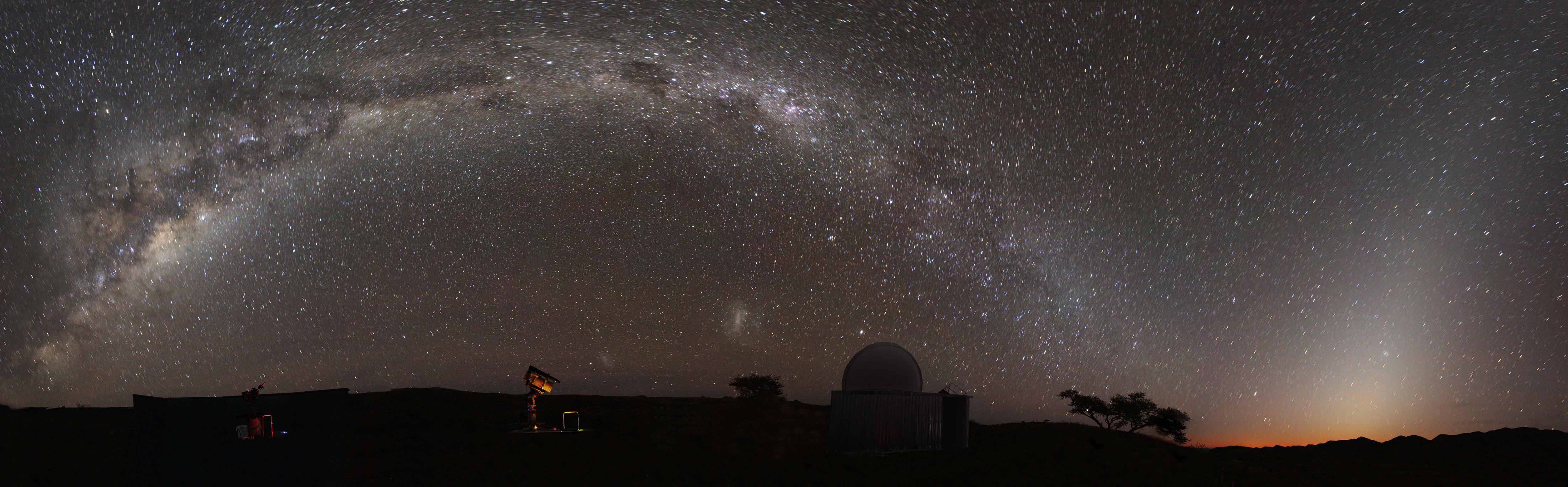
An unusual triangle of light is visible this time of year just before dawn, in the northern hemisphere. Once considered a false dawn, this triangle of light is actually zodiacal light, light reflected from interplanetary dust particles. The bright reflecting triangle is clearly visible on the right of the above horizontally-compressed image taken just after sunset from Namibia in the southern hemisphere in 2009 June. The central band of our Milky Way Galaxy on the left first mirrors the zodiacal band on the right but then curves around the sky. The faint smudges inside the arch of the Milky Way are the Large and Small Magellanic Clouds. Zodiacal dust orbits the Sun predominantly in the same plane as the planets: the ecliptic. Zodiacal light is so bright in the north this time of year because the dust band is oriented nearly vertical at sunrise, so that the thick air near the horizon does not block out relatively bright reflecting dust. Zodiacal light is also bright for people in Earth's northern hemisphere in March and April just after sunset. In the southern hemisphere, zodiacal light is most notable after sunset in late summer, and brightest before sunrise in late spring.
Un triángulo inusual de luz es visible este tiempo del año justo antes del amanecer, en el hemisferio norte. Una vez considerada una aurora falsa, este triángulo de luz es en realidad luz zodiacal, luz reflejada por partículas de polvo interplanetario. El brillante triángulo reflejante es claramente visible a la derecha en la imagen horizontalmente comprimida tomada justo después del atardecer en Namibia, en el hemisferio sur, en junio de 2009. La banda central de nuestra Galaxia Vía Láctea a la izquierda primero refleja la banda zodiacal a la derecha, pero luego se curva alrededor del cielo. Los leves manchones dentro del arco de la Vía Láctea son las Nubes de Magallanes Mayor y Menor. El polvo zodiacal orbita al Sol principalmente en el mismo plano que los planetas: la eclíptica. La luz zodiacal es tan brillante en el norte este tiempo del año porque la banda de polvo está orientada casi verticalmente al amanecer, de modo que el aire denso cerca del horizonte no bloquea la relativamente brillante luz reflejada por el polvo. La luz zodiacal también es brillante para las personas en el hemisferio norte de la Tierra en marzo y abril, justo después del atardecer. En el hemisferio sur, la luz zodiacal es más notable después del atardecer en el verano tardío, y más brillante antes del amanecer en la primavera tardía.