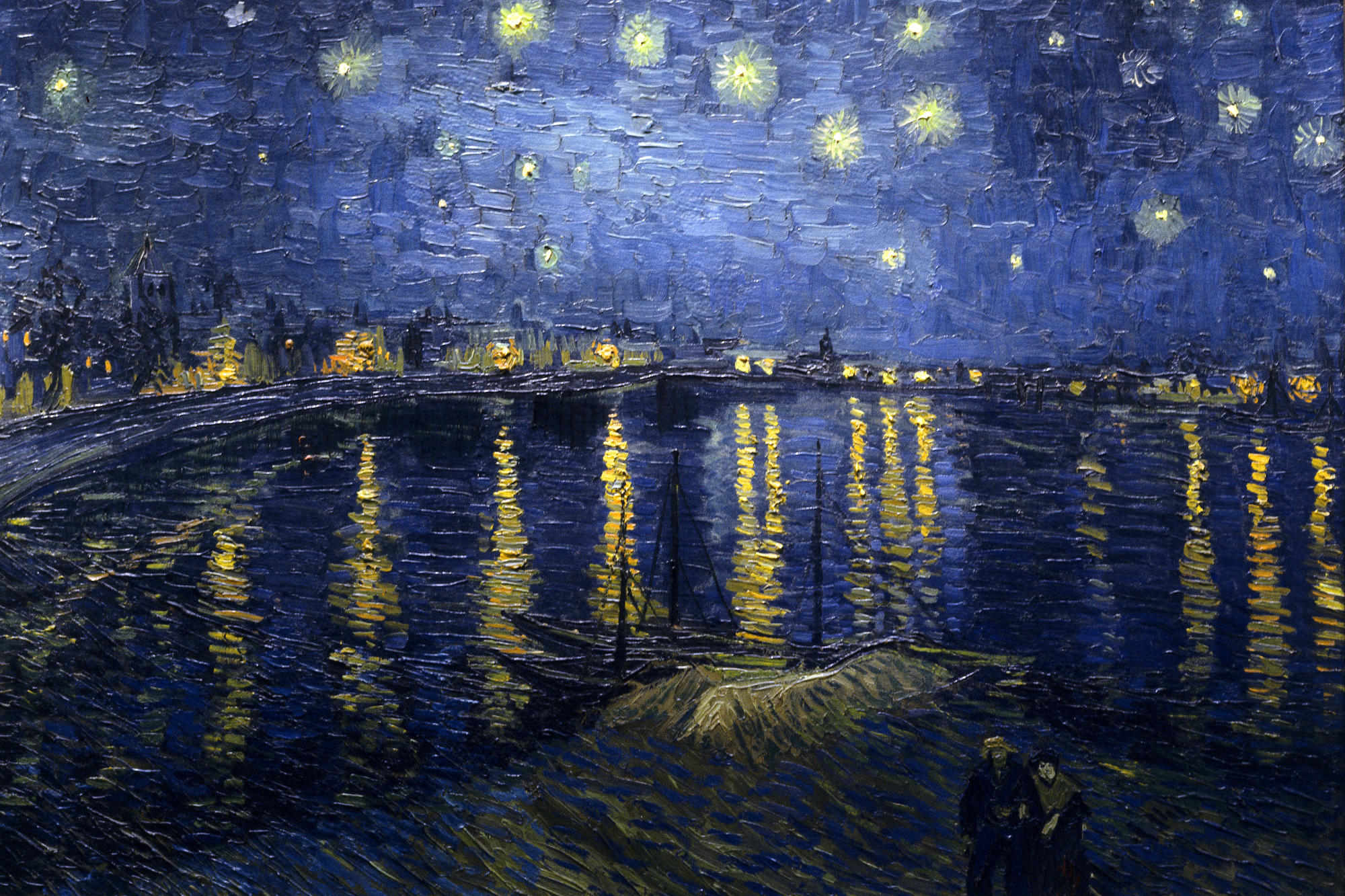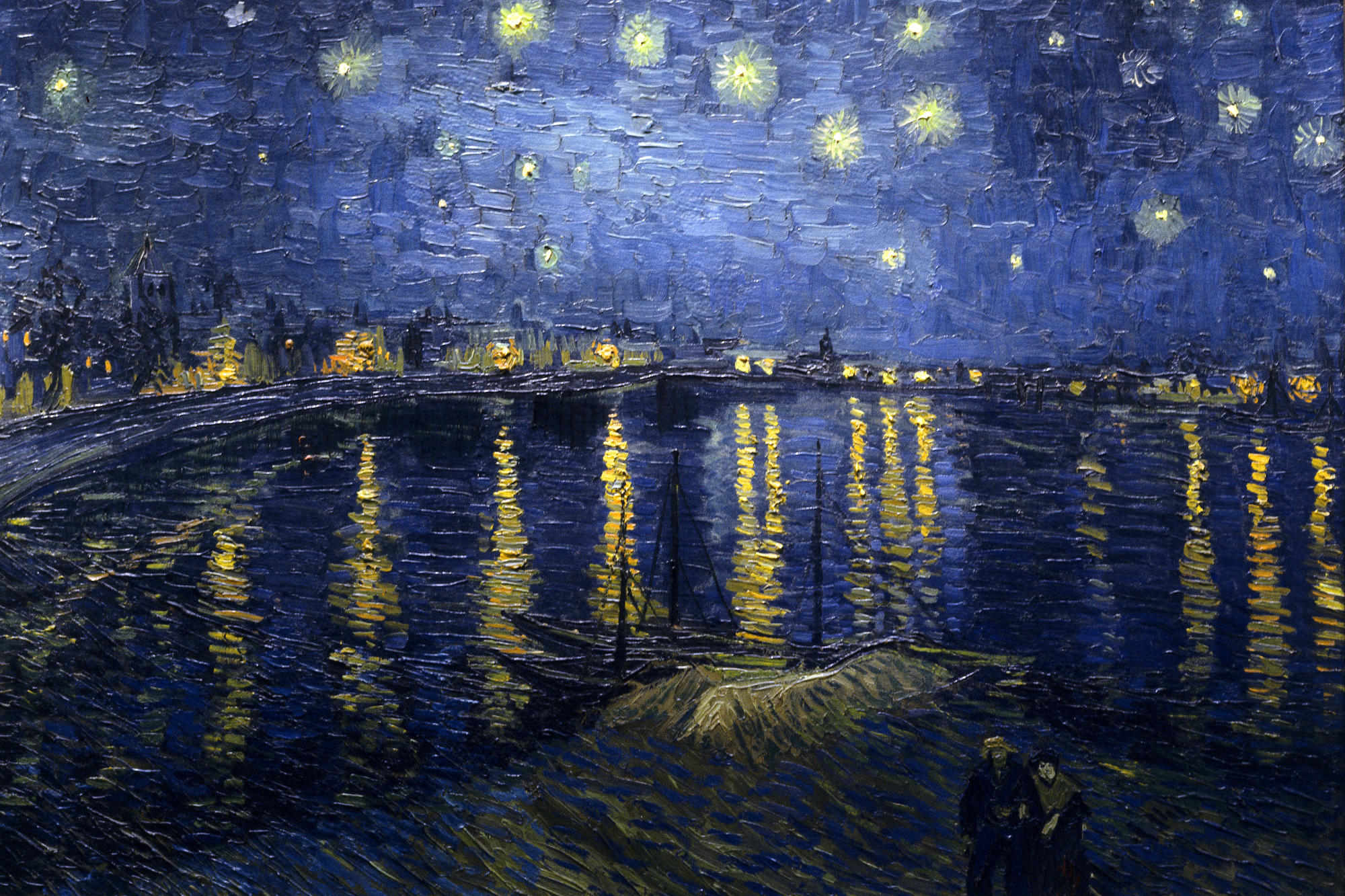
How can the majesty of the night sky best be captured in a painting? This was a continual challenge for Vincent van Gogh, a famous painter in the late 1800s who pioneered stirring depictions of star filled skies into several of his works. Pictured above is van Gogh's Starry Night Over the Rhone, where the French town of Arles is depicted complete with gas lights reflecting off the Rhone river. van Gogh's night sky appears alive with turbulent stellar images contrasting with lofty dark blue hues. Above the river, one can discern the stars of the familiar Big Dipper asterism. Following a line connecting the two Big Dipper stars on the right, the North Star Polaris could be easily found, the height of which can then be estimated and actually gives the latitude where the painting was created.
¿Cómo se puede capturar mejor la majestuosidad del cielo nocturno en una pintura? Este fue un desafío constante para Vincent van Gogh, un pintor famoso de finales del siglo XIX que pionero en representar de manera conmovedora cielos llenos de estrellas en varias de sus obras. En la imagen se muestra la pintura de van Gogh 'Noche estrellada sobre el Ródano', donde se representa la ciudad francesa de Arles completa con luces de gas reflejándose en el río Ródano. El cielo nocturno de van Gogh parece estar lleno de vida con imágenes estelares turbulentas en contraste con tonos oscuros de azul. Sobre el río, se pueden discernir las estrellas de la conocida constelación del Cazo Mayor. Siguiendo una línea que conecta las dos estrellas del Cazo Mayor a la derecha, se podría fácilmente encontrar la Estrella Polar, cuya altura puede estimarse y en realidad da la latitud en la que se creó la pintura.