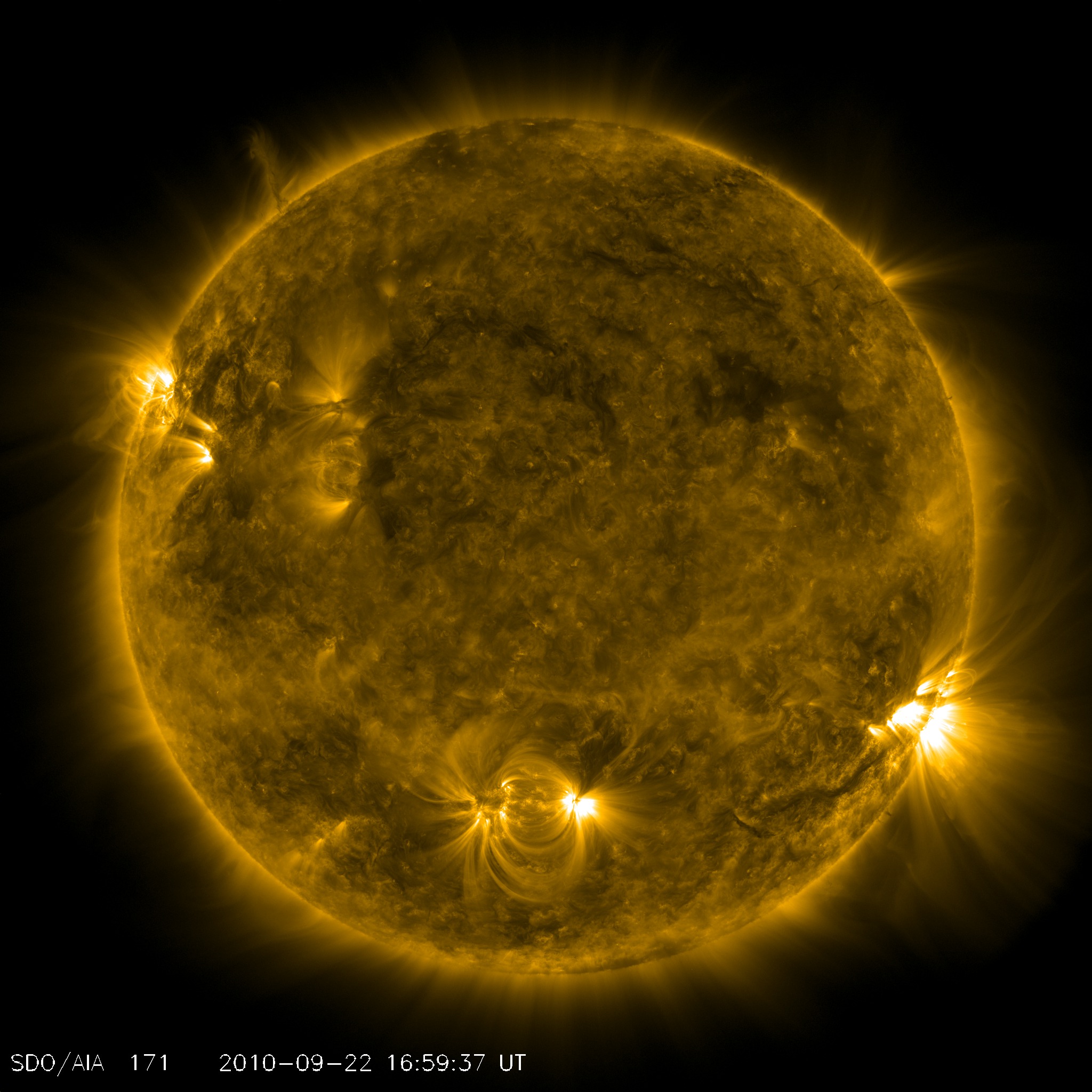
Today, the Sun crosses the celestial equator heading south at 03:09 Universal Time. Known as an equinox, this astronomical event marks the first day of autumn in the northern hemisphere and spring in the south. Equinox means equal night. With the Sun on the celestial equator, Earth dwellers will experience nearly 12 hours of daylight and 12 hours of darkness. Of course, in the north the days continue to grow shorter, the Sun marching lower in the sky as winter approaches. To celebrate the equinox, consider this view of the Sun in extreme ultraviolet light from the Sun staring Solar Dynamics Observatory. Recorded yesterday, the false-color image shows emission from highly ionized iron atoms. Loops and arcs trace the glowing plasma suspended in magnetic fields above solar active regions.
Hoy, el Sol cruza el ecuador celeste en dirección sur a las 03:09 Tiempo Universal. Conocido como equinoccio, este evento astronómico marca el primer día de otoño en el hemisferio norte y primavera en el sur. Equinoccio significa noche igual. Con el Sol sobre el ecuador celeste, los habitantes de la Tierra experimentarán casi 12 horas de luz solar y 12 horas de oscuridad. Por supuesto, en el norte los días continúan acortándose, el Sol se mueve cada vez más bajo en el cielo a medida que se acerca el invierno. Para celebrar el equinoccio, considere esta vista del Sol en luz ultravioleta extrema del Observatorio Solar Solar Dynamics Observatory. Registrada ayer, la imagen en falso color muestra emisión de átomos de hierro altamente ionizados. Bucles y arcos trazan el plasma brillante suspendido en campos magnéticos sobre regiones activas solares.