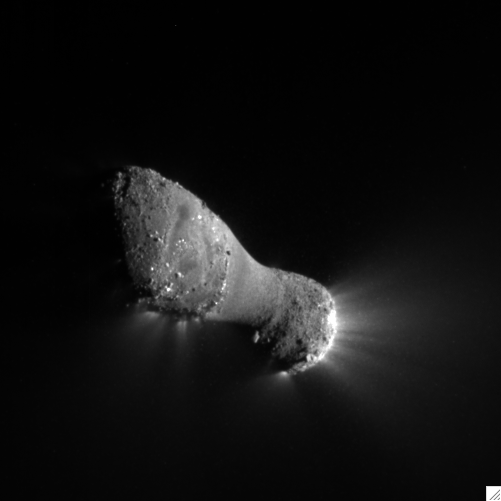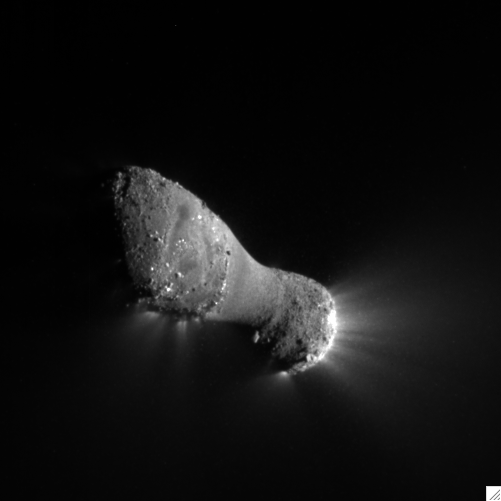
What kind of comet is this? Last week, NASA's robotic EPOXI spacecraft whizzed past Comet 103P/Hartley, also known as Comet Hartley 2, and recorded images and data that are both strange and fascinating. EPOXI was near its closest approach -- about 700 kilometers away -- when it snapped the above picture. As expected, the comet has indeed shown itself to be a tumbling iceberg orbiting the Sun between Earth and Jupiter. However, unexpected features on the images have raised many questions. For example, where are all the craters? Why is there a large smooth area around the middle? How much of Comet Hartley 2 is a loose pile of dust and ice shards? Future analyses and comparisons to other comet nuclei may answer some of these questions and, hopefully, lead to a better general understanding of comets, meteors, and the early Solar System.
¿Qué tipo de cometa es este? La semana pasada, la nave espacial robótica EPOXI de la NASA pasó cerca del cometa 103P/Hartley, también conocido como cometa Hartley 2, y registró imágenes y datos que resultan tanto extraños como fascinantes. EPOXI tomó la imagen mostrada cuando se encontraba cerca de su punto más cercano, a unos 700 kilómetros de distancia. Como se esperaba, el cometa ha demostrado ser efectivamente un iceberg giratorio que orbita al Sol entre la Tierra y Júpiter. Sin embargo, características inesperadas en las imágenes han planteado muchas preguntas. Por ejemplo, ¿dónde están todos los cráteres? ¿Por qué hay un área amplia y lisa alrededor del centro? ¿Qué proporción del cometa Hartley 2 está compuesta por un montón suelto de fragmentos de hielo y polvo? Análisis futuros y comparaciones con otros núcleos cometarios podrían responder algunas de estas preguntas y, con suerte, contribuir a una comprensión más general de los cometas, los meteoros y el Sistema Solar primitivo.